  | |
| Observation data Epoch J2000.0 Equinox ICRS | |
|---|---|
| Constellation | Leo |
| Right ascension | 10h 35m 02.15893s1 |
| Declination | +08° 39′ 01.5434″1 |
| Apparent magnitude (V) | 5.66 - 5.752 |
| Characteristics | |
| Spectral type | A2V3 |
| B−V color index | 0.0594 |
| Variable type | Algol/detached25 |
| Astrometry | |
| Proper motion (μ) | RA: −52.68±0.731 mas/yr Dec.: −4.23±0.461 mas/yr |
| Parallax (π) | 7.61±0.67 mas1 |
| Distance | 430 ± 40 ly (130 ± 10 pc) |
| Absolute magnitude (MV) | 0.4584 |
| Orbit | |
| Period (P) | 2.4450566 d6 |
| Eccentricity (e) | 0.060±0.0107 |
| Inclination (i) | 66.86° |
| Argument of periastron (ω) (secondary) | 295.9±96° |
| Argument of periastron (ω) (primary) | 7° |
| Details | |
| TX Leonis Aa | |
| Mass | 2.75±0.128 M☉ |
| Radius | 3.49±0.168 R☉ |
| Luminosity | 739 L☉ |
| Temperature | 8,61610 K |
| Rotational velocity (v sin i) | 1511 km/s |
| TX Leonis Ab | |
| Mass | 1.05±0.058 M☉ |
| Radius | 2.10±0.098 R☉ |
| Luminosity | 6.09 L☉ |
| Temperature | 6,2669 K |
| Age | 85012 Myr |
| B | |
| Mass | 1.7513 M☉ |
| Surface gravity (log g) | 4.2410 cgs |
| Temperature | 6,33810 K |
| Metallicity [Fe/H] | −0.2410 dex |
| Other designations | |
| 49 Leonis, BD+09 2374, HD 91636, HIP 51802, HR 4148, SAO 11838014 | |
| Database references | |
| SIMBAD | data |
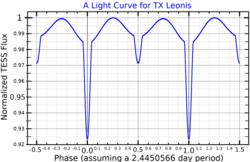
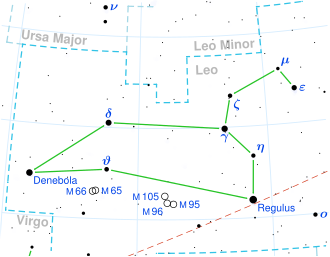
TX Leonis, also known by its Flamsteed designation 49 Leonis, is a triple star system that includes an eclipsing binary, located in the constellation Leo. It was discovered to be a variable star, showing eclipses, by Ernst-Joachim Meyer in 1933.16 The apparent magnitude of TX Leonis ranges between 5.66 and 5.75, making it faintly visible to the naked eye for an observer located well outside of urban areas.2 The star's brightness drops by 0.09 and 0.03 magnitudes during the primary and secondary eclipses respectively, and neither the primary nor the secondary eclipse is total.5
TX Leonis is a triple star, consisting of magnitude 8.1 star (component B) separated by 2 arc seconds from the brighter eclipsing pair (components Aa and Ab).1718 Although orbital motion has not been detected, the companion shares a common proper motion with the primary star and is at approximately the same distance.13
Both stars comprising the eclipsing binary are main sequence stars. Of those two stars, star Aa has been assumed to be 8 times more luminous than star Ab,6 although newer estimates give the luminosities as 83 L☉ and 6 L☉ respectively.9
References
References
- van Leeuwen, Floor (13 August 2007). "Validation of the new Hipparcos reduction". Astronomy & Astrophysics. 474 (2): 653–664. arXiv:0708.1752. Bibcode:2007A&A...474..653V. doi:10.1051/0004-6361:20078357. eISSN 1432-0746. ISSN 0004-6361.
- Samus', N. N.; Kazarovets, E. V.; Durlevich, O. V.; Kireeva, N. N.; Pastukhova, E. N. (2017). "General catalogue of variable stars: Version GCVS 5.1". Astronomy Reports. 61 (1): 80. Bibcode:2017ARep...61...80S. doi:10.1134/S1063772917010085. S2CID 125853869.
- Giuricin, G.; Mardirossian, F.; Mezzetti, M. (February 1984). "Synchronization in eclipsing binary stars". Astronomy and Astrophysics. 131: 152–158. Bibcode:1984A&A...131..152G.
- Bilir, S.; Ak, T.; Soydugan, E.; Soydugan, F.; Yaz, E.; Filiz Ak, N.; Eker, Z.; Demircan, O.; Helvaci, M. (October 2008). "New absolute magnitude calibrations for detached binaries". Astronomische Nachrichten. 329 (8): 835. arXiv:0806.1290. Bibcode:2008AN....329..835B. doi:10.1002/asna.200811002. S2CID 6131326.
- Avvakumova, E. A.; Malkov, O. Yu.; Kniazev, A. Yu. (October 2013). "Eclipsing variables: Catalogue and classification". Astronomische Nachrichten. 334 (8): 860. Bibcode:2013AN....334..860A. doi:10.1002/asna.201311942. hdl:10995/27061.
- Srivastava, J. B.; Kandpal, C. D. (January 1968). "Photoelectric elements of the eclipsing binary TX Leo". Bulletin of the Astronomical Institute of Czechoslovakia. 19: 381. Bibcode:1968BAICz..19..381S.
- Chamberlin, Carl; McNamara, D. H. (October 1957). "The Orbit of the Eclipsing Binary TX Leonis". Publications of the Astronomical Society of the Pacific. 69 (410): 462. Bibcode:1957PASP...69..462C. doi:10.1086/127125. S2CID 120162415.
- Dryomova, G. N.; Svechnikov, M. A. (April 2007). "Effect of tidal evolution in determining the ages of eclipsing-variable early main sequence close binary systems". Astrophysics. 50 (2): 239–253. Bibcode:2007Ap.....50..239D. doi:10.1007/s10511-007-0023-9. S2CID 121459015.
- De Greve, J. P.; Vanbeveren, D. (1980). "Close Binary Systems Before and after Mass Transfer - a Comparison of Observations and Theory". Astrophysics and Space Science. 68 (2): 433. Bibcode:1980Ap&SS..68..433D. doi:10.1007/BF00639709. S2CID 123281741.
- Anders, F.; Khalatyan, A.; Chiappini, C.; Queiroz, A. B.; Santiago, B. X.; Jordi, C.; Girardi, L.; Brown, A. G. A.; Matijevič, G.; Monari, G.; Cantat-Gaudin, T.; Weiler, M.; Khan, S.; Miglio, A.; Carrillo, I.; Romero-Gómez, M.; Minchev, I.; De Jong, R. S.; Antoja, T.; Ramos, P.; Steinmetz, M.; Enke, H. (2019). "Photo-astrometric distances, extinctions, and astrophysical parameters for Gaia DR2 stars brighter than G = 18". Astronomy and Astrophysics. 628: A94. arXiv:1904.11302. Bibcode:2019A&A...628A..94A. doi:10.1051/0004-6361/201935765. S2CID 131780028.
- Abt, Helmut A.; Boonyarak, Chayan (November 2004). "Tidal Effects in Binaries of Various Periods". The Astrophysical Journal. 616 (1): 562–566. Bibcode:2004ApJ...616..562A. doi:10.1086/423795.
- Pan, K. -K (1997). "Synchronization in the early-type detached binary stars". Astronomy and Astrophysics. 321: 202. Bibcode:1997A&A...321..202P.
- Tokovinin, Andrei (2018-03-01). "The Updated Multiple Star Catalog". The Astrophysical Journal Supplement Series. 235 (1): 6. arXiv:1712.04750. Bibcode:2018ApJS..235....6T. doi:10.3847/1538-4365/aaa1a5. ISSN 0067-0049. S2CID 119047709.
- "49 Leo -- Eclipsing Binary". SIMBAD. Centre de données astronomiques de Strasbourg. Retrieved 2023-01-08.
- "MAST: Barbara A. Mikulski Archive for Space Telescopes". Space Telescope Science Institute. Retrieved 8 January 2023.
- Meyer, Ernst-Joachim (May 1933). "Neuer heller Bedeckungsveränderlicher 61.1933 Leonis". Astronomische Nachrichten. 248 (23): 419. Bibcode:1933AN....248..419M. doi:10.1002/asna.19332482308.
- Eggleton, P. P.; Tokovinin, A. A. (September 2008). "A catalogue of multiplicity among bright stellar systems". Monthly Notices of the Royal Astronomical Society. 389 (2): 869–879. arXiv:0806.2878. Bibcode:2008MNRAS.389..869E. doi:10.1111/j.1365-2966.2008.13596.x. S2CID 14878976.
- Mason, Brian D.; Hartkopf, William I.; Wycoff, Gary L.; Rafferty, Theodore J.; Urban, Sean E.; Flagg, Laura (December 2004). "Speckle Interferometry at the US Naval Observatory. X.". The Astronomical Journal. 128 (6): 3012–3018. Bibcode:2004AJ....128.3012M. doi:10.1086/425532.