| Igneous rock | |
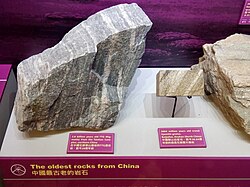 Tonalite-trondhjemite-granodiorite migmatite (left) and trondhjemitic gneiss (right) from northern China | |
| Composition | |
|---|---|
| plagioclase: (albite to andesine), quartz, alkali feldspar |
Trondhjemites are leucotonalites, a variety of leucocratic tonalite in which the modal mineralogy mostly consists of plagioclase in the form of albite to andesine, >20% quartz, and <10% alkali feldspar.12 Trondhjemites that occur in the oceanic crust or in ophiolites are usually called plagiogranites.34
Trondhjemites are common in Archean terranes, occurring in conjunction with tonalite and granodiorite as the TTG (tonalite-trondhjemite-granodiorite) orthogneiss suite.5 Trondhjemite dikes also commonly form part of the sheeted dike complex of an ophiolite.4
The rock type was first described by Victor Goldschmidt in 1916. The name of the rock type is derived from the city of Trondheim, Norway.1 Despite the name and locality, the Trondheim trondhjemites are not considered ideal type specimen because greenschist metamorphism has erased their original mineralogy.2 Other well-known trondhjemite localities include the Rio Brazos quartz-eye trondhjemite in the Brazos Mountains, New Mexico,6 the Twilight Gneiss of the Needle Mountains, Colorado, trondhjemites of the Wind River Range, Wyoming, the Trinity Alps of California, and areas near Riggins, Idaho.2
Formation
Generation of trondhjemite-tonalitic magmas are understood be caused by fractionation of wet basaltic and/or dry low-K tholeiitic-andesitic magmas caused by partial melting of quartz eclogites, amphibolites or gabbros.2
Notes
Notes
- Jackson 1997, "trondjhemite".
- Barker 1979.
- Jackson 1997, "plagiogranite".
- Philpotts & Ague 2009, pp. 367, 372.
- Philpotts & Ague 2009, p. 398.
- Barker, Fred; Peterman, Z. E.; Henderson, W. T.; Hildreth, R. E. (1974). "Rubidium-strontium dating of the trondhjemites of Rio Brazos, New Mexico and of the Kroenke Granodiorite, Colorado" (PDF). Journal of Research of the U.S. Geological Survey. 2 (6). U.S. Geological Survey: 705–709.
References
References
- Jackson, Julia A., ed. (1997). Glossary of geology (4th ed.). Alexandria, Virginia: American Geological Institute. ISBN 0922152349.
- Philpotts, Anthony R.; Ague, Jay J. (2009). Principles of igneous and metamorphic petrology (2nd ed.). Cambridge, UK: Cambridge University Press. ISBN 9780521880060.
- Barker, Fred (1979). Developments in Petrology: Trondhjemites, Dacites, and Related Rocks. Elsevier. ISBN 0-444-41765-6.
Further reading
Further reading
- Best, Myron G. (2002) Igneous and Metamorphic Petrology, Blackwell Publishing, 2nd ed. ISBN 1-4051-0588-7