| Trithuria australis | |
|---|---|
| |
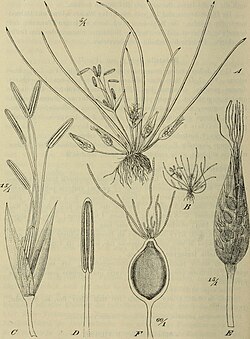
| Botanical illustration of Trithuria australis | |
Scientific classification 
| |
| Kingdom: | Plantae |
| Clade: | Embryophytes |
| Clade: | Tracheophytes |
| Clade: | Spermatophytes |
| Clade: | Angiosperms |
| Order: | Nymphaeales |
| Family: | Hydatellaceae |
| Genus: | Trithuria |
| Section: | Trithuria sect. Hydatella |
| Species: | T. australis
|
| Binomial name | |
| Trithuria australis | |
| |
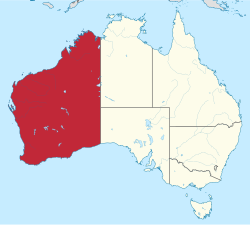
| Trithuria australis is endemic to Western Australia1 | |
| Synonyms1 | |
| |
Trithuria australis is a species of aquatic plant in the family Hydatellaceae endemic to Western Australia.1
Description
Vegetative characteristics
Trithuria australis is an annual,2 submerged aquatic plant. The terete, pointed leaves are 20–25 mm long, and 0.3 mm wide.3
Generative characteristics
The reproductive units ("flowers") are unisexual. Both female and male reproductive units are present on the same plant.2 The reproductive units are sessile or exhibit very short peduncles.4 The male reproductive unit has 3-8 stamens.2 The seed coat is brown3 and smooth.2 It is believed to be self-pollinating.456
Cytology
The chromosome count is 2n = 14.5
Distribution
It is known from several populations5 occurring in the Western and Southwestern parts of the state Western Australia.2
Taxonomy
Trithuria australis (Diels) D.D.Sokoloff, Remizowa, T.D.Macfarl. & Rudall was first described as Hydatella australis Diels by Friedrich Ludwig Emil Diels in 1904.13 Later it was included in the genus Trithuria Hook.f. as Trithuria australis (Diels) D.D.Sokoloff, Remizowa, T.D.Macfarl. & Rudall by Dmitry Dmitrievich Sokoloff, Margarita Vasilyena Remizowa, Terry Desmond Macfarlane & Paula J. Rudall in 2008.12 The type specimen was collected by L. Diels in Hamersley River, Western Australia in October 1901.2 It is included in Trithuria sect. Hydatella (Diels) D.D. Sokoloff, Iles, Rudall & S.W. Graham, of which it is the type species.5
Etymology
The specific epithet australis means southern.78
Ecology
Habitat
It grows in swamps. It occurs sympatrically with Centrolepis.4
References
References
- "Trithuria australis (Diels) D.D.Sokoloff, Remizowa, T.D.Macfarl. & Rudall". Plants of the World Online. Royal Botanic Gardens, Kew. Retrieved 23 October 2024.
- Sokoloff, D. D., Remizowa, M. V., Macfarlane, T. D., & Rudall, P. J. (2008). Classification of the early‐divergent angiosperm family Hydatellaceae: One genus instead of two, four new species and sexual dimorphism in dioecious taxa. Taxon, 57(1), 179-200.
- Diels, L., & Pritzel, E. (1905). Fragmenta Phytographiae Australiae occidentalis. Beiträge zur Kenntnis der Pflanzen Westaustraliens, ihrer Verbreitung und ihrer Lebens-Verhältnisse. In Botanische Jahrbücher fur Systematik, Pflanzengeschichte und Pflanzengeographie (Vol. 35, pp. 55–160). https://www.biodiversitylibrary.org/page/126540
- Taylor, Mackenzie Lorraine, "Developmental Evolution of the Progamic Phase in Nymphaeales. " PhD diss., University of Tennessee, 2011. https://trace.tennessee.edu/utk_graddiss/1031
- Iles, W. J. D. (2013). The phylogeny and evolution of two ancient lineages of aquatic plants (Doctoral dissertation, University of British Columbia).
- Smissen, R. D., Ford, K. A., Champion, P. D., & Heenan, P. B. (2019). Genetic variation in Trithuria inconspicua and T. filamentosa (Hydatellaceae): a new subspecies and a hypothesis of apomixis arising within a predominantly selfing lineage. Australian Systematic Botany, 32(1), 1-11.
- A Grammatical Dictionary of Botanical Latin. (n.d.-b). Retrieved October 28, 2024, from http://www.mobot.org/mobot/latindict/keyDetail.aspx?keyWord=australis
- Daniels, R. (2020, May 30). Demystifying native plant names – an introduction. Australian Plants Society - NSW. Retrieved October 28, 2024, from https://resources.austplants.com.au/stories/demystifying-native-plant-names-an-introduction/