| |||
| Names | |||
|---|---|---|---|
| IUPAC name
Tetrabutylammonium tris(3,4,5,6-tetrachlorobenzene-1,2-diolato-κ2O1,O2)phosphorus(V)
| |||
| Other names
Tetrabutylammonium tris(tetrachlorocatecholato)phosphorus(1−)
Bu4N+ PHAT− 1-Butanaminium, N,N,N-tributyl-, (OC-6-11-Δ)-tris[3,4,5,6-tetrachloro-1,2-benzenediolato(2−)-κO1,κO2]phosphate(1−) (1:1) | |||
| Identifiers | |||
| |||
3D model (JSmol)
|
| ||
| ChemSpider |
| ||
| EC Number |
| ||
PubChem CID
|
| ||
CompTox Dashboard (EPA)
|
| ||
| |||
| |||
| Properties | |||
| [C16H36N][C18Cl12O6P] | |||
| Molar mass | 1011.06 | ||
| Appearance | colourless solid | ||
| CH2Cl2 | |||
Except where otherwise noted, data are given for materials in their standard state (at 25 °C [77 °F], 100 kPa).
| |||
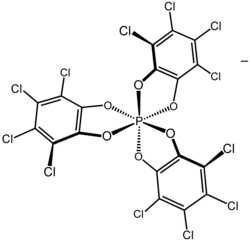
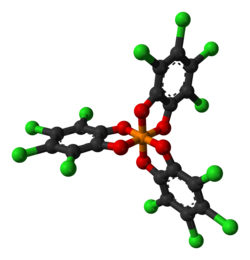


TRISPHAT (full name tris(tetrachlorocatecholato)phosphate(1−)) is an inorganic anion with the formula P(O2C6Cl4)3−, often prepared as the tributylammonium ((C4H9)3NH+) or tetrabutylammonium ((C4H9)4N+) salt. The anion features phosphorus(V) bonded to three tetrachlorocatecholate (C6Cl4O2−2) ligands. This anion can be resolved into the axially chiral enantiomers, which are optically stable (the picture shows the Δ enantiomer).
The TRISPHAT anion has been used as a chiral shift reagent for cations.1 It improves the resolution of 1H NMR spectra by forming diastereomeric ion pairs.
Preparation
The anion is prepared by treatment of phosphorus pentachloride with tetrachlorocatechol followed by a tertiary amine gives the anion:
- PCl5 + 3 C6Cl4(OH)2 → H[P(O2C6Cl4)3] + 5 HCl
- H[P(O2C6Cl4)3] + Bu3N → Bu3NH+[P(O2C6Cl4)3]−
Using a chiral amine, the anion can be readily resolved.2
References
References
- Ratni, Hassen; Jodry, Jonathan J.; Lacour, Jérôme; Kündig, E. Peter (2000). "[n-Bu4N][Δ-TRISPHAT] Salt, an Efficient NMR Chiral Shift Reagent for Neutral Planar Chiral Tricarbonylchromium Complexes". Organometallics. 19 (19): 3997–3999. doi:10.1021/om000437f.
- Favarger, France; Goujon-Ginglinger, Catherine; Monchaud, David; Lacour, Jérôme (2004). "Large-Scale Synthesis and Resolution of TRISPHAT [Tris(tetrachlorobenzenediolato) Phosphate(V)] Anion". Journal of Organic Chemistry. 69 (24): 8521–8524. doi:10.1021/jo048641q. PMID 15549835.