| Triphyophyllum | |
|---|---|

| |
| Climbing adult Triphyophyllum with hooked leaves | |
Scientific classification 
| |
| Kingdom: | Plantae |
| Clade: | Embryophytes |
| Clade: | Tracheophytes |
| Clade: | Spermatophytes |
| Clade: | Angiosperms |
| Clade: | Eudicots |
| Order: | Caryophyllales |
| Family: | Dioncophyllaceae |
| Genus: | Triphyophyllum Airy Shaw |
| Species: | T. peltatum
|
| Binomial name | |
| Triphyophyllum peltatum | |

| |
| Triphyophyllum is native to Guinea, Ivory Coast, Liberia, and Sierra Leone2 | |
| Synonyms2 | |
| |
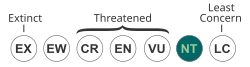
Triphyophyllum peltatum is a facultatively carnivorous,3 up to 60 m (200 ft) tall vine4 in the monotypic genus Triphyophyllum /ˌtrɪfioʊˈfɪləm/ in the family Dioncophyllaceae native to tropical western Africa, in Guinea, Ivory Coast, Liberia, and Sierra Leone5 where it grows in tropical rainforest.4
Description


Vegetative characteristics
It is a facultatively carnivorous, heterophyllous,6 up to 60 m (200 ft) tall vine with glabrous, terete stems.7 It has a three-stage lifecycle, each with a different shaped leaf, as indicated by its Greek name. In the first stage, T. peltatum forms a rosette of simple lanceolate Dracaena-like leaves about 18 cm (7.1 in) in length with undulate margins. At times when there is insufficient phosphorus in the soil89 it develops long, slender, glandular, circinate leaves up to 35 cm (14 in) in length and bearing two sorts of glands, and resembling those of the related Drosophyllum, which capture insects; there being one to three of these leaves in each rosette.10 In the plant's adult liana form it has short non-carnivorous leaves bearing a pair of "grappling hooks" 11 at their tips on a long twining stem which can become 50 metres (160 ft) in length and 10 centimetres (3.9 in) thick.1213 T. peltatum is the largest of all confirmed carnivorous plants in the world, but its carnivorous nature did not become known until 1979, over 50 years after the plant's scientific description.6
Generative characteristics
The axillary,1415 branched,16 cymose, few-flowered15 or many-flowered inflorescence bears up to 80 small, ephemeral,16 fragrant,14 white to pink,16 bisexual, actinomorphic, pedicellate flowers.15 The pedicel is up to 3 cm long. The flower has 5 triangular, 2 mm long sepals, and 5 obovate, 13 mm long petals.15 The androecium consists of 10 stamens.157 The style is very short.7 The up to 4 cm wide, 1-seeded,15 4–5-valved capsule fruit715 bears discoid, papery,15 flat, winged, circular, pink to red,14 5–87(–10) cm wide seeds1714 with an up to 5.5 cm (2.2 in) long funiculus extending beyond the fruit.15 Most of the seed's development occurs outside the fruit.18 The seeds are wind-dispersed.719
Cytology
The chromosome count is 2n = 24,715 36.15
Taxonomy
Triphyophyllum peltatum was first described as Dioncophyllum peltatum Hutch. & Dalziel by John Hutchinson and John McEwan Dalziel in 1927.2 It was moved to a new monotypic genus Triphyophyllum Airy Shaw as Triphyophyllum peltatum (Hutch. & Dalziel) Airy Shaw by Herbert Kenneth Airy Shaw in 1952.52
Etymology
The generic name Triphyophyllum is derived from triphyes meaning of threefold form,20 and phyllum meaning leaf.21 It refers to the three growth stages of the plant with three different types of leaves.8 The specific epithet peltatum means shield-like22 and refers to the discoid seeds,19 which have a long stalk that extends the seed beyond the capsule fruit.15
Distribution and habitat
Triphyophyllum is found in Guinea, Ivory Coast, Liberia, and Sierra Leone,5 where it occurs in primary7 and old secondary dry evergreen rainforests. The habitat has a 6–7 month dry season. The acid, nutrient-poor soil is shallow.6
Conservation
It is a rare and endangered species,8 classified as Near Threatened on the IUCN Red List.1 Its population is declining, primarily due to habitat destruction from logging and mining.1
Cultivation
Triphyophylum peltatum is difficult to cultivate.823 It is cultivated in several botanical gardens: Würzburg, Hannover,24 Abidjan, Bonn, Cambridge University and is exceedingly rare in private collections.
Uses

Triphyophyllum peltatum is traditionally used in folk medicine in the treatment of elephantiasis157 and malaria.7 It produces many pharmaceutically active secondary metabolites, some of which have been found to have strong antiplasmodial activity. Some metabolites were found to have antitumoral and anti-multiple myeloma activity.8 The stems are used as tying material.15
References
References
- Cheek, M.; Hooper, O.; Couch, C. (2025). "Triphyophyllum peltatum". IUCN Red List of Threatened Species. 2025 e.T85731562A85731586. doi:10.2305/IUCN.UK.2025-2.RLTS.T85731562A85731586.en. Retrieved 20 March 2026.
- "Triphyophyllum peltatum (Hutch. & Dalziel) Airy Shaw". Plants of the World Online. Royal Botanic Gardens, Kew. Retrieved March 28, 2025.
- Walker, C. (2023). "Triggered by phosphorous deficiency". Nature Plants. 9 (6): 853. Bibcode:2023NatPl...9..853W. doi:10.1038/s41477-023-01450-9.
- Cross, A.; Krueger, T. (26 November 2020). "Save me, Seymour! The increasingly dire plight of Darwin's "Most wonderful plants in the world."". Natural History of Ecological Restoration. Restoration Ecology Lab, Ecological Health Network, & Missouri Botanical Garden. Retrieved March 28, 2025.
- "Triphyophyllum Airy Shaw". Plants of the World Online. Royal Botanic Gardens, Kew. Retrieved March 28, 2025.
- Green, S.; Green, T. L.; Heslop-Harrison, Y. (1979). "Seasonal heterophylly and leaf gland features in Triphyophyllum (Dioncophyllaceae), a new carnivorous plant genus". Botanical Journal of the Linnean Society. 78 (2): 99–116. Bibcode:1979BJLS...78...99G. doi:10.1111/j.1095-8339.1979.tb02188.x.
- Porembski, S.; Barthlott, W. (2003). "Dioncophyllaceae". In Kubitzki, K.; Bayer, C. (eds.). Flowering Plants · Dicotyledons. The Families and Genera of Vascular Plants. Vol. 5. Berlin, Heidelberg: Springer. pp. 178–181. doi:10.1007/978-3-662-07255-4_19. ISBN 978-3-642-07680-0.
- Winkelmann, Traud; Bringmann, Gerhard; Herwig, Anne; Hedrich, Rainer (2023). "Carnivory on demand: phosphorus deficiency induces glandular leaves in the African liana Triphyophyllum peltatum". New Phytologist. 239 (3): 1140–1152. Bibcode:2023NewPh.239.1140W. doi:10.1111/nph.18960. ISSN 0028-646X. PMID 37191044.
confirmation of phosphorus starvation to be essential and sufficient
- Simons, Paul (17 April 2024). "Plantwatch: why does a rainforest vine turn into a part-time carnivore?". The Guardian.
- "Triphyophyllum peltatum - Redfern Natural History". www.redfernnaturalhistory.com. Archived from the original on 2017-03-19.
- "Image of Triphyophyllum leaves". Archived from the original on 2018-02-16.
- George Cheer (1992). A GUIDE TO CARNIVOROUS PLANTS OF THE WORLD. Pymble, New South Wales, Aust.: Angus and Robertson. p. 122.
- Slack, Adrian (1980). Carnivorous Plants. Cambridge, Massachusetts: Massachusetts Institute of Technology. p. 231-232 (Appendix 2). ISBN 9781899296132.
- Slack, A. (2000). Carnivorous Plants. MIT Press. pp. 231–232. ISBN 978-0-262-69089-8.
- Fibres. Niederlande: Prota Foundation. 2012. pp. 438–440. ISBN 978-92-9081-481-8.
- "Triphyophyllum, das Hakenblatt". Gesellschaft Für Fleischfressende Pflanzen. Retrieved March 28, 2025.
- Schmid-Hollinger, R. "Triphyophyllum peltatum ("Hakenblatt")". Retrieved March 30, 2025.
- John Hutchinson and J. M. Dalziel (1928). "Tropical African Plants II". Kew Bulletin: 31–32. (Under the name Dioncophyllum peltatum)
- Stach, G.; Timmann, L. (11 February 2006). "Species: Triphyophyllum peltatum (Hutchinson & Dalziel) Airy Shaw, {1952}". Die Karnivoren-Datenbank. Retrieved March 30, 2025.
- The Alkaloids: Chemistry and Biology. Niederlande: Academic Press. 2024. p. 14. ISBN 978-0-443-29555-3.
- "-phyllum". Merriam-Webster.com dictionary. Merriam-Webster. Retrieved March 29, 2025.
- "Pelargonium peltatum (L) L'Hér". PlantZAfrica. South African National Biodiversity Institute (SANBI). Retrieved March 29, 2025.
- Bringmann, Gerhard; Schlauer, Jan; Wolf, Kristina; Rischer, Heiko; Buschbom, Uwe; Kreiner, Andreas; Thiele, Friedrich; Duschek, Martin; Assi, Laurent Ake (1999-03-01). "Cultivation of Triphyophyllum peltatum (Dioncophyllaceae), the part-time carnivorous plant". Carnivorous Plant Newsletter. 28 (1): 7–13. doi:10.55360/cpn281.gb418.
- "Mangel weckt den Appetit auf Fleisch". Universität Würzburg (Press release) (in German). 16 May 2023. Retrieved March 30, 2025.
External links
External links
- The Carnivorous Plant FAQ: About Triphyophyllum
- Bringmann, G., H. Rischer, J. Schlauer, K. Wolf, A. Kreiner, M. Duschek & L.A. Assi 2002. "The Tropical Liana Triphyophyllum peltatum (Dioncophyllaceae): Formation of Carnivorous Organs is only a facultative prerequisite for shoot elongation" (PDF). (1.30 MiB) Carnivorous Plant Newsletter 31(2): 44–52.
- Bringmann, G., J. Schlauer, K. Wolf, H. Rischer, U. Buschbom, A. Kreiner, F. Thiele, M. Duschek & L.A. Assi 1999. "Cultivation of Triphyophyllum peltatum (Dioncophyllaceae), the part-time carnivorous plant" (PDF). (1.25 MiB) Carnivorous Plant Newsletter 28(1): 7–13.
- Bringmann, G., M. Wenzel, H.P. Bringmann & J. Schlauer 2001. "Uptake of the amino acid alaninie by digestive leaves: proof of carnivory in the tropical liana Triphyophyllum peltatum (Dioncophyllaceae)" (PDF). (434 KiB) Carnivorous Plant Newsletter 30(1): 15–21.
- Jonathan 1992. "A letter from Sierra Leone" (PDF). (541 KiB) Carnivorous Plant Newsletter 21(3): 51–53.
- Rice, B. 2007. Carnivorous plants with hybrid trapping strategies. Carnivorous Plant Newsletter 36(1): 23–27.
- Simons, P. 1981. "How Exclusive are Carnivorous Plants?" (PDF). (1.10 MiB) Carnivorous Plant Newsletter 10(3): 65–68, 79–80.