| Triphragmium ulmariae | |
|---|---|
| |
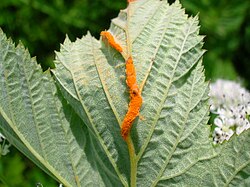
| Mature gall on a leaf of meadowsweet (Filipendula ulmaria) | |
Scientific classification 
| |
| Kingdom: | Fungi |
| Division: | Basidiomycota |
| Class: | Pucciniomycetes |
| Order: | Pucciniales |
| Family: | Phragmidiaceae |
| Genus: | Triphragmium |
| Species: | T. ulmariae
|
| Binomial name | |
| Triphragmium ulmariae (DC.) Link
| |
| Synonyms1 | |
|
Puccinia ulmariae DC. (1808) | |
Triphragmium ulmariae is a species of rust fungus in the family Phragmidiaceae. It causes meadowsweet rust gall,2 which develops as a chemically induced swelling, arising from the lower surface of the meadowsweet (Filipendula ulmaria) leaves.3
Life cycle
The fungus grows in the petioles and midribs of the perennial plant meadowsweet (Filipendula ulmaria), a member of the rose family, causing swelling and distortion. Sori develop with bright orange spores.3 The rust's spores reach the new meadowsweet plants via air movements.
The rust has a severe effect on the survival of meadowsweet seedlings.
References
References
- "Triphragmium ulmariae (DC.) Link 1825". MycoBank. International Mycological Association. Retrieved 2011-07-08.
- Biolimages Archived 2008-08-21 at the Wayback Machine
- Stubbs, F. B. Edit. (1986) Provisional Keys to British Plant Galls. Pub. Brit Plant Gall Soc. ISBN 0-9511582-0-1. P. 27.