 | |
 | |
| Names | |
|---|---|
| Preferred IUPAC name
Triethylsilane | |
| Identifiers | |
| |
3D model (JSmol)
|
|
| ChemSpider | |
| ECHA InfoCard | 100.009.579 |
| EC Number |
|
PubChem CID
|
|
| UNII | |
CompTox Dashboard (EPA)
|
|
| |
| |
| Properties | |
| C6H16Si | |
| Molar mass | 116.28 g/mol |
| Appearance | colorless liquid |
| Density | 0.728 g/mL |
| Melting point | −156.1 °C (−249.0 °F; 117.0 K) |
| Boiling point | 107–108 °C (225–226 °F; 380–381 K) |
| log P | 3.08 |
| Vapor pressure | 31 hPa at 20 °C 75 hPa at 38 °C 126 hPa at 50 °C |
| Hazards | |
| GHS labelling: | |

| |
| Danger | |
| H225, H4121 | |
| P210, P2731 | |
| Flash point | −2.99 °C (26.62 °F; 270.16 K) closed cup1 |
Except where otherwise noted, data are given for materials in their standard state (at 25 °C [77 °F], 100 kPa).
| |


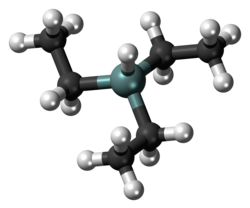
Triethylsilane , also known as TES or triethylsilicon hydride, is the organosilicon compound with the formula (C2H5)3SiH. It is a trialkylsilane. The Si-H bond is reactive.
It was first discovered by Albert Ladenburg in 1872 among the products of reduction of tetraethyl orthosilicate with sodium and diethylzinc.2 He also prepared it by a stepwise reduction via ethoxytriethylsilane and named it silicoheptyl hydride, reflecting the idea of a silicon compound analogous to a seven-carbon hydrocarbon. This colorless liquid finds occasion use in organic synthesis.3 As one of the simplest trialkylsilanes that is a liquid at room temperature, triethylsilane is often used in studies of hydrosilylation catalysis.4
Organic chemistry
Triethylsilane is an occasional reagent in organic synthesis. In combination with indium compounds, it reduces esters to ethers. The reaction is typically performed in chloroform at 60 °C, using 0.05 equivalents of InBr3 catalyst.56 This system can also accommodate other carbonyl compounds like tertiary amides and carboxylic acids.7
Additional reading
- Richard T. Beresis, Jason S. Solomon, Michael G. Yang, Nareshkumar F. Jain, and James S. Panek (1998). "Synthesis of Chiral (E)-Crotylsilanes: [3R- AND 3S-]-(4E)-Methyl 3-(Dimethylphenylsilyl)-4-Hexenoate ". Organic Syntheses. 75: 78
{{cite journal}}: CS1 maint: multiple names: authors list (link). - Alessandro Dondoni and Daniela Perrone (2000). "Diastereoselective Synthesis of Protected Vicinal Amino Alcohols: (S)-2-[(4S)-N-tert-Butoxycarbonyl-2,2-Dimethyl-1,3,-oxazolidinyl]-2-tert-butyldimethylsiloxyethanal from a Serine-Derived Aldehyde ". Organic Syntheses. 77: 78.
- Pape C. (1881). "Über Siliziumpropylverbindungen". Ber. 14: 1873.
- Charles A. Kraus & Walter K. Nelson (1934). "The Chemistry of the Triethylsilicyl Group". J. Am. Chem. Soc. 56 (1): 195–202. Bibcode:1934JAChS..56..195K. doi:10.1021/ja01316a062.
References
References
- Sigma-Aldrich Co., Triethylsilane. Retrieved on 2015-01-30.
- Ladenburg, A. (1872). "Ueber die Reductionsproducte des Kieselsäureäthers und deren Derivate". Justus Liebigs Annalen der Chemie (in German). 164 (2): 300–332. doi:10.1002/jlac.18721640212. ISSN 0075-4617.
- Fry, James L.; Rahaim, Ronald J.; Maleczka, Robert E. (2007). "Triethylsilane". Encyclopedia of Reagents for Organic Synthesis. doi:10.1002/9780470842898.rt226.pub2. ISBN 978-0471936237.
- Brookhart, M.; Grant, B. E. (1993). "Mechanism of a cobalt(III)-catalyzed olefin hydrosilation reaction: Direct evidence for a silyl migration pathway". Journal of the American Chemical Society. 115 (6): 2151–2156. Bibcode:1993JAChS.115.2151B. doi:10.1021/ja00059a008.
- Sakai, Norio; Moriya, Toshimitsu; Fujii, Kohji; Konakahara, Takeo (November 2008). "Direct Reduction of Esters to Ethers with an Indium(III) Bromide/Triethylsilane Catalytic System". Synthesis. 2008 (21): 3533–3536. doi:10.1055/s-0028-1083191. ISSN 0039-7881.
- "Synthesis of Ethers from Carbonyl Compounds by Reductive Etherification Catalyzed by Iron(III) and Silyl Chloride". www.organic-chemistry.org. Retrieved 2026-01-12.
- "An Efficient One-Pot Synthesis of Unsymmetrical Ethers: A Directly Reductive Deoxygenation of Esters Using an InBr3/Et3SiH Catalytic System". www.organic-chemistry.org. Retrieved 2026-01-12.