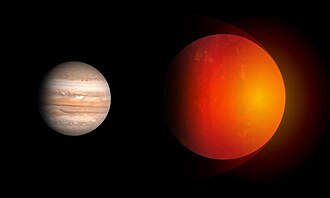
 Size comparison of TrES-4 with Jupiter | |
| Discovery | |
|---|---|
| Discovered by | Mandushev et al1 |
| Discovery date | 2006–2007 |
| Transit | |
| Orbital characteristics | |
| 0.05091 ± 0.00071 AU (7.616 ± 0.106 million km)2 | |
| Eccentricity | 0 |
| 3.553945 ± 0.000075 d | |
| Inclination | 82.86 ± 0.332 |
| Semi-amplitude | 86.1 |
| Star | GSC 02620-00648 A2 |
| Physical characteristics | |
| 1.73±0.06 RJ3 | |
| Mass | 0.49±0.04 MJ4 |
Mean density | 0.156+0.072 −0.071 g/cm35 |
| 7.04 ± 1.12 m/s2 (23.1 ± 3.7 ft/s2) 0.718 ± 0.114 g | |
| Temperature | 1,782±29 K (1,509 °C; 2,748 °F, equilibrium)2 |
TrES-4b is an exoplanet. It was discovered in 2006, and announced in 2007, by the Trans-Atlantic Exoplanet Survey, using the transit method. At the time of its discovery TrES-4 was the largest confirmed exoplanet ever found; now more than 10 larger planets have been discovered. It is approximately 1,400 light-years (430 pc) away orbiting the star GSC 02620-00648, in the constellation Hercules.1
Orbit
TrES-4 orbits its primary star every 3.543 days and eclipses it when viewed from Earth.
A 2008 study concluded that the GSC 02620-00648 system (among others) is a binary star system allowing even more accurate determination of stellar and planetary parameters.2
The study in 2012, utilizing a Rossiter–McLaughlin effect, have determined the planetary orbit is probably aligned with the equatorial plane of the star, misalignment equal to 6.3±4.7°.6
Physical characteristics
The planet is slightly less massive than Jupiter (0.919 ± 0.073 MJ) but its diameter is 84% larger. This give TrES-4 an average density of only about a third of a gram per cubic centimetre, approximately the same as Saturn's moon Methone. At the time of its discovery in 2007, TrES-4 was described as both the largest known planet and the planet with the lowest known density.21
TrES-4b's orbital radius is 0.05091 AU, giving it a predicted surface temperature of about 1,782 K (1,509 °C; 2,748 °F). This by itself is not enough to explain the planet's low density, however. It is not currently known why TrES-4b is so large. The probable causes are the proximity to a parent star that is three to four times more luminous than the Sun as well as the internal heat within the planet.21
References
References
- Mandushev, Georgi; et al. (2007). "TrES-4: A Transiting Hot Jupiter of Very Low Density". The Astrophysical Journal Letters. 667 (2): L195–L198. arXiv:0708.0834. Bibcode:2007ApJ...667L.195M. doi:10.1086/522115. S2CID 6087170.
- Daemgen, S.; Hormuth, F.; Brandner, W.; Bergfors, C.; Janson, M.; Hippler, S.; Henning, T. (2009). "Binarity of transit host stars - Implications for planetary parameters" (PDF). Astronomy and Astrophysics. 498 (2): 567–574. arXiv:0902.2179. Bibcode:2009A&A...498..567D. doi:10.1051/0004-6361/200810988. S2CID 9893376.
- de Laverny, Patrick; Ligi, Roxanne; Crida, Aurélien; Recio-Blanco, Alejandra; Palicio, Pedro A. (July 2025). "The Gaia spectroscopic catalogue of exoplanets and host stars". Astronomy & Astrophysics. 699: A100. arXiv:2505.22205. Bibcode:2025A&A...699A.100D. doi:10.1051/0004-6361/202554739. ISSN 0004-6361.
- Sozzetti, A.; Bonomo, A. S.; Biazzo, K.; Mancini, L.; Damasso, M.; Desidera, S.; Gratton, R.; Lanza, A. F.; Poretti, E.; Rainer, M.; Malavolta, L.; Affer, L.; Barbieri, M.; Bedin, L. R.; Boccato, C.; Bonavita, M.; Borsa, F.; Ciceri, S.; Claudi, R. U.; Gandolfi, D.; Giacobbe, P.; Henning, T.; Knapic, C.; Latham, D. W.; Lodato, G.; Maggio, A.; Maldonado, J.; Marzari, F.; Fiorenzano, A. F.; Micela, G.; Molinari, E.; Mordasini, C.; Nascimbeni, V.; Pagano, I.; Pedani, M.; Pepe, F.; Piotto, G.; Santos, N.; Scandariato, G.; Shkolnik, E.; Southworth, J. Martinez (2015). "The GAPS programme with HARPS-N at TNG VI. The curious case of TrES-4b". Astronomy & Astrophysics. 575 L15(2015): 1–10. doi:10.1051/0004-6361/201425570.
- Johns, Daniel; Marti, Connor; Huff, Madison; McCann, Jacob; Wittenmyer, Robert A.; Horner, Jonathan; Wright, Duncan J. (2018-11-01). "Revised Exoplanet Radii and Habitability Using Gaia Data Release 2". The Astrophysical Journal Supplement Series. 239 (1): 14. arXiv:1808.04533. Bibcode:2018ApJS..239...14J. doi:10.3847/1538-4365/aae5fb. ISSN 0067-0049.
- Albrecht, Simon; Winn, Joshua N.; Johnson, John A.; Howard, Andrew W.; Marcy, Geoffrey W.; Butler, R. Paul; Arriagada, Pamela; Crane, Jeffrey D.; Shectman, Stephen A.; Thompson, Ian B.; Hirano, Teruyuki; Bakos, Gaspar; Hartman, Joel D. (2012). "Obliquities of Hot Jupiter Host Stars: Evidence for Tidal Interactions and Primordial Misalignments". The Astrophysical Journal. 757 (1): 18. arXiv:1206.6105. Bibcode:2012ApJ...757...18A. doi:10.1088/0004-637X/757/1/18. S2CID 17174530.
External links
External links
Media related to TrES-4 at Wikimedia Commons
- "Team finds largest exoplanet yet". BBC News. 7 August 2007. Retrieved 14 May 2023.
- Miller, Barbara; staff reporters (7 August 2007). "New monster planet 'could float on water'". ABC News (Australia). Retrieved 14 May 2023.
- Than, Ker (6 August 2007). "Largest Known Exoplanet Discovered". Space.com news service. Retrieved 14 May 2023.
- Muir, Hazel (6 August 2007). "Largest known exoplanet puzzles astronomers". NewScientist.com news service. Retrieved 14 May 2023.