| Observation data Epoch J2000.0 Equinox ICRS | |
|---|---|
| Constellation | Draco1 |
| TrES-2A | |
| Right ascension | 19h 07m 14.0376s2 |
| Declination | +49° 18′ 59.091″2 |
| Apparent magnitude (V) | 11.413 |
| Characteristics | |
| TrES-2A | |
| Evolutionary stage | main sequence2 |
| Spectral type | G0V3 |
| Apparent magnitude (B) | ~12.0304 |
| Apparent magnitude (V) | 11.411±0.0054 |
| Apparent magnitude (I) | 11.075 |
| Apparent magnitude (Z) | 11.045 |
| Apparent magnitude (J) | 10.232±0.0206 |
| Apparent magnitude (H) | 9.920±0.0266 |
| Apparent magnitude (K) | 9.846±0.0226 |
| Variable type | Planetary transit3 |
| TrES-2C | |
| Spectral type | K5 |
| Apparent magnitude (I) | 14.735 |
| Apparent magnitude (Z) | 14.475 |
| Astrometry | |
| Radial velocity (Rv) | 1.20±1.212 km/s |
| Proper motion (μ) | RA: 5.434(15) mas/yr2 Dec.: 1.572(16) mas/yr2 |
| Parallax (π) | 4.6308±0.0116 mas2 |
| Distance | 704 ± 2 ly (215.9 ± 0.5 pc) |
| Details7 | |
| TrES-2A | |
| Mass | 0.983+0.059 −0.063 M☉ |
| Radius | 1.003±0.033 R☉ |
| Temperature | 5850±50 K |
| Metallicity [Fe/H] | −0.15±0.10 dex |
| Rotational velocity (v sin i) | 2.0±1.5 km/s |
| Age | 5.0+2.7 −2.1 Gyr |
| TrES-2C | |
| Mass | 0.675 M☉ |
| Other designations | |
| TrES-2 Parent Star, V581 Dra, WDS J19072+4919AB, Kepler-1, KOI-1, KIC 11446443, TOI-2140, TIC 399860444, TYC 3549-2811-1, GSC 03549-02811, 2MASS J19071403+49185904 | |
| Database references | |
| SIMBAD | TrES-2A |
| TrES-2C | |
| Exoplanet Archive | data |
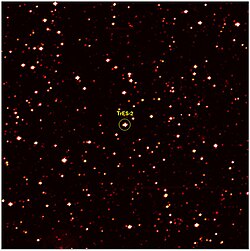
GSC 03549-02811 (sometimes referred to as Kepler-1, or either TrES-2A or TrES-2 parent star in reference to its exoplanet TrES-2b)8 is a binary star system containing a G-type main-sequence star similar to the Sun. This star is located approximately 704 light-years away in the constellation of Draco. The apparent magnitude of this star is 11.41, which means it is not visible to the naked eye but can be seen with a medium-sized amateur telescope on a clear dark night. The age of this star is about 5 billion years.4
Nomenclature
The designation GSC 03549-02811 comes from the Guide Star Catalog.
The star is often called TrES-2,9 in reference to its planet discovered by the Trans-Atlantic Exoplanet Survey (TrES). The discovery paper3 and the SIMBAD database4 use this designation for the planet itself, but other sources call the star TrES-2 (or TrES-2A)10 and the planet TrES-2b,11 following the standard exoplanet naming convention. In keeping with the planet being component b, the companion star is designated TrES-2C, although it is also designated Kepler-1B.4
The planet was also observed by the Kepler space telescope, and so the star is also known as Kepler-1.4 Since the planet transits the star, the star is classified as a planetary transit variable and has received the variable star designation V581 Draconis.12
Binary star
In 2008 a study was undertaken of fourteen stars with exoplanets that were originally discovered using the transit method through relatively small telescopes. These systems were re-examined with the 2.2M reflector telescope at the Calar Alto Observatory in Spain. This star system, along with two others, was determined to be a previously unknown binary star system. The previously unknown secondary star is a dim magnitude 15 K-type star separated by about 232 AU from the primary, appearing offset from the primary by about one arc second in the images. This discovery resulted in a significant recalculation of parameters for both the planet and the primary star.5
Planetary system

In 2006, the exoplanet TrES-2b was discovered by the Trans-Atlantic Exoplanet Survey using the transit method. It was also within the field of view of the Kepler Mission planet-hunter spacecraft.3 This system continues to be studied by other projects and the parameters are continuously improved.14 The planet orbits the primary star.5
TrES-2b is a hot Jupiter, with a mass and size similar to those of Jupiter but an orbital period of only two days. Its orbit is prograde relative to its star's rotation.11 In 2011, TrES-2b was found to have a very low albedo, reflecting less than 1 percent of the light from its star, making it the darkest known exoplanet at the time. However, it also emits a significant amount of light because its surface temperature is so hot that it glows red.15 Due to its close orbit, it is assumed to be tidally locked to its parent star.16
| Companion (in order from star) |
Mass | Semimajor axis (AU) |
Orbital period (days) |
Eccentricity | Inclination (°) |
Radius |
|---|---|---|---|---|---|---|
| b | 1.199(52) MJ | 0.03555(75) | 2.4706133738(187) | 0 (assumed) | 83.908(9) | 1.189(25) RJ |
The Kepler mission

In March 2009, NASA launched the Kepler spacecraft. This spacecraft was a dedicated mission to discover extrasolar planets by the transit method from solar orbit. In April 2009 the project released the first light images from the spacecraft, and TrES-2b was one of two objects highlighted in these images. Although TrES-2b was not the only known exoplanet in the field of view of this spacecraft, it was the only one identified in the first-light images. This object was important for calibration and check-out.18
References
References
- Roman, Nancy G. (1987). "Identification of a constellation from a position". Publications of the Astronomical Society of the Pacific. 99 (617): 695. Bibcode:1987PASP...99..695R. doi:10.1086/132034. Constellation record for this object at VizieR.
- Vallenari, A.; et al. (Gaia collaboration) (2023). "Gaia Data Release 3. Summary of the content and survey properties". Astronomy and Astrophysics. 674: A1. arXiv:2208.00211. Bibcode:2023A&A...674A...1G. doi:10.1051/0004-6361/202243940. S2CID 244398875. Gaia DR3 record for this source at VizieR.
- O'Donovan, Francis T.; et al. (2006). "TrES-2: The First Transiting Planet in the Kepler Field". The Astrophysical Journal Letters. 651 (1): L61–L64. arXiv:astro-ph/0609335. Bibcode:2006ApJ...651L..61O. doi:10.1086/509123.
- "Kepler-1". SIMBAD. Centre de données astronomiques de Strasbourg. Retrieved 2009-04-22.
- Daemgen, S.; et al. (2009). "Binarity of transit host stars. Implications for planetary parameters". Astronomy and Astrophysics. 498 (2): 567–574. arXiv:0902.2179. Bibcode:2009A&A...498..567D. doi:10.1051/0004-6361/200810988. S2CID 9893376.
- Skrutskie, Michael F.; et al. (1 February 2006). "The Two Micron All Sky Survey (2MASS)". The Astronomical Journal. 131 (2): 1163–1183. Bibcode:2006AJ....131.1163S. doi:10.1086/498708. Vizier catalog entry
- Bonomo, A. S.; Desidera, S.; et al. (June 2017). "The GAPS Programme with HARPS-N at TNG. XIV. Investigating giant planet migration history via improved eccentricity and mass determination for 231 transiting planets". Astronomy & Astrophysics. 602: A107. arXiv:1704.00373. Bibcode:2017A&A...602A.107B. doi:10.1051/0004-6361/201629882.
- Mislis, D.; Schröter, S.; Schmitt, J. H. M. M.; Cordes, O.; Reif, K. (February 2010). "Multi-band transit observations of the TrES-2b exoplanet". Astronomy and Astrophysics. 510: A107. arXiv:0912.4428. Bibcode:2010A&A...510A.107M. doi:10.1051/0004-6361/200912910.
- "TrES-2 Overview". NASA Exoplanet Archive. Retrieved 10 March 2025.
- Barclay, Thomas; Huber, Daniel; et al. (December 2012). "Photometrically Derived Masses and Radii of the Planet and Star in the TrES-2 System". The Astrophysical Journal. 761 (1): 53. arXiv:1210.4592. Bibcode:2012ApJ...761...53B. doi:10.1088/0004-637X/761/1/53.
- Winn, Joshua N.; Johnson, John Asher; et al. (August 2008). "The Prograde Orbit of Exoplanet TrES-2b". The Astrophysical Journal. 682 (2): 1283–1288. arXiv:0804.2259. Bibcode:2008ApJ...682.1283W. doi:10.1086/589235.
- "V581 Dra". General Catalog of Variable Stars - VizieR. Retrieved 10 March 2025.
- "MAST: Barbara A. Mikulski Archive for Space Telescopes". Space Telescope Science Institute. Retrieved 12 March 2025.
- Alessandro Sozzetti; Torres, Guillermo; Charbonneau, David; Latham, David W.; Holman, Matthew J.; Winn, Joshua N.; Laird, John B.; o’Donovan, Francis T. (August 1, 2007). "Improving Stellar and Planetary Parameters of Transiting Planet Systems: The Case of TrES-2". The Astrophysical Journal. 664 (2): 1190–1198. arXiv:0704.2938. Bibcode:2007ApJ...664.1190S. doi:10.1086/519214. S2CID 17078552.
- Kipping, David M.; Spiegel, David S. (October 2011). "Detection of visible light from the darkest world". Monthly Notices of the Royal Astronomical Society: Letters. 417 (1): L88–L92. arXiv:1108.2297. Bibcode:2011MNRAS.417L..88K. doi:10.1111/j.1745-3933.2011.01127.x.
- "Coal-Black Alien Planet is Darkest Ever Seen". 11 August 2011.
- Raetz, St.; et al. (2014). "Transit timing of TrES-2: A combined analysis of ground- and space-based photometry". Monthly Notices of the Royal Astronomical Society. 444 (2): 1351–1368. arXiv:1408.7022. Bibcode:2014MNRAS.444.1351R. doi:10.1093/mnras/stu1505.
- "Kepler Eyes Cluster and Known Planet". NASA. 2009-04-16. Retrieved 2009-05-09.
External links
External links
- "Host to 'Hot Jupiter' (labeled)". multimedia/images. NASA. 2009-04-16. Retrieved 2009-04-28.
- "TrES-2". Exoplanets. Archived from the original on 2009-11-25. Retrieved 2009-04-28.
- KIC 11446443