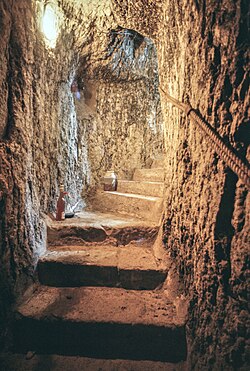
A cache (or temporary hiding place) is a type of shelter or hidden place1 used since ancient times by primitive peoples, and currently used in some military operations or to conceal sensitive materials.2 In certain contexts, it has also been used to hide terrorist material, such as explosives or weapons, for example in hiding places used by armed groups in southern France,3 or in underground tunnels in Gaza.4
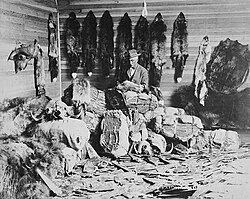
In the past centuries was used, among others, by trappers in the North American fur trade. These caches were used to conceal supplies for the entire trapping season and to store the pelts collected in preparation for the return trip to distant markets.5 This practice, likely derived from animal hoarding, has historical roots in Neolithic hunter-gatherer civilizations, and was also established among Native American communities before the arrival of European trappers.
Etymology
cache is a French word, derived from the verb cacher meaning to conceal or hide. Webster's 1911 dictionary defines cache as: "a hole in the ground, made for concealing and protecting materials which, for various reasons, one does not want to transport at the moment, and for returning to when convenient."
Trapper's cache
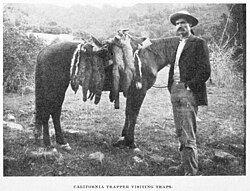
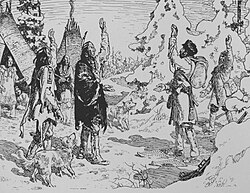
As stated earlier, there were a variety of reasons for hiding things in a cache. Among the types of items a trapper might have hidden in a cache, a rough list would include: beaver furs, traps, guns, gunpowder, rocks, lead bars, tobacco, knives, axes, coffee, sugar, salt, ham, pork, beans, corn, buffalo coats, wool blankets, cloth, Indian hardware, and an amount of other items. The mountain man's reasons for using a cache varied depending on whether he was an explorer, a trader, or a trapper:6
- The explorer could lighten his load during a difficult part of his journey, or store important items (such as food, lead, and gunpowder) in the cache for his return trip.
- The trader could store some of his commercial goods to recover them later.
- The trapper needed a place to hide his beaver furs until he was ready to transport them to markets in the east.
Construction of a trapper's cache
Captain Meriwether Lewis, on June 9, 1805, describes it this way:7
- A hidden place.
- A hole made in the ground.
- A concealed cover.
See also
See also
References
References
- The Utah Journey. Gibbs Smith. pp. 73–. ISBN 978-1-4236-2384-7.
- "Enterrado_en_un_zulo" (PDF). memorialvt.com (in Spanish). Retrieved 2025-10-10.
- "El zulo de ETA localizado en Francia". La Moncloa. Home (in Spanish). Retrieved 2025-10-10.
- Abu Amer, Adnan. "Tunnel May Signal Shift In Hamas-Israel Conflict". Al Monitor. Al Monitor. Archived from the original on 25 August 2014. Retrieved 29 July 2014.
- The Utah Journey. Gibbs Smith. ISBN 978-1-4236-2384-7. Retrieved 2025-08-23.
- Meriwether Lewis; William Clark (1815). Travels of the Source of the Missouri River and Across the American Continent to the Pacific Ocean: Performed by Order of the Government of the United States, in the Years 1804, 1805, and 1806. Longman, Hurst, Rees, Orme, and Brown.
- Meriwether Lewis; William Clark (1815). Travels of the Source of the Missouri River and Across the American Continent to the Pacific Ocean: Performed by Order of the Government of the United States, in the Years 1804, 1805, and 1806. Longman, Hurst, Rees, Orme, and Brown. pp. 350–.