| Tramea | |
|---|---|
| |
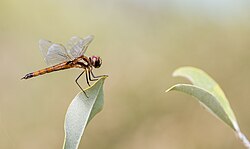
| In the Galápagos Islands | |
Scientific classification 
| |
| Kingdom: | Animalia |
| Phylum: | Arthropoda |
| Clade: | Pancrustacea |
| Class: | Insecta |
| Order: | Odonata |
| Infraorder: | Anisoptera |
| Superfamily: | Libelluloidea |
| Family: | Libellulidae |
| Subfamily: | Trameinae |
| Tribe: | Trameini |
| Genus: | Tramea Hagen, 18611 |
| Synonyms2 | |
| |
Tramea is a genus of dragonflies in the family Libellulidae, the skimmers and perchers.3 Members of the genus occur throughout tropical and subtropical regions worldwide.4
Tramea dragonflies typically have dark or coloured patches at the bases of their hindwings, creating the appearance of saddlebags when in flight. This feature gives rise to the common names saddlebags and saddlebag gliders.56
Taxonomic history
In 1849, Hagen introduced the name Trapezostigma for dragonflies characterised by their distinctive wing markings.7 In 1861, Hagen established Tramea as a genus, shortening the earlier name Trapezostigma and incorporating an allusion to the Latin trameare ("to pass through"), referring to the migratory behaviour of species in the genus.18
Description
Species of Tramea are medium-sized to large dragonflies with conspicuous dark patches at the bases of the hindwings.9 The hindwings have a distinctive arrangement of veins and cells near the wing base.9
Species of Tramea are strong fliers and many are highly migratory or nomadic, occurring throughout tropical and warm temperate regions worldwide.49
Species
The genus Tramea includes the following species,102 some of which have subspecies:11
- Tramea abdominalis (Rambur, 1842) – Vermilion Saddlebags12
- Tramea aquila Lieftinck, 1942
- Tramea basilaris (Palisot de Beauvois, 1805) – Keyhole Glider, Wheeling Glider, Red Marsh Trotter13
- Tramea binotata (Rambur, 1842) – Sooty Saddlebags12
- Tramea carolina (Linnaeus, 1763) – Carolina Saddlebags12
- Tramea cophysa Hagen, 1867
- Tramea darwini Kirby, 1889 – Striped Saddlebags12
- Tramea eurybia Selys, 1878
- Tramea insularis Hagen, 1861 – Antillean Saddlebags12
- Tramea lacerata Hagen, 1861 – Black Saddlebags12
- Tramea liberata Lieftinck, 1949
- Tramea limbata (Desjardins, 1832) – Ferrugineus Glider, Voyaging Glider,14 Black Marsh Trotter15
- Tramea loewii Kaup in Brauer, 1866 – Common Glider9
- Tramea minuta De Marmels & Rácenis, 1982
- Tramea onusta Hagen, 1861 – Red Saddlebags,12 Red-mantled Saddlebags16
- Tramea phaeoneura Lieftinck, 1953
- Tramea rosenbergi Brauer, 1866
- Tramea rustica De Marmels & Rácenis, 1982
- Tramea stenoloba (Watson, 1962) - Narrow-lobed glider9
- Tramea transmarina Brauer, 1867 – Red Glider17
- Tramea virginia (Rambur, 1842)
Etymology
The genus name Tramea is derived from the Latin trameare ("to pass through" or "travel across"), referring to the migratory or vagrant behaviour of species in the genus.8
The earlier name Trapezostigma is derived from the Greek τραπέζιον (trapezion, "trapezium") and στίγμα (stigma, "spot" or "mark"), likely referring to the shape of the pterostigma.78
Gallery
Wing markings in species of Tramea are distinctive and vary considerably between species.
-
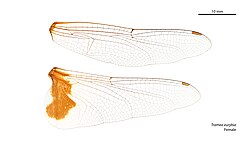 Female Tramea eurybia wings
 -
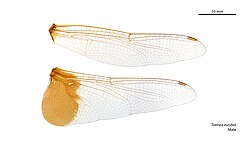 Male Tramea eurybia wings
 -
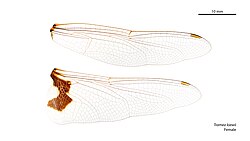 Female Tramea loewii wings
 -
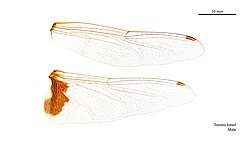 Male Tramea loewii wings
 -
 Female Tramea stenoloba wings
 -
 Male Tramea stenoloba wings
 -
 Female Tramea transmarina wings
 -
 Male Tramea transmarina wings
References
References
- Hagen, Hermann (1861). "Synopsis of the Neuroptera of North America with a List of the South American Species". Smithsonian Miscellaneous Collections. 4: 347 [143] – via Biodiversity Heritage Library.
- Paulson, D.; Schorr, M.; Abbott, J.; Bota-Sierra, C.; Deliry, C.; Dijkstra, K.-D.; Lozano, F. "World Odonata List". OdonataCentral. University of Alabama. Retrieved 23 April 2026.
- "Genus Tramea Hagen, 1861". Australian Faunal Directory. Australian Biological Resources Study. 2012. Retrieved 28 February 2017.
- Watson, J.A.L.; Theischinger, G.; Abbey, H.M. (1991). The Australian Dragonflies: A Guide to the Identification, Distributions and Habitats of Australian Odonata. Melbourne: CSIRO. p. 278. ISBN 978-0-643-05136-2.
- "Tramea". Atlas of Living Australia.
- Winterbourn, MJ; Pohe, SR; Ball, OJ-P (2011). "Establishment of larval populations of the dragonfly Tramea loewii Kaup, 1866 (Odonata: Libellulidae) in lakes of northern New Zealand". New Zealand Journal of Zoology. 38 (2): 173–179. doi:10.1080/03014223.2010.548561.
- Hagen, H.A. (1849). "Uebersicht der neueren Literatur betreffend die Neuropteren". Entomologische Zeitung (in German). 10: 167–177 [174].
- Endersby, Ian; Fliedner, Heinrich (2015). The Naming of Australia's Dragonflies. Eltham, Victoria, Australia: Busybird Publishing. ISBN 9781925260625.
- Theischinger, G; Hawking, J (2006). The Complete Field Guide to Dragonflies of Australia. Collingwood Vic.: CSIRO Publishing. p. 298. ISBN 978-0-64309-073-6.
- "Tramea". Integrated Taxonomic Information System.
- odonata.info (2005)
- "North American Odonata". University of Puget Sound. 2009. Retrieved 5 August 2010.
- Clausnitzer, V.; Suhling, F.; Dijkstra, K.-D.B.; Dow, R.A.; Boudot, J.-P.; Schneider, W.; Samraoui, B. (2016). "Tramea basilaris". IUCN Red List of Threatened Species. 2016 e.T60049A83871612. doi:10.2305/IUCN.UK.2016-3.RLTS.T60049A83871612.en. Retrieved 12 November 2021.
- Clausnitzer, V. (2016). "Tramea limbata". IUCN Red List of Threatened Species. 2016 e.T60050A83381971. doi:10.2305/IUCN.UK.2016-3.RLTS.T60050A83381971.en. Retrieved 12 November 2021.
- Subramanian, K. A. (2005). Dragonflies and Damselflies of Peninsular India (PDF).
- Dunkle, S. W. (2000). Dragonflies through Binoculars. New York: Oxford University Press. p. 219. ISBN 978-0-19-511268-9.
- Wilson, K.D.P.; Rowe, R.; Marinov, M. (2020). "Tramea transmarina". IUCN Red List of Threatened Species. 2020 e.T167183A83375536. doi:10.2305/IUCN.UK.2020-1.RLTS.T167183A83375536.en. Retrieved 12 November 2021.