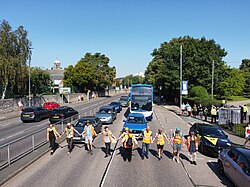
Traffic obstruction is a common tactic used during public protests and political demonstrations.12
Legality
Most jurisdictions consider the obstruction of traffic an illegal activity and have developed rules to prosecute those who block, obstruct, impede, or otherwise interfere with the normal flow of vehicular or pedestrian traffic upon a public street or highway.3 Some jurisdictions also penalize slow moving vehicle traffic.4
Examples
Examples of intentional traffic obstructions aimed to articulate a protest agenda include Extinction Rebellion protests,5 air traffic controller strike, highway revolts, Critical Mass bicycle rides corking intersections, obstruction of rail transport of nuclear fuel in Germany, road blockades by farmers or truckers in France and other countries, impact on Eurotunnel operations by the Migrant Crisis around Calais, pipeline protests (e.g. Dakota Access Pipeline), etc.
On September 18, 2025, during a protest outside immigration court and detention facility 26 Federal Plaza, protesters outside the facility crowded together and blocked a garage that an ICE vehicle was attempting to exit.6 The Department of Homeland Security (DHS) contacted the NYPD, who sent the controversial Strategic Response Group policing unit to move in and arrest protesters blocking the garage who chose to remain after receiving dispersal orders from the NYPD.6 Activist and politician Jumaane Williams was the first to be detained outside,6 and four government officials were arrested in total outside the facility.7 A DHS spokesperson claimed 71 "agitators" and "sanctuary politicians" had been arrested following the incident.6 Brad Lander's office claimed more than 75 arrests were made.7
Traffic obstruction was used at the 2026 Delaney Hall hunger strike and protests, and Immigration and Customs Enforcement (ICE) agents attacked protesters in response making arrests.89
References
References
- Badger, Emily (13 July 2016). "Why highways have become the center of civil rights protest". The Washington post. Retrieved 7 September 2017.
- Yongshun, Cai (2010). Collective Resistance in China: Why Popular Protests Succeed Or Fail. Stanford University Press. pp. 110–111. ISBN 978-0804763394.
- "Supreme Court: Protesters can't block roads or public spaces, rules Supreme Court". The Times of India.
- "Law section". leginfo.legislature.ca.gov. Retrieved 2022-05-11.
- Emilie Ruscoe; Esha Ray (23 June 2019). "70 people arrested protesting climate change outside New York Times hq in Midtown". New York Daily News.
- Olivares, José; Motal, Julius Constantine (19 September 2025). "New York lawmakers arrested for blocking Ice access to federal building". The Guardian. Retrieved 4 May 2026.
- Paúl, María Luisa; Moon, Grace (18 September 2025). "Democratic elected officials arrested at ICE facility in New York City". The Washington Post. Archived from the original on 20 September 2025. Retrieved 4 May 2026.
- Moses, Dean (June 6, 2026). "Delaney Hall chaos returns: ICE clashes with protesters, photographer hit by security staff driver outside immigrant detention center". amNewYork. Schneps Media. Retrieved July 2, 2026.
- Moore, Amanda (June 9, 2026). "Inside the Anti-ICE Protests at Delaney Hall". The Nation. Retrieved June 24, 2026.