| Titanoides | |
|---|---|
| |
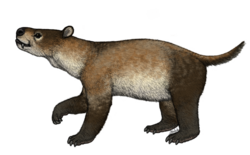
| Life restoration of T. primaevus | |
Scientific classification 
| |
| Kingdom: | Animalia |
| Phylum: | Chordata |
| Class: | Mammalia |
| Infraclass: | Placentalia |
| Order: | †Pantodonta |
| Superfamily: | †Pantolambdoidea |
| Family: | †Titanoideidae Patterson, 1934 |
| Genus: | †Titanoides Gidley, 1917 |
| Type species | |
| †Titanoides primaevus Gidley, 1917
| |
| Species1 | |
| |
| Synonyms | |
| |
Titanoides is an extinct genus of pantodont mammal which lived in western North America during the late Paleocene (Tiffanian 2 to Clarkforkian 2 ages).23 It was a medium-sized pantodont which weighed up to 150 kg (330 lb).4 It was one of the largest mammals in its habitat, a tropical swampland where the main predators were semiaquatic reptiles such as crocodilians and choristoderes.5
Titanoides looked similar to a bear in size and stance, though it has no close living relatives.54 The skull is proportionally large, the tail is short, and the neck is thick and muscular. Its canine teeth are distinctive: the upper canines are saber-like (very long from top-to-bottom), while the lower canines are shaped like hooked blades (with a long base from front-to-back). The limbs are strong and stocky, with five digits on each paw. The rear paws are not fully preserved, but the front paws have narrow curved claws rather than hoofs, unlike other pantodonts. Despite their fearsome canines, the shape of the postcanine teeth (premolars and molars) indicate that Titanoides were probably herbivores.2 The claws and canines may have been used to dig up and slice through roots and tubers.6
Discovery and species
Footprints attributed to Titanoides are known from the Firkanten Formation of Svalbard. These footprints are classified as the ichnospecies Thulitheripus svalbardii.7
T. primaevus
Titanoides primaevus, the type species of Titanoides, was named by Gidley (1917) for a few lower jaw fragments discovered in the Williston Basin, near Buford, North Dakota. These initial fragments were discovered in 1913 by Vernon Bailey, who collected from the Sentinel Butte Formation. Gidley noted that it was "by far the largest mammal yet known from the Paleocene". Its large size and the shape of its molar teeth reminded him of brontotheres, a family of hoofed mammals which he referred to as titanotheres. He established the name Titanoides in reference to the similarity.8
The exact site of Bailey's discovery was elusive for decades before being relocated by Princeton University paleontologists in 1951. They were able to collect many more fossils of a Titanoides skull, probably the same exact individual which the original jaw fragments came from.23
T. primaevus fossils are also known from Alberta, Saskatchewan (specifically the Roche Percée local fauna in the Ravenscrag Formation), and the Bison Basin of Fremont County, Wyoming.910 Sites preserving T. primaevus fossils are generally considered to be Tiffanian 4 in age.310
T. gidleyi
Titanoides gidleyi was named by Jepsen (1930) for fossils from the Silver Coulee beds (Fort Union Formation) in the Bighorn Basin of Wyoming. It is a medium-sized species which is slightly older than T. primaevus, dating to the Tiffanian 3.311
Simpson (1937) named another Titanoides species, Titanoides zeuxis, from the Melville Formation in the Crazy Mountain Basin near Melville, Montana. It is a somewhat smaller species, also from the Tiffanian 3.2 Gingerich (1996) regarded T. zeuxis as a synonym of T. gidleyi. "T. zeuxis" fossils from the Black Peaks Formation of Texas may also represent fossils of T. gidleyi.3 Simons (1960) named another Titanoides species from the Crazy Mountain Basin, T. simpsoni,2 but later authors considered it to belong within Pantolambda instead.3
T. looki
Titanoides looki was originally named as Sparactolambda looki by Patterson (1939), who was collecting on behalf of the Field Museum of Natural History. Patterson applied this name to well-preserved skull and postcranial fossils from the DeBeque Formation (Tiffanian 5 to Clarkforkian 1) in Plateau Valley, near De Beque, Colorado.6 Subsequent authors recognized "Sparactolambda" as a synonym of Titanoides, once more skull material of the latter was found in North Dakota.923 Simons (1960) regarded Sparactolambda looki as a synonym of T. primaevus in particular, with other Colorado Titanoides fossils referable to T. zeuxis.2 Gingerich (1996) argued that T. looki was still distinct enough to be considered its own species within Titanoides.3 In any case, the best Titanoides fossils are represented by Patterson's Colorado collection.62
Prior to naming "Sparactolambda", Patterson reported collecting numerous Titanoides fossils from the Plateau Valley area through the 1930s.1213 However, in 1937 he classified these earlier finds as a different pantodont genus, Barylambda.14
T. major
T. major was named by Simons (1960) for a single lower jaw fossil from the Silver Coulee beds in the Bighorn Basin of Wyoming. It appears to be the largest known Titanoides species and one of the oldest (Tiffanian 2 in age).23
T. nanus
T. nanus was named by Gingerich (1996) for lower jaw fossils from the Clarks Fork Basin, a small offshoot of the Bighorn Basin at the north edge of Wyoming. T. nanus is the youngest known Titanoides species (Clarkforkian 2 in age) as well as the smallest, with its teeth measuring about 10-25% smaller than other species.3
References
References
- "Pantodonta". After McKenna & Bell (1997) and Alroy (2002). Retrieved 2 November 2013.
- Simons, Elwyn L. (1960). "The Paleocene Pantodonta". Transactions of the American Philosophical Society. 50 (6): 3–99. doi:10.2307/1005810. ISSN 0065-9746. JSTOR 1005810.
- Gingerich, Philip D. (1996). "New Species of Titanoides (Mammalia, Pantodonta) from the Middle Clarkforkian (Late Paleocene) of Northwestern Wyoming". Contributions from the Museum of Paleontology, The University of Michigan. 29 (14): 403–412.
- "Pantodonts, uintatheres and xenungulates: The first large herbivorous mammals". Paleocene mammals of the world. 2001.
- "Titanoides" (PDF). North Dakota Geological Survey.
- Patterson, B. (1939). "New Pantodonta and Dinocerata from the upper Paleocene of western Colorado". Geological Series of the Field Museum of Natural History. 6: 351–384.
- Lüthje, Charlotta J.; Milàn, Jesper; Hurum, Jørn H. (2010). "Paleocene tracks of the mammal Pantodont genus Titanoides in coal-bearing strata, Svalbard, Arctic Norway". Journal of Vertebrate Paleontology. 30 (2): 521–527. doi:10.1080/02724631003617449. ISSN 0272-4634.
- Gidley, James William (1917). "Notice of a new Paleocene mammal, a possible relative of the titanotheres". Proceedings of the United States National Museum. 52: 431–435.
- Gazin, C. Lewis (1956). "Paleocene mammalian faunas of the Bison Basin in south-central Wyoming". Smithsonian Miscellaneous Collections. 131: 1–57.
- Sweedler, Rory E.; Rust, Kathleen L.; Beard, K. Christopher (2025-12-31). "Late Paleocene (Tiffanian) Mammalia from the Titanoides Locality, Bison Basin, Wyoming: Revised Biostratigraphic Age and Paleobiogeographic Implications". Annals of Carnegie Museum. 91 (3). doi:10.2992/007.091.0303. ISSN 0097-4463.
- Jepsen, G. L. (1930). "Stratigraphy and Paleontology of the Paleocene of Northeastern Park County, Wyoming". Proceedings of the American Philosophical Society. 69 (1): 463–528. ISSN 0003-049X. JSTOR 984379.
- Patterson, Bryan (1934). "A Contribution to the Osteology of "Titanoides" and the Relationships of the Amblypoda". Proceedings of the American Philosophical Society. 73 (2): 71–101. ISSN 0003-049X. JSTOR 984758.
- Patterson, Bryan (1935). "Second Contribution to the Osteology and Affinities of the Paleocene Amblypod Titanoides". Proceedings of the American Philosophical Society. 75 (2): 143–162. ISSN 0003-049X. JSTOR 984533.
- Patterson, Bryan (1937). "A new genus Barylambda, for Titanoides faberi, Paleocene amblypod". Field Museum of Natural History Geological series. 6 (16): 229–231.