 | |
| Type | Home computer |
|---|---|
| Released | 1984 (1984) |
Introductory price | PLZ 106,000 |
| Discontinued | 1989 (1989) |
| Sinclair BASIC TOS and CP/M with Timex FDD3000 | |
| CPU | Zilog Z80A @ 3.5 MHz |
| Memory | 48 KB |
| Display | PAL TV or video monitor; text: 32×24 lines, 16 colours; graphics: 256×192, 16 colours or 512×192 pixels, two colours; attributes: 32x24 or 32x192, two colours per area. |
| Graphics | Timex SCLD |
| Sound | Beeper |
| ZX Spectrum | |
| Predecessor | Timex Sinclair 2068 |
| Successor | Komputer 2086, Spectrum SE |
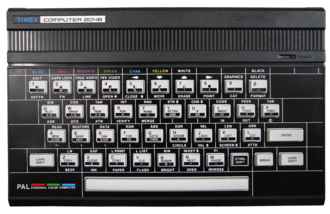
The Timex Computer 2048 or TC 2048 is a 1984 computer developed by Timex Portugal (the Portuguese branch of Timex Corporation), at the time part of Timex Sinclair. It was based on the Timex Sinclair 2048 prototype (see below), with a similar redesign case, composite video output, Kempston joystick interface, and additional video modes,1 while being highly compatible with the Sinclair ZX Spectrum computer (although ROM differences prevented 100% compatibility).2
After connecting an external disk drive, Timex FDD3000, the computer could work under TOS - Timex Operating System3 or CP/M.
As Timex Portugal sold the Timex Sinclair models in Portugal and Poland under the Timex Computer4 brand, this computer is named "Timex Computer 2048", even though the "Timex Sinclair 2048" was never produced.
Timex Sinclair 2048 (prototype)
The Timex Sinclair 2048 was not released by Timex Sinclair because of the failure of the T/S 1500. According to an early Timex Sinclair 200056 computer flyer, it would be a cut-down Timex Sinclair 2068 with 16 KB of RAM. It had an added Kempston-compatible joystick interface and a monochrome high resolution mode for 80 column text.7
History
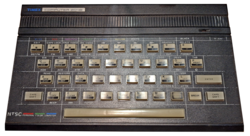
In contrast with the ZX Spectrum, which was the best-selling computer in Britain at the time, the T/S 2068 and T/S 1500 were considered failures. Timex Corporation withdrew from the U.S. home computer market in February 1984. Timex Portugal continued to manufacture and sell the TC 2048 in Portugal and Poland, where it was very successful, selling more than 10000 units.18 Also, a NTSC version was sold in Chile.910
TC 2048 started to be sold in Poland in 1986, with 5000 units available at the "Central Scouting Store" for a price of PLZ 106,000.11 It was the equivalent of 4 average salaries (24,095 PLZ),12 and slightly higher than a ZX Spectrum (PLZ 70,000-80,000).11
Peripherals where also made available at the time of release:11
| Description | Price PLZ | Quantity |
|---|---|---|
| TIMEX 3″ diskdrive | 250 000 | 1 500 |
| TIMEX 50 Printer | 96 000 | 700 |
| TIMEX 1000 Printer | 280 000 | 500 |
| TIMEX 2020 cassette tape recorder | 30 000 | 2000 |
| "Quickshot" Joystick | 8 500 | 3 500 |
| 3″ floppy disc | 3 000 | 15 000 |
Production of the computer ended in 1989.
Further developments
This computer forms the basis of a proposal for an improved Spectrum-compatible machine, the ZX Spectrum SE. Based on the Timex TC 2048 and the ZX Spectrum 128, with Timex graphic modes and 280K RAM,13 it was proposed by Andrew Owen and Jarek Adamski in 2000.13 A prototype was created and this configuration is supported by different emulators.1415
Two modifications of the TC 2048 exist:16 the TC 212817 (by STAVI)18 and the TC 2144192017 (by Jarek Adamski). Both extend the RAM to 128K and upgrade the ULA to use four screen areas.
Technical specifications
- Zilog Z80A @ 3.50 MHz
- 16 KB
- 48 KB
Display
- Timex SCLD chip212223 instead of the Spectrum's ULA, offering additional Extended Color, Dual Screen and High Resolution screen modes:
- Text: 32×24 characters (8×8 pixels, rendered in graphics mode)
- Graphics: 256×192 pixels, 15 colours (two simultaneous colours - "attributes" - per 8×8 pixels, causing attribute clash)
- Extended Color: 256×192 pixels, 15 colors with colour resolution of 32×192 (two simultaneous colours - "attributes" - per 8x1 pixels)
- Dual Screen: (two 256×192 pixels screens can be placed in memory)
- High Resolution: 512×192 mode with 2 colours (Four palettes: Black & White, Blue & Yellow, Red & Cyan, Magenta & Green).
- Timex additional screen modes
-
 Standard Graphics 256x192 (8x8 attributes)
 -
 Extended Color 256x192 (8x1 attributes)
 -
 High Resolution 512x192 (Black & White palette)
 -
 High Resolution 512x192 (Blue & Yellow palette)
 -
 High Resolution 512x192 (Magenta & Green palette)
 -
 High Resolution 512x192 (Red & Cyan palette)
Sound
- Beeper (1 channel, 10 octaves and 10+ semitones via internal speaker) [By separate purchase the Joystick/Sound Unit was available to enhance sound and provide a joystick port.]
I/O
- Z80 bus in/out
- Line audio in/out for external cassette tape storage
- RF television out
- Composite video monitor out
- Kempston Joystick input
Storage
- External cassette tape recorder
- 1–8 external ZX Microdrives (using ZX Interface 1)
- Timex FDD (Floppy Disk Drive System Power Supply, Controller and Disk Drive in separate cases. 16K RAM, Timex Operating System (TOS))
- Timex FDD3000 (Enhanced version (all in one case) of the Timex FDD but upgraded to 64K RAM & TOS with two Hitachi 3″ disk drives)
- Timex Storage devices
-
 Timex FDD (left to right: Timex Controller, Timex Floppy Disk, Timex Power Supply).
 -
 Front picture of a Timex FDD3000
References
References
- "TC-2048 Timex Computers". www.old-computers.com.
- Red, Johnny (2001). "Timex Computer 2048". Timex Computer World.
- TIMEX COMPUTER FDD3000 Service Manual. Timex. 7 January 2002.
- "TC-2048". OLD-COMPUTERS.COM : The Museum.
- Mace, Scott (June 20, 1983). "TRS-80 MC-10 "battles" T/S 2000". InfoWorld. Vol. 5, no. 25. p. 1.
- Mace, Scott (January 31, 1983). "Timex shows color computer with 48K RAM for under $200". InfoWorld. Vol. 5, no. 5. p. 18.
- Owen, Chris (2003). "Computers: Timex/Sinclair: TS 2048". Planet Sinclair.
- "Timex Computer 2048". MCbx Old Computer Collection.
- "TC2048". LOAD ZX - TIMEX COMPUTER World. Retrieved 2025-08-12.
- "Timex Computer 2048 (NTSC)". Sinclair Collection Site - A resource of ZX Spectrums from all around the world.
- "Bajtek : z mikrokomputerem na ty : dodatek specjalny "Odrodzenia" i "Sztandaru Młodych"". Sztandaru Młodych (in Polish). January 20, 1985. OCLC 749136207.
- "Strona główna - ZUS". www.zus.pl.
- Owen, Andrew (2002). "The ZX Spectrum SE" (PDF). ZXF03. No. 3. p. 18.
- Adamski, Jarek (2009). "ZX Spectrum SE Technical specifications". 8bit Projects For Everyone.
- "ZX Spectrum SE Technical Information". worldofspectrum.org.
- "Timex Technical Information". comp.sys.sinclair FAQ. 2004.
- "Disk Reference". comp.sys.sinclair FAQ.
- Johnny, Red (2003). "Timex Sinclair 2128". Timex Computer World.
- Adamski, Jarek (2009). "TC2144". 8bit Projects For Everyone.
- selenpixelrat (2020). "Rubi [Timex TC2144/TC2128 Hi-Res Gigascreen] by selenpixelrat on DeviantArt". www.deviantart.com.
- Florindo, Bruno. "CIRCE - AMERICAN COUSINS" (PDF). Byte High No Limit (22): 64.
- "SCLD Chip". Timex/Sinclair - The Authoritative Website for Timex/Sinclair Computers. Retrieved 2023-01-27.
- "Scld in spectrusty::chip::scld - Rust". docs.rs. Retrieved 2023-01-27.