  | |
| Observation data Epoch J2000 Equinox ICRS | |
|---|---|
| Constellation | Libra |
| Right ascension | 15h 53m 49.53806s1 |
| Declination | −16° 43′ 45.4582″1 |
| Apparent magnitude (V) | 4.1362 |
| Characteristics | |
| Evolutionary stage | red clump2 |
| Spectral type | G9IIIb3 |
| U−B color index | +0.824 |
| B−V color index | +1.014 |
| Astrometry | |
| Radial velocity (Rv) | 4.56±0.255 km/s |
| Proper motion (μ) | RA: +100.331 mas/yr Dec.: +135.021 mas/yr |
| Parallax (π) | 19.36±0.15 mas6 |
| Distance | 168 ± 1 ly (51.7 ± 0.4 pc) |
| Absolute magnitude (MV) | 0.6652 |
| Details | |
| Mass | 1.477 M☉ |
| Radius | 12.277 R☉ |
| Luminosity | 68.17 L☉ |
| Surface gravity (log g) | 2.447 cgs |
| Temperature | 4,7397 K |
| Metallicity [Fe/H] | −0.357 dex |
| Rotational velocity (v sin i) | 0.05 km/s |
| Age | 3.47 Gyr |
| Other designations | |
| θ Lib, 46 Librae, BD−16°4174, HD 142198, HIP 77853, HR 5908, SAO 1595638 | |
| Database references | |
| SIMBAD | data |
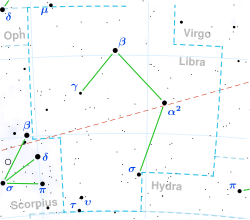
Theta Librae is a single9 star in the southern zodiac constellation of Libra, near the constellation border with Scorpius. Its name is a Bayer designation that is Latinized from θ Librae, and abbreviated Theta Lib or θ Lib. It is visible to the naked eye as a faint, orange-hued star with an apparent visual magnitude of 4.14.2 The distance to this star is approximately 168 light years, as determined by parallax, and it is drifting further away with a radial velocity of 5 km/s.5 The position of this star near the ecliptic means it is subject to lunar occultations.10
This object is an aging giant star with a stellar classification of G9IIIb.3 Having exhausted the supply of hydrogen at its core, it has cooled and expanded; at present it has 12.3 times the girth of the Sun.7 The star has an estimated mass about 47% greater than the Sun. It is radiating about 68 times the luminosity of the Sun from its photosphere at an effective temperature of about 4,739 K.7 It is probably on the red giant branch, which indicates it is generating energy through hydrogen fusion in a shell outside an inert helium core.7 However, there is a 41% chance that it is a red clump giant on the horizontal branch,2 which would mean it was somewhat older and less massive.7 It has sometimes been classified spectroscopically as a subgiant, but detailed study shows that it is too cool and luminous to be on the subgiant branch.11
References
References
- Brown, A. G. A.; et al. (Gaia collaboration) (August 2018). "Gaia Data Release 2: Summary of the contents and survey properties". Astronomy & Astrophysics. 616. A1. arXiv:1804.09365. Bibcode:2018A&A...616A...1G. doi:10.1051/0004-6361/201833051. Gaia DR2 record for this source at VizieR.
- Liu, Y. J.; et al. (2007). "The abundances of nearby red clump giants". Monthly Notices of the Royal Astronomical Society. 382 (2): 553–66. Bibcode:2007MNRAS.382..553L. doi:10.1111/j.1365-2966.2007.11852.x.
- Keenan, Philip C.; McNeil, Raymond C. (1989). "The Perkins catalog of revised MK types for the cooler stars". The Astrophysical Journal Supplement Series. 71: 245. Bibcode:1989ApJS...71..245K. doi:10.1086/191373.
- Johnson, H. L.; et al. (1966). "UBVRIJKL photometry of the bright stars". Communications of the Lunar and Planetary Laboratory. 4 (99): 99. Bibcode:1966CoLPL...4...99J.
- Massarotti, Alessandro; et al. (January 2008), "Rotational and Radial Velocities for a Sample of 761 HIPPARCOS Giants and the Role of Binarity", The Astronomical Journal, 135 (1): 209–231, Bibcode:2008AJ....135..209M, doi:10.1088/0004-6256/135/1/209, S2CID 121883397
- van Leeuwen, F. (2007). "Validation of the new Hipparcos reduction". Astronomy and Astrophysics. 474 (2): 653–664. arXiv:0708.1752. Bibcode:2007A&A...474..653V. doi:10.1051/0004-6361:20078357. S2CID 18759600.
- Reffert, Sabine; Bergmann, Christoph; Quirrenbach, Andreas; Trifonov, Trifon; Künstler, Andreas (2015). "Precise radial velocities of giant stars. VII. Occurrence rate of giant extrasolar planets as a function of mass and metallicity". Astronomy and Astrophysics. 574: A116. arXiv:1412.4634. Bibcode:2015A&A...574A.116R. doi:10.1051/0004-6361/201322360. S2CID 59334290.
- "tet Lib". SIMBAD. Centre de données astronomiques de Strasbourg. Retrieved 2017-06-19.
- Eggleton, P. P.; Tokovinin, A. A. (September 2008). "A catalogue of multiplicity among bright stellar systems". Monthly Notices of the Royal Astronomical Society. 389 (2): 869–879. arXiv:0806.2878. Bibcode:2008MNRAS.389..869E. doi:10.1111/j.1365-2966.2008.13596.x. S2CID 14878976.
- Edwards, D. A.; et al. (April 1980). "Photoelectric observations of lunar occultations. XI". Astronomical Journal. 85: 478–489. Bibcode:1980AJ.....85..478E. doi:10.1086/112700.
- Thorén, P.; Edvardsson, B.; Gustafsson, B. (2004). "Subgiants as probes of galactic chemical evolution". Astronomy and Astrophysics. 425: 187–206. arXiv:astro-ph/0407260. Bibcode:2004A&A...425..187T. doi:10.1051/0004-6361:20040421. S2CID 2116895.