The Theory of Forms or Theory of Ideas,abc also known as Platonic idealism or Platonic realism, is a philosophical theory credited to the Classical Greek philosopher Plato.
A major concept in metaphysics, the theory suggests that the physical world is not as real or true as Forms (or Ideas, typically capitalized):1 the timeless, absolute, non-physical, and unchangeable essences of all things, which objects and matter in the physical world merely participate in, imitate, or resemble.2 In other words, Forms are various abstract ideals that exist even outside of human minds and that constitute the basis of reality. Thus, Plato's Theory of Forms is a type of philosophical realism, asserting that certain ideas are literally real, and a type of idealism, asserting that reality is fundamentally composed of ideas, or abstract objects.
Plato describes these entities only through the characters (primarily Socrates) in his dialogues who sometimes suggest that these Forms are the only objects of study that can provide knowledge.3 The theory itself is contested by characters within the dialogues, and it remains a general point of controversy in philosophy. Nonetheless, the theory is considered to be a classical solution to the problem of universals.4
Etymology
Referring to Forms, Plato used a number of Ancient Greek terms that mainly relate to vision, sight, and appearance, including ἰδέα (idéā; from a root meaning to see), a word that precedes attested philosophical usage. Plato uses these aspects of sight and appearance in his dialogues to explain his Forms, including the supreme one: the Form of the Good. Other terms include εἶδος (eîdos) meaning "visible form", and the related terms μορφή (morphḗ) meaning "shape",d and φαινόμενα (phainómena) meaning "appearances", from φαίνω (phaínō) meaning "shine", ultimately from Indo-European *bʰeh₂- or *bhā-.5 The original meanings of these terms remained stable over the centuries before the beginning of Western philosophy, at which time they became equivocal, acquiring additional specialized philosophic meanings. Plato used the terms eidos and idea interchangeably.6
Pre-Socratic philosophy
The pre-Socratic philosophers, ancient Greek thinkers born before Plato, noted that appearances change, and they began to ask what the thing that changes "really" is. If something changes, what component or essence of it remains "real"? The answer was substance, which stands under the changes and is the actually existing thing being seen. The status of appearances now came into question, including how the appearance is related to the substance. For instance, the earliest known pre-Socratic philosopher, Thales, argued that the fundamental substance all things are made of is water.
Scriptures written by Pythagoras, another pre-Socratic philosopher, suggest that he developed an earlier theory similar to Plato's Forms. For Pythagoras, like Plato, the substance or essence of all things was not something physical (like water) but rather something abstract. However, Pythagoras's theory was much narrower than Plato's, proposing that the non-physical and timeless essences that compose the physical world are specifically numbers, whereas Plato conceived of his Forms as a vast array of intangible ideals.
Theory
The Forms are expounded in Plato's dialogues, wherein it is proposed that every (suitable)e kind or quality—goodness, justice, equality, beds, horses, etc.—has a corresponding Form; these Forms are held to be that which is "really real", whereas sensible phenomena (i.e., those perceived through the senses) are merely their "shadows" or imitations: momentary portrayals of the Form, as realized under various circumstances. Thus, for Plato, Forms are more real than the objects of our everyday experience: though Forms are timeless and unchanging, physical things are in constant flux; where Forms are unqualified perfection, physical things are qualified and conditioned.7
Form answers the question, "What is that, essentially?" That is, a Form is something like the essence of a thing or quality: that without which the thing would not be the kind of thing that it is. For example, there are countless and disparate tables in the world, but the "Form of Table" is that essence of "tableness" in virtue of which each particular table is a table.8 Alternatively, or in addition, a Form may be understood as a sort of objective "blueprint":9 the perfect and unchanging paradigm for some kind, quality, or mathematical object.
Given that such Forms are exactly the same whenever anyone chooses to consider them (as it is difficult to imagine what it would even mean for there to be a change in the very geometrical ideal of, e.g., the isosceles triangle)—i.e., time only affects the observer, not the ideal—and are similarly unaffected by location, Plato obtained what was perhaps his most original result, qua Forms:10: 23 that they are aspatial (transcendent to space) and atemporal (transcendent to time).11f Neither sempiternal (enduring for all time) nor mortal, they transcend time altogether;12: 78d–79a 13 similarly, they have no spatial dimensions—and thus, neither any orientation in space—nor (like the point) do they possess locations.g
Though Forms are non-physical, neither are they merely within the mind (i.e., they are real in the strictest sense of the word). Indeed, according to the Platonic understanding, the world of Form is—as well as transcendent to the sensible world—the essential basis both thereof, and of true (stable, enduring) knowledge.14 Conversely, sensible particulars—being changeable, subject-relative, and tied to unreliable perception—provide an apt basis for only opinion.15
For example, consider a triangle drawn upon a blackboard: such a triangle, as drawn by a human hand, is necessarily imperfect—as will be all earthly triangles—so whence the recognition thereof as approximations of mathematically ideal triangles (which we have never seen)? For Plato, it is the intelligibility of the "Form of Triangle" that allows us to know the drawing on the chalkboard as a triangle. Similarly, the Form of the circle enables us to draw, define, speak, and write about particular circles—and to understand and recognize the ways in which they fall short of the ideal—though a perfect circle cannot be encountered or perceived by the senses.
For the Platonist, then, the idea of the perfect circle is discovered, not invented—the Form itself exists eternally, regardless of whether it is instantiated or cognized. It follows that the same would go for the Form of Beauty, and indeed for all Forms.
Intelligible realm and separation of the Forms
Plato often invokes poetic language—particularly in the Phaedo, Republic, and Phaedrus—to illustrate the mode in which the Forms are said to exist. Near the end of the Phaedo, for example, Plato describes the world of Forms as a pristine region of the physical universe located above the surface of the Earth.12: 109a–111c In the Phaedrus, the Forms are in a "place beyond heaven" (hyperouranios topos);16 and in the Republic, the sensible world is contrasted with the intelligible realm (noēton topon) in the famous Allegory of the Cave.
It would be a mistake to take Plato's imagery as positing the intelligible world as a literal physical space apart from this one.1718 Plato emphasizes that the Forms are not beings that extend in space (or time), but rather subsist apart from any physical space whatsoever.19 Thus we read in the Symposium of the Form of Beauty: "It is not anywhere in another thing, as in an animal, or in earth, or in heaven, or in anything else, but itself by itself with itself" (211b). And in the Timaeus, Plato writes: "Since these things are so, we must agree that which keeps its own form unchangingly, which has not been brought into being and is not destroyed, which neither receives into itself anything else from anywhere else, nor itself enters into anything anywhere, is one thing." (52a; emphasis added.)
Ambiguities of the theory
Plato's conception of Forms actually differs from dialogue to dialogue, and in certain respects it is never fully explained, so many aspects of the theory are open to interpretation. Forms are first introduced in the Phaedo,12: 65d–75d but in that dialogue the concept is taken as something with which the participants are already familiar, and the theory itself is not developed. Similarly, in the Republic, Plato relies on the concept of Forms as the basis of many of his arguments, but feels no need to argue for the validity of the theory itself or to explain precisely what Forms are. Commentators have been left with the task of explaining what Forms are and how physical objects participate in them, and there has been no shortage of disagreement.
Some scholars advance the view that Forms are paradigms, perfect examples on which the imperfect world is modeled;20 others place emphasis upon the Forms as universals, so that the Form of Beauty, for example, is that quality that all beautiful things share.21 Yet others interpret Forms as "stuffs", the conglomeration of all instances of a quality in the visible world; under this interpretation, we could say that there is a little beauty in one person, a little beauty in another, and so on—thence, all the beauty in the world put together is the Form of Beauty. Plato himself was aware of the ambiguities and inconsistencies in his conception of Forms, as is evident from the incisive criticism he makes of his own theory in the Parmenides.
Evidence of Forms
Human perception
But if the very nature of knowledge changes, at the time when the change occurs there will be no knowledge, and, according to this view, there will be no one to know and nothing to be known: but if that which knows and that which is known exist ever, and the beautiful and the good and every other thing also exist, then I do not think that they can resemble a process of flux, as we were just now supposing.
Plato believed that long before our bodies ever existed, our souls existed and inhabited heaven, where they became directly acquainted with the forms themselves. Real knowledge, to him, was knowledge of the forms. But knowledge of the forms cannot be gained through sensory experience because the forms are not in the physical world. Therefore, our real knowledge of the forms must be the memory of our initial acquaintance with the forms in heaven. Therefore, what we seem to learn is in fact just remembering.23
Perfection
No one has ever seen a perfect circle, nor a perfectly straight line, yet everyone knows what a circle and a straight line are. Plato uses the tool-maker's blueprint as evidence that Forms are real:24
... when a man has discovered the instrument which is naturally adapted to each work, he must express this natural form, and not others which he fancies, in the material ....
Perceived circles or lines are not exactly circular or straight, and true circles and lines could never be detected since by definition they are sets of infinitely small points. But if the perfect ones were not real, how could they direct the manufacturer?
Universals
A given quality (e.g., sphericity) often appears to be possessed alike by multiple distinct entities at once (e.g., ball-bearings as well as tennis balls); the question as to what exactly (if anything) is shared therebetween, and how it is that one thing in general could yet be many things in particular, is known as the problem of universals. Plato is usually taken to be the originator of the conundrum,10 and he advanced the theory of Forms as providing a solution: when the same general quality can be predicated of many particular objects, it is because the particulars partake of the same Form; e.g., a beautiful flower, a beautiful face, and a beautiful building—though beautiful in entirely different ways—all participate in the Form of the Beautiful; it is this that enables us to speak of their common beauty, and "beauty" in general (rather than being able only to speak, separately, of particular beautiful things).
Thus, the Form—though itself a distinct singular entity—causes,i or explains, the plurality of its sensible instances in particular objects, and there is no need to suppose that one and the same thing be both one and many simultaneously. For example, in the dialogue Parmenides, Socrates states: "Nor, again, if a person were to show that all is one by partaking of one, and at the same time many by partaking of many, would that be very astonishing. But if he were to show me that the absolute one was many, or the absolute many one, I should be truly amazed."25: 129
Criticisms of Platonic Forms
Self-criticism
One difficulty lies in the conceptualization of the "participation" of an object in a form (or Form). The young Socrates conceives of his solution to the problem of the universals in another metaphor:25: 132
Nay, but the idea may be like the day which is one and the same in many places at once, and yet continuous with itself; in this way each idea may be one and the same in all at the same time.
But exactly how is a Form like the day in being everywhere at once? The solution calls for a distinct Form, in which the particular instances, which are not identical to the Form, participate; i.e., the Form is shared out somehow like the day to many places. The concept of "participate", represented in Greek by more than one word, is as obscure in Greek as it is in English. Plato hypothesized that distinctness meant existence as an independent being, thus opening himself to the famous Third Man argument of Parmenides,j which many have held to prove that Forms cannot independently exist and be participated.k
The argument, in outline, proceeds as follows. Suppose that the members of a set E are all possessed of a certain quality—canonically, "largeness"—in virtue of their participating in the Form thereof, F₁ (the Form of Largeness, or "Largeness Itself"); suppose, further, that F₁ is itself large (else, in what way might participation therein confer or explain largeness?). A new collection of large entities may be then be considered—the original members of E, plus F₁—all of which must, as before, be large in virtue of participating in some Form of Largeness F₂. Given a few fairly natural premisses (e.g., that a Form is not identical to any of its participants / nothing participates in itself), an infinite regress now becomes inevitable: since F₁ and F₂ must be distinct, there is a third set of large things—composed of F₂, F₁, and the members of E—all of which must participate in another distinct "Form of Largeness"; and so on, ad infinitum. That is: an endless series of "third men".27
Plato's Socrates and his titular interlocutor take for granted that the regress is fatal to Socrates' initial theory of Forms: the infinity of distinct Forms-of-Largeness might—as well as being intuitively unappealing, and conflicting with the desideratum that there be only one unique Form per predicate28—be considered to fail as an explanation for largeness (the largeness of the entities in E is never grounded in a final principle), which some take to be Plato's intended interpretation; others understand the argument to rest upon the fact that, given a model wherein a "piece" of a Form is in whatever partakes thereof,25: 130e–131e the Forms of the regress are not unitary but rather must be composed of infinite parts.
The young Socrates did not give up the Theory of Forms over the Third Man but took another tack: that Forms are paradigms, of a sort, which their participants resemble; since resemblance is a symmetrical relation, this necessarily means that the Forms also resemble their participants. Parmenides immediately destroys this suggestion, as well, with the "Likeness Regress"25: 132c–133a —an argument variously interpreted as being either a retread of the Third Man, or different thereto in a crucial respect. Whichever interpretation may be correct, the argument is successful, and Parmenides thence goes on to raise a further pair of difficulties with Socrates' version of the Forms.m25: 133a–134e Despite Parmenides' characterization of these as the theory's greatest difficulties yet, scholars are divided upon the interpretation and validity of the arguments. Similarly, whether the Third Man and Likeness regresses are truly fatal to the theory depends upon the axioms from which one begins, and various opinions exist as to what these should be.n
Aristotelian criticism
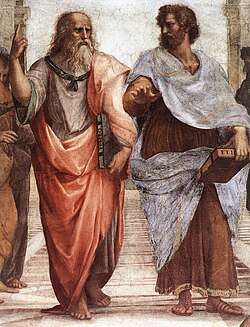
The topic of Aristotle's criticism of Plato's Theory of Forms is vast, and continues to expand. Rather than quote Plato, Aristotle often summarized. Classical commentaries thus recommended Aristotle as an introduction to Plato, even when in disagreement; the Platonist Syrianus used Aristotelian critiques to further refine the Platonic position on forms in use in his school, a position handed down to his student Proclus.32 As a historian of prior thought, Aristotle is invaluable; however, this was secondary to his own dialectic, and in some cases he treats purported implications as if Plato had actually mentioned them, or even defended them. For examining Aristotle's critiques, it is helpful to understand his own hylomorphic forms, by which he intended to salvage much of Plato's theory.
Aristotle argues that on the standard Platonic assumptions, as he sees them, it seems that Forms ought exist only for substances: Forms—being entities that exist separately and independently—are clearly (Aristotelian) substances, and whatever participates in such a Form must share in this substantiality. But many Platonic arguments, such as the "arguments from the sciences",o appear to militate in favor of Forms for many non-substantial entities as well—e.g., health is an object of study in the science of medicine, yet it is certainly not a substance.34
Given that Aristotle has accurately interpreted his predecessor's claims, Plato seems to have been caught in a contradiction: only substances have corresponding Forms—yet there are Forms that correspond to the objects of science, among which are many non-substances. Aristotle's critiques—here and elsewhere—proved highly influential, though scholars have differed as to whether, and to what degree, this criticism and its fellows are truly problematic for (Platonic) Forms; Scottish philosopher W. D. Ross, for example, objects that this is a mischaracterization of Plato,35 whereas Gail Fine finds Aristotle to be broadly correct.p
Plato did not claim to know where the line between Form and non-Form is to be drawn. As Cornford points out,36 those things about which the young Socrates (and Plato) asserted "I have often been puzzled about these things"25: 130c (in reference to Man, Fire, and Water) nevertheless appear as Forms in later works. However, others—such as hair, mud, and dirt—do not. Of these, Socrates is made to assert that "it would be too absurd to suppose" that they have Forms.
Ross35 also objects to Aristotle's criticism that the Form of Otherness accounts for the differences between Forms and, purportedly, leads to contradictory forms: the Not-Tall, the Not-Beautiful, etc. That particulars participate in Forms is, for Aristotle, much too vague to permit analysis; and, further, the Forms would—he argues—cease to be of one essence, due to multiple participation. As Ross indicates, however, Plato himself did not make the leap from "A is not B" to "A is Not-B"; Otherness would only apply to its own particulars, and not to those of other Forms. For example, there is no "Form of Not-Greek", only particulars of Otherness that somehow suppress the Form of Greek. Regardless of whether Socrates meant the particulars of Otherness to yield Not-Greek, Not-Tall, Not-Beautiful, etc., the particulars would operate specifically rather than generally, each somehow yielding only one exclusion.
Aristotle also developed arguments against Plato's epistemology, in regard to the latter's hypothesis that we know Forms through a remembrance of the soul's past lives.37
Scholastic criticism
Nominalism (from Latin nomen, "name") says that ideal universals are mere names, human creations; the blueness shared by sky and blue jeans is a shared concept, communicated by our word "blueness". Blueness is held not to have any existence beyond that which it has in instances of blue things.38 This concept arose in the Middle Ages,39 as part of Scholasticism.
Scholasticism was a highly multinational, polyglottal school of philosophy, and the nominalist argument may be more obvious if an example is given in more than one language. For instance, colour terms are strongly variable by language; some languages consider blue and green the same colour, others have monolexemic terms for several shades of blue, which are considered different; other languages, like the Mandarin qing denote both blue and black. The German word "Stift" means a pen or a pencil, and also anything of the same shape. The English "pencil" originally meant "small paintbrush"; the term later included the silver rod used for silverpoint. The German "Bleistift" and "Silberstift" can both be called "Stift", but this term also includes felt-tip pens, which are clearly not pencils.
The shifting and overlapping nature of these concepts makes it easy to imagine them as mere names, with meanings not rigidly defined, but specific enough to be useful for communication. Given a group of objects, how is one to decide if it contains only instances of a single Form, or several mutually exclusive Forms?
See also
See also
- Archetype
- As above, so below
- Correspondence
- Analogy of the Divided Line
- Divine embodiment
- Dmuta in Mandaeism
- Exaggerated realism
- Form of the Good
- Hyperuranion
- Idealism
- Jungian archetypes
- Map–territory relation
- Nominalism
- Plotinus
- Problem of universals
- Substantial form
- Synchronicity
- Platonic solid
- Plato's unwritten doctrines, for debates over Forms and Plato's higher, esoteric theories
- Realism (disambiguation)
- True form (Taoism)
Notes and references
Notes
- Modern English textbooks and translations prefer "theory of Form" to "theory of Ideas", but the latter has a long and respected tradition starting with Cicero and continuing in German philosophy until present, and some English philosophers prefer this in English too. See W. D. Ross, Plato's Theory of Ideas (1951).
- The name of this aspect of Plato's thought is not modern and has not been extracted from certain dialogues by modern scholars. However, it is attributed to Plato without any direct textual evidence that Plato himself holds the views of the speakers of the dialogues. The term was used at least as early as Diogenes Laërtius, who called it (Plato's) "Theory of Ideas": Πλάτων ἐν τῇ περὶ τῶν ἰδεῶν ὑπολήψει... "Plato". Lives of Eminent Philosophers. Vol. Book III. p. Paragraph 15.
- Plato uses many different words for what is traditionally called Form in English translations and Idea in German and Latin translations (Cicero). These include idéa, morphē, eîdos, and parádeigma, but also génos, phýsis, and ousía. He also uses expressions such as to x auto, "the x itself" or kath' auto "in itself". See Christian Schäfer: Idee/Form/Gestalt/Wesen, in Platon-Lexikon, Darmstadt 2007, p. 157.
- Possibly cognate with Sanskrit bráhman. See Thieme (1952): Bráhman, ZDMG, vol. 102, p. 128.ZDMG online..
- In Parmenides (130d3–5), Plato's Socrates denies that things such as mud or filth are worthy of Forms of their own, and speculates that these things are just as we see them—no more, no less. The question of exactly which entities reflect ideal Forms, and which do not, would remain an object of investigation for Plato's successors, both immediate and remote.
- These terms (viz., those here prefixed with a-) are not ancient. For the usage, refer to "a- (2)". (Online Etymology Dictionary). They are, however, customary terms of modern metaphysics; for example, see Beck, Martha C. (1999). Plato's Self-Corrective Development of the Concepts of Soul, Form and Immortality in Three Arguments of the Phaedo. Edwin Mellon Press. p. 148. ISBN 0-7734-7950-3. See also Hawley, Dr. Katherine (2001). How Things Persist. Oxford: Clarendon Press. Chapter 1. ISBN 0-19-924913-X.
- Space answers to matter, the place-holder of form: "... and there is a third nature [besides transcendent Form and sensible form], which is space [chōra], and is eternal [aei, 'always': certainly not atemporal], and admits not of destruction and provides a home for all created things ... we say of all existence that it must of necessity be in some place and occupy space ..." (Timaeus 52a–b). Some readers will have long since remembered that in Aristotle, time and space are accidental forms. Plato does not make this distinction, and concerns himself mainly with essential form. In Plato, if time and space were admitted to be Forms, time would be atemporal and space aspatial.
- Aristotle in Metaphysics Α987a.29–b.14 and Μ1078b9–32 says that Plato devised the Forms to answer a weakness in the doctrine of Heraclitus, who held that nothing exists, but everything is in a state of flow. If nothing exists then nothing can be known. It is possible that Plato took the Socratic search for definitions and extrapolated it into a distinct metaphysical theory. Little is known of the historical Socrates' own views, and the theory of Forms may be a Platonic innovation.
- In some unspecified way; Plato gives various metaphors for the mechanism, such as that of a paradigm vs. a copy thereof,25: 132d–133a 26: 28a–29b or the "stamping" of an image into a medium.26: 50c–51b.
- The name is from Aristotle, who says in Metaphysics A.IX.990b.15: "(The argument) they call the third man." A summary of the argument and the quote from Aristotle can be found in the venerable Grote, George (1880). "App I Aristotle's Objections to Plato's Theory". Aristotle: Second Edition with Additions. London: John Murray. pp. 559–560, note b. Grote points out that Aristotle lifted this argument from the Parmenides of Plato; certainly, his words indicate the argument was already well-known under that name.
- Analysis of the argument has been going on for quite a number of centuries now, and some analyses are complex, technical and perhaps tedious for the general reader. Those who are interested in the more technical analyses can find more of a presentation in Hales, Steven D. (1991). "The Recurring Problem of the Third Man" (PDF). Auslegung. 17 (1): 67–80. Archived from the original (PDF) on 26 September 2007. Retrieved 26 September 2007. and Durham, Michael (1997). "Two Men and the Third Man" (PDF). The Dualist: Undergraduate Journal of Philosophy (Stanford University). 4. Archived from the original (PDF) on 10 November 2014. Retrieved 23 October 2014.
- Plato to a large extent identifies that which is today called insight with recollection: "whenever on seeing one thing you conceived another, whether like or unlike, there must surely have been an act of recollection" (Phaedo 229). Thus, geometric reasoning on the part of persons who know no geometry is not insight, but recollection. Plato does, however, recognize the possibility of insight with regard to "the course of scrutiny": "... with a sudden flash there shines forth understanding about every problem ..." (The Seventh Letter 344b). Unfortunately, the intelligible world cannot be directly verified in the world of the senses, and so—from an empirical standpoint—its nature can be only a matter of speculation. Plato was aware of the problem: "How real existence is to be studied or discovered is, I suspect, beyond you and me." (Cratylus, 439.)
- One of the aforementioned pair of arguments seems to end in the conclusion that humans cannot obtain knowledge of the Forms (though the premisses from which the argument proceeds are somewhat obscure to the non-specialist; for details, see e.g. the SEP entry on the Parmenides).27 As recorded in the dialogue, Socrates appears to have been stymied by these objections; his later answer would be that men already know the Forms because they were in the world of Forms before birth—the objects and qualities of the sensible world only recall these Forms to memory.l
- See, e.g., the work of Rickless2930 and Meinwald.31
- In brief, these arguments aim to show that—because sensible particulars are in constant flux, obscured by various inessential features, too specific to be suitable as general causes, and so on—(scientific) knowledge requires that there be Forms; hence, given that science is clearly possible, Forms must in fact exist.33
- Though she writes that "Aristotle is right to say that the Arguments from the Sciences are invalid arguments for the existence of forms, if forms are taken to be non-sensible, everlasting, separate, perfect paradigms[...]", she also concludes that "[...] once we understand Aristotle's interpretative strategies, we can avoid saying that Aristotle either misinterprets or refutes Plato."33: 89, 102 (Emphasis added.)
References
- "Chapter 28: Form" of The Great Ideas: A Syntopicon of Great Books of the Western World (Vol. II). Encyclopædia Britannica (1952), pp. 526–542. This source states that Form or Idea get capitalized according to this convention when they refer "to that which is separate from the characteristics of material things and from the ideas in our mind". Thus, capitalization of the word "Idea" here is meant to show that it is a special technical term in philosophy, rather than the ordinary English word "idea".
- Meinwald, Constance C. (updated Sept. 2024). "Plato: Forms as perfect exemplars". Britannica.
- Watt, Stephen (1997). "Introduction: The Theory of Forms (Books 5–9)". Plato: Republic. London: Wordsworth Editions. pp. xiv–xvi. ISBN 1-85326-483-0.
- Kraut, Richard (2017), "Plato", in Zalta, Edward N. (ed.), The Stanford Encyclopedia of Philosophy (Fall 2017 ed.), Metaphysics Research Lab, Stanford University, retrieved 20 May 2021
- "*bhā-". American Heritage Dictionary: Fourth Edition: Appendix I. 2000.
- Morabito, Joseph; Sack, Ira; Bhate, Anilkumar (2018). Designing Knowledge Organizations: A Pathway to Innovation Leadership. Hoboken, NJ: John Wiley & Sons. p. 33. ISBN 9781118905845.
- Kidder, D. S. and Oppenheim, N. D. (2006), The Intellectual Devotional, p. 27, Borders Group, Inc, Ann Arbor, ISBN 978-1-60961-205-4.
- Cratylus 389: "For neither does every smith, although he may be making the same instrument for the same purpose, make them all of the same iron. The form must be the same, but the material may vary ...."
- For example, Timaeus 28a–b: "The work of the artificer, whenever he looks to the unchangeable and fashions the form and nature of his work after an unchangeable pattern, must necessarily be made fair and perfect ..."
- Bonazzi, Mauro (2013). "Universals Before Universals: Some Remarks on Plato in His Context". In Chiaradonna, Riccardo; Galluzzo, Gabriele (eds.). Universals in Ancient Philosophy. Pisa: Edizioni della Normale. pp. 23–40.
- Mammino, Liliana; Ceresoli, Davide; Maruani, Jean; Brändas, Erkki (2020). Advances in Quantum Systems in Chemistry, Physics, and Biology: Selected Proceedings of QSCP-XXIII (Kruger Park, South Africa, September 2018). Cham, Switzerland: Springer Nature. p. 355. ISBN 978-3-030-34940-0.
- Plato. Phaedo.
- The creation of the universe is the creation of time: "For there were no days and nights and months and years ... but when he (God) constructed the heaven, he created them also." (Timaeus 37d–e.) For the creation God used "the pattern of the unchangeable," which is "that which is eternal" (Tim. 29a). Therefore, "eternal" (to aïdion, "the everlasting"), as applied to Form, means "atemporal".
- For example, Theaetetus 185d–e: "...the mind in itself is its own instrument for contemplating the common terms that apply to everything." "Common terms" here refers to existence, non-existence, likeness, unlikeness, sameness, difference, unity, and number.
- I.e., doxa; see e.g. Republic V.479d–480a.
- Phaedrus 247c ff.
- "No sensible man would insist that these things are as I have described them..." (Phd. 114d).
- "There is no Platonic 'elsewhere', similar to the Christian 'elsewhere'." (Iris Murdoch, "Metaphysics as a Guide to Morals" (London, Chatto & Windus 1992) 399).
- Silverman, Allan (2022), "Plato's Middle Period Metaphysics and Epistemology", in Zalta, Edward N.; Nodelman, Uri (eds.), The Stanford Encyclopedia of Philosophy (Fall 2022 ed.), Metaphysics Research Lab, Stanford University, retrieved 10 February 2023
- Sedley, David (2024), Betegh, Gábor; Tsouna, Voula (eds.), "Are Platonic Forms Concepts?", Conceptualising Concepts in Greek Philosophy, Cambridge: Cambridge University Press, pp. 74–95, doi:10.1017/9781009369596.007, ISBN 978-1-009-36959-6, retrieved 18 May 2026
{{citation}}: CS1 maint: work parameter with ISBN (link) - Chiaradonna, Riccardo; Galluzzo, Gabriele, eds. (2013). Universals in Ancient Philosophy. Pisa: Edizioni della Normale.
- Cratylus, paragraph 440.
- Kidder, D. S. and Oppenheim, N. D, (2006), The Intellectual Devotional, p. 27, Borders Group, Inc, Ann Arbor. ISBN 978-1-60961-205-4
- Plato, Cratylus 389.
- Plato. Parmenides.
- Plato. Timaeus.
- Rickless, Samuel (2026), Zalta, Edward N.; Nodelman, Uri (eds.), "Plato's Parmenides", The Stanford Encyclopedia of Philosophy (Spring 2026 ed.), Metaphysics Research Lab, Stanford University, retrieved 18 May 2026
- Plato, Republic X.597c1–d3.
- Rickless, Samuel C. (1998). "How Parmenides Saved the Theory of Forms". The Philosophical Review. 107 (4): 501–554. doi:10.2307/2998374. ISSN 0031-8108.
- Rickless, Samuel C. (2006). Plato's Forms in Transition: A Reading of the Parmenides. Cambridge: Cambridge University Press. doi:10.1017/CBO9780511482618. ISBN 978-0-521-86456-5.
- Meinwald, Constance C. (1992), Kraut, Richard (ed.), "Good-bye to the Third Man", The Cambridge Companion to Plato, Cambridge Companions to Philosophy, Cambridge: Cambridge University Press, pp. 365–396, doi:10.1017/CCOL0521430186.012, ISBN 978-1-139-00057-4, retrieved 18 May 2026
{{citation}}: CS1 maint: work parameter with ISBN (link) - Syrianus (2006). O'Meara, Dominic J.; Dillon, John M. (eds.). On Aristotle's Metaphysics 13–14. Bloomsbury Academic Press. ISBN 9780801445323.
- Fine, Gail (24 August 1995). "5. The Arguments from the Sciences: Forms and Knowledge". On Ideas. Oxford University Press. pp. 66–80. doi:10.1093/0198235496.003.0005. ISBN 978-0-19-823549-1.
- See Metaphysics I, 990b9–17, for Aristotle's summary of these issues; the "arguments from the sciences" are laid out more fully in (what is very likely) his work On Ideas, though this text has—unfortunately—come down to us only fragmentarily. Socrates makes similar arguments in, e.g., Euthyphro 5–6 and Meno 71–74; these arguments may also be related to the "argument from knowledge" (for which see, most notably, Republic V.476c–480a).
- Ross, Chapter XI, initial.
- Pp. 82–83.
- Aristotle. Metaphysics. Vol. III. 999a ff.
- Borghini, Andrea (22 March 2018). "The Debate Between Nominalism and Realism". ThoughtCo.
- Rodriguez-Pereyra, Gonzalo (2019). "Nominalism in Metaphysics". The Stanford Encyclopedia of Philosophy. Metaphysics Research Lab, Stanford University.
Primary sources
Dialogues that discuss Forms
- Meno: 71–81, 85–86: The discovery (or "recollection") of knowledge as latent in the soul, pointing forward to the theory of Forms
- Phaedo
- 73–80: The theory of recollection restated as knowledge of the Forms in soul before birth in the body,109–111: The myth of the afterlife, 100c: The theory of absolute beauty
- Symposium: 210–211: The archetype of Beauty.
- Phaedrus: 248–250: Reincarnation according to knowledge of the true, 265–266: The unity problem in thought and nature.
- Cratylus: 389–390: The archetype as used by craftsmen, 439–440: The problem of knowing the Forms.
- Theaetetus: 184–186: Universals understood by mind and not perceived by senses.
- Sophist: 246–259: True essence a Form. Effective solution to participation problem. The problem with being as a Form; if it is participatory then non-being must exist and be being.
- Parmenides: 129–135: Participatory solution of unity problem. Things partake of archetypal like and unlike, one and many, etc. The nature of the participation (Third man argument). Forms not actually in the thing. The problem of their unknowability.
- Republic
- Book III: 402–403: Education the pursuit of the Forms.
- Book V: 472–483: Philosophy the love of the Forms. The philosopher-king must rule.
- Books VI–VII: 500–517: Philosopher-guardians as students of the Beautiful and Just implement archetypical order, Metaphor of the Sun: The sun is to sight as Good is to understanding, Allegory of the Cave: The struggle to understand forms like men in cave guessing at shadows in firelight.
- Books IX–X, 589–599: The ideal state and its citizens. Extensive treatise covering citizenship, government and society with suggestions for laws imitating the Good, the True, the Just, etc. Metaphor of the three beds.
- Timaeus: 27–52: The design of the universe, including numbers and physics. Some of its patterns. Definition of matter.
- Philebus: 14–18: Unity problem: one and many, parts and whole.
- Seventh Letter: 342–345: The epistemology of Forms. The Seventh Letter is possibly spurious.
Bibliography
Bibliography
- Alican, Necip Fikri; Thesleff, Holger (2013). "Rethinking Plato's Forms". Arctos: Acta Philologica Fennica. 47: 11–47. doi:10.71390/arctos.85075. ISSN 0570-734X.
- Alican, Necip Fikri (2014). "Rethought Forms: How Do They Work?". Arctos: Acta Philologica Fennica. 48: 25–55. doi:10.71390/arctos.85056. ISSN 0570-734X.
- Cornford, Francis MacDonald (1957). Plato and Parmenides. New York: The Liberal Arts Press.
- Dancy, Russell (2004). Plato's Introduction of Forms. Cambridge: Cambridge University Press. ISBN 978-0-521037-18-1.
{{cite book}}: CS1 maint: publisher location (link) - Fine, Gail (1993). On Ideas: Aristotle's Criticism of Plato's Theory of Forms. Oxford: Oxford University Press. ISBN 978-0-198235-49-1. OCLC 191827006.
{{cite book}}: CS1 maint: publisher location (link) Reviewed by Gerson, Lloyd P (1993). "Gail Fine, On Ideas. Aristotle's Criticism of Plato's Theory of Forms". Bryn Mawr Classical Review. - Fine, Gail (2003). Plato on Knowledge and Forms: Selected Essays. Oxford: Clarendon Press. ISBN 978-0-199245-59-8.
{{cite book}}: CS1 maint: publisher location (link) - Grabowski, Francis A. III (2008). Plato, Metaphysics and the Forms. Continuum Studies in Ancient Philosophy. Continuum.
- Matía Cubillo, Gerardo Óscar (2021). "Suggestions on How to Combine the Platonic Forms to Overcome the Interpretative Difficulties of the Parmenides Dialogue", Revista de Filosofía de la Universidad de Costa Rica, vol. 60, 156: 157–171.
- Patterson, Richard (1985). Image and Reality in Plato's Metaphysics. Indianapolis: Hackett Publishing Company. ISBN 978-0-915145-72-0.
{{cite book}}: CS1 maint: publisher location (link) - Rodziewicz, Artur (2012). IDEA AND FORM. ΙΔΕΑ ΚΑΙ ΕΙΔΟΣ. On the Foundations of the Philosophy of Plato and the Presocratics (IDEA I FORMA. ΙΔΕΑ ΚΑΙ ΕΙΔΟΣ. O fundamentach filozofii Platona i presokratyków). Wroclaw: WUWR.
- Ross, William David (1951). Plato's Theory of Ideas. Oxford: Clarendon Press. ISBN 978-0-837186-35-1.
{{cite book}}: ISBN / Date incompatibility (help)CS1 maint: publisher location (link) - Thesleff, Holger (2009). Platonic Patterns: A Collection of Studies by Holger Thesleff. Las Vegas: Parmenides Publishing. ISBN 978-1-930972-29-2.
{{cite book}}: CS1 maint: publisher location (link) - Welton, William A., ed. (2002). Plato's Forms: Varieties of Interpretation. Lanham: Rowman & Littlefield. ISBN 978-0-7391-0514-6.
External links
External links
- . Encyclopædia Britannica (11th ed.). 1911.
- Cohen, Marc (2006). "Theory of Forms". Philosophy 320: History of Ancient Philosophy. University of Washington Philosophy Department.
- "Lesson Three: Plato's Theory of Forms". International Catholic University.
- Ruggiero, Tim (July 2002). "Plato And The Theory of Forms". philosophical society.com.
- Silverman, Allan. "Plato's Middle Period Metaphysics and Epistemology". In Zalta, Edward N. (ed.). Stanford Encyclopedia of Philosophy. ISSN 1095-5054. OCLC 429049174.
- Balaguer, Mark. "Platonism in Metaphysics". In Zalta, Edward N. (ed.). Stanford Encyclopedia of Philosophy. ISSN 1095-5054. OCLC 429049174.