The Byrds | |
|---|---|
 | |
| Background information | |
| Origin | Los Angeles, California, U.S. |
| Genres | |
| Years active |
|
| Labels | |
| Spinoffs | |
| Spinoff of |
|
| Past members | Roger McGuinn Gene Clark David Crosby Michael Clarke Chris Hillman Kevin Kelley Gram Parsons Clarence White Gene Parsons John York Skip Battin |
| Website | thebyrds |
The Byrds (/bɜːrdz/ BURDZ) were an American rock band formed in Los Angeles, California, in 1964.1 The band underwent multiple lineup changes; frontman Roger McGuinn (known as Jim McGuinn until mid-1967) was the sole consistent member.2 For a short time in the mid-1960s, the Byrds were among the most popular groups in the world, with critics considering them to be among the most influential rock acts of their era.134 The band's signature sound of "angelic harmonies" and McGuinn's jangly 12-string Rickenbacker guitar sound was "absorbed into the vocabulary of rock" and has continued to be influential.15
Initially, the Byrds pioneered the musical genre of folk rock as a popular format in 1965 by melding the influence of the Beatles and other British Invasion bands with contemporary and traditional folk music on their first and second albums and the hit singles "Turn! Turn! Turn!" and "Mr. Tambourine Man".6789 As the 1960s progressed, the band was influential in originating psychedelic rock and raga rock, with their song "Eight Miles High" (1966) and the albums Fifth Dimension (1966), Younger Than Yesterday (1967), and The Notorious Byrd Brothers (1968).11011 The band also helped pioneer country rock,1 particularly with the 1968 album Sweetheart of the Rodeo.12
The band's original five-piece lineup consisted of McGuinn (lead guitar, vocals), Gene Clark (tambourine, vocals), David Crosby (rhythm guitar, vocals), Michael Clarke (drums), and Chris Hillman (bass guitar, vocals).13 In early 1966, Clark left due to anxiety and his increasing isolation within the group.14 The Byrds continued as a quartet until late 1967, when Crosby and Clarke departed.15 McGuinn and Hillman recruited new members, including country rock pioneer Gram Parsons, but by late 1968, Hillman and Parsons had also left the band.1 McGuinn rebuilt a new version of the Byrds that featured guitarist Clarence White among others.1 McGuinn disbanded that iteration of the band in early 1973 to make way for a reunion of the original quintet.16 The Byrds released their final album in March 1973, with the reunited group disbanding later that year.17
Several members of the Byrds went on to successful careers as solo artists or as members of such groups as Crosby, Stills, Nash & Young, the Flying Burrito Brothers, McGuinn, Clark & Hillman, and the Desert Rose Band.1 In 1991, the Byrds were inducted into the Rock and Roll Hall of Fame in a ceremony that saw the five original members perform together for the last time.1819 Gene Clark died of a heart attack later that year,20 while Michael Clarke died of liver failure in 1993.21 Crosby died in 2023.22 McGuinn and Hillman remain musically active.
History
Formation (1964)
McGuinn and I started picking together in The Troubadour bar which was called The Folk Den at the time ... We went into the lobby and started picking on the stairway where the echo was good and David came walking up and just started singing away with us doing the harmony part ... We hadn't even approached him.
The nucleus of the Byrds formed in early 1964, when Jim McGuinn, Gene Clark, and David Crosby came together as a trio.24 All three musicians had a background rooted in folk music, with each one having worked as a folk singer on the acoustic coffeehouse circuit during the early 1960s.1 In addition, they had all served time—independently of each other—as sidemen in various "collegiate folk" groups: McGuinn with the Limeliters and the Chad Mitchell Trio, Clark with the New Christy Minstrels, and Crosby with Les Baxter's Balladeers.252627 McGuinn had also spent time as a professional songwriter at the Brill Building in New York City, under the tutelage of Bobby Darin.28 By early 1964, McGuinn had become enamored with the music of the Beatles, and had begun to intersperse his solo folk repertoire with acoustic versions of Beatles' songs.24 While performing at the Troubadour folk club in Los Angeles, McGuinn was approached by fellow Beatles fan Gene Clark, and the pair soon formed a Peter and Gordon-style duo, playing Beatles' covers, Beatlesque renditions of traditional folk songs, and some self-penned material.12429 Soon after, David Crosby introduced himself to the duo at The Troubadour and began harmonizing with them on some of their songs.23 Impressed by the blend of their voices, the three musicians formed a trio and named themselves the Jet Set, a moniker inspired by McGuinn's love of aeronautics.23
Crosby introduced McGuinn and Clark to his associate Jim Dickson, who had access to World Pacific Studios, where he had been recording demos of Crosby.23 Sensing the trio's potential, Dickson quickly took on management duties for the group, while his business partner, Eddie Tickner, became the group's accountant and financial manager.2330 Dickson began utilizing World Pacific Studios to record the trio as they honed their craft and perfected their blend of Beatles pop and Bob Dylan-style folk.3132 It was during the rehearsals at World Pacific that the band's folk rock sound—an amalgam of their own Beatles-influenced material, their folk music roots and their Beatlesque covers of contemporary folk songs—began to coalesce.32 Initially, this blend arose organically, but as rehearsals continued, the band began to actively attempt to bridge the gap between folk music and rock.2333 Demo recordings made by the Jet Set at World Pacific Studios were later collected on the compilation albums Preflyte, In the Beginning, The Preflyte Sessions, and Preflyte Plus.
Drummer Michael Clarke joined the Jet Set in mid-1964.34 Clarke was recruited largely due to his good looks and Brian Jones-esque hairstyle, rather than for his musical experience, which was limited to having played congas in a semi-professional capacity in and around San Francisco and L.A.35 Clarke did not even own his own drum kit and initially had to play on a makeshift setup consisting of cardboard boxes and a tambourine.35 As the band continued to rehearse, Dickson arranged a one-off single deal for the group with Elektra Records' founder Jac Holzman.14 The single, which coupled the band originals "Please Let Me Love You" and "Don't Be Long", featured McGuinn, Clark, and Crosby, augmented by session musicians Ray Pohlman on bass and Earl Palmer on drums.14 In an attempt to cash in on the British Invasion craze that was dominating the American charts at the time, the band's name was changed for the single release to the suitably British-sounding the Beefeaters.14 "Please Let Me Love You" was issued by Elektra Records on October 7, 1964, but it failed to chart.36

In August 1964, Dickson managed to acquire an acetate disc of the then-unreleased Bob Dylan song "Mr. Tambourine Man", which he felt would make an effective cover for the Jet Set.3437 Although the band was initially unimpressed with the song, they began rehearsing it with a rock band arrangement, changing the time signature from 2
4 to a rockier 4
4 configuration in the process.3738 In an attempt to bolster the group's confidence in the song, Dickson invited Dylan himself to World Pacific to hear the band perform "Mr. Tambourine Man".37 Impressed by the group's rendition, Dylan enthusiastically commented, "Wow, man! You can dance to that!"37 His ringing endorsement erased any lingering doubts that the band had over the song's suitability.37
Soon after, inspired by the Beatles' film A Hard Day's Night, the band decided to equip themselves with similar instruments to the Fab Four: a Rickenbacker twelve-string guitar for McGuinn, a Ludwig drum kit for Clarke, and a Gretsch Tennessean guitar for Clark (although Crosby commandeered it soon after, resulting in Clark switching to tambourine).3439 In October 1964, Dickson recruited mandolin player Chris Hillman as the Jet Set's bassist.40 Hillman's background was more oriented towards country music than folk or rock, having been a member of the bluegrass groups the Scottsville Squirrel Barkers, the Hillmen (also known as the Golden State Boys), and, concurrently with his recruitment into the Jet Set, the Green Grass Group.4142
Through connections that Dickson had with impresario Benny Shapiro, and with a helpful recommendation from jazz trumpeter Miles Davis, the group signed a recording contract with Columbia Records on November 10, 1964. Two weeks later, during a Thanksgiving dinner at Tickner's house, the Jet Set decided to rename themselves as the Byrds, a moniker that retained the theme of flight and also echoed the deliberate misspelling of the Beatles.4344
Folk rock (1965)
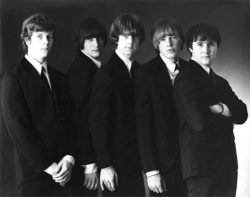
On January 20, 1965, the Byrds entered Columbia Studios in Hollywood to record "Mr. Tambourine Man" for release as their debut single on Columbia.3645 Since the band had not yet completely gelled musically, McGuinn was the only Byrd to play on "Mr. Tambourine Man" and its Clark-penned B-side, "I Knew I'd Want You".43 Rather than using band members, producer Terry Melcher hired a collection of top session musicians, retroactively known as the Wrecking Crew, including Hal Blaine (drums), Larry Knechtel (bass), Jerry Cole (guitar), Bill Pitman (guitar), and Leon Russell (electric piano), who (along with McGuinn on guitar) provided the instrumental backing track over which McGuinn, Crosby and Clark sang.434647 By the time the sessions for their debut album began in March 1965, Melcher was satisfied that the band was competent enough to record its own musical backing.46 The use of outside musicians on the Byrds' debut single has given rise to the persistent misconception that all of the playing on their debut album was done by session musicians.1
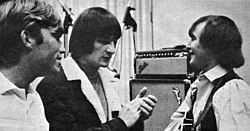
On March 21, 1965, while the band waited for "Mr. Tambourine Man" to be released, they began a residency at Ciro's Le Disc nightclub on the Sunset Strip in Hollywood.48 The band's regular appearances at Ciro's in March and April allowed them to hone their ensemble playing, perfect their aloof stage persona, and expand their repertoire.4849 It was during their residency at the nightclub that the band first began to accrue a dedicated following among L.A.'s youth culture and hip Hollywood fraternity, with scenesters like Kim Fowley, Peter Fonda, Jack Nicholson, Arthur Lee, and Sonny & Cher regularly attending the band's performances.505152 On March 26, the author of the band's forthcoming debut single, Bob Dylan, made an impromptu visit to the club and joined the Byrds on stage for a rendition of Jimmy Reed's "Baby What You Want Me to Do".48 The excitement generated by the Byrds at Ciro's quickly made them a must-see fixture on L.A.'s nightclub scene and resulted in hordes of teenagers filling the sidewalks outside the club, desperate to see the band perform.48 A number of noted music historians and authors, including Richie Unterberger, Ric Menck, and Peter Buckley, have suggested that the crowds of young Bohemians and hipsters that gathered at Ciro's to see the Byrds perform represented the first stirrings of the West Coast hippie counterculture.134953

Columbia Records eventually released the "Mr. Tambourine Man" single on April 12, 1965.36 The full, electric rock band treatment that the Byrds and producer Terry Melcher had given the song effectively created the template for the musical subgenre of folk rock.5455 McGuinn's melodic, jangling 12-string Rickenbacker guitar playing—which was heavily compressed to produce an extremely bright and sustained tone—was immediately influential and has remained so to the present day.4556 The single also featured another major characteristic of the band's sound: their clear harmony singing, which usually featured McGuinn and Clark in unison, with Crosby providing the high harmony.5157 Richie Unterberger has stated that the song's abstract lyrics took rock and pop songwriting to new heights; never before had such intellectual and literary wordplay been combined with rock instrumentation by a popular music group.58
Within three months "Mr. Tambourine Man" had become the first folk rock smash hit,59 reaching number 1 on both the U.S. Billboard Hot 100 chart and the UK Singles Chart.6061 The single's success initiated the folk rock boom of 1965 and 1966, during which a number of Byrds-influenced acts had hits on the American and British charts.658 The term "folk rock" was itself coined by the American music press to describe the band's sound in June 1965, at roughly the same time as "Mr. Tambourine Man" peaked at number 1 in the U.S.6263
The Mr. Tambourine Man album followed on June 21, 1965,36 peaking at number six on the Billboard Top LPs chart and number seven on the UK Albums Chart.6164 The album mixed reworkings of folk songs, including Pete Seeger's musical adaptation of the Idris Davies' poem "The Bells of Rhymney", with a number of other Dylan covers and the band's own compositions, the majority of which were written by Clark.638 In particular, Clark's "I'll Feel a Whole Lot Better" has gone on to become a rock music standard, with many critics considering it one of the band's and Clark's best songs.656667 Upon release, the Mr. Tambourine Man album, like the single of the same name, was influential in popularizing folk rock8 and served to establish the band as an internationally successful rock act, representing the first effective American challenge to the dominance of the Beatles and the British Invasion.146
The Byrds' next single was "All I Really Want to Do", another interpretation of a Dylan song.68 Despite the success of "Mr. Tambourine Man", the Byrds were reluctant to release another Dylan-penned single, feeling that it was too formulaic, but Columbia Records were insistent, believing that another Dylan cover would result in an instant hit for the group.68 The Byrds' rendition of "All I Really Want to Do" is noticeably different in structure to Dylan's original: it features an ascending melody progression in the chorus and uses a completely new melody for one of the song's verses, to turn it into a Beatlesque, minor-key bridge.69 Issued on June 14, 1965, while "Mr. Tambourine Man" was still climbing the U.S. charts, the single was rush-released by Columbia in an attempt to bury a rival cover version that Cher had released simultaneously on Imperial Records.6870 A chart battle ensued, but the Byrds' rendition stalled at number 40 on the Billboard Hot 100, while Cher's version reached number 15.70 The reverse was true in the UK, where the Byrds' version reached number 4, while Cher's peaked at number 9.71
Author John Einarson has written that during this period of their career, the Byrds enjoyed tremendous popularity among teenage pop fans, with their music receiving widespread airplay on Top 40 radio and their faces adorning countless teen magazines.3 Much was made at the time of the Byrds' unconventional dress sense, with their casual attire strikingly at odds with the prevailing trend for uniformity among contemporary beat groups.72 With all five members sporting Beatlesque moptop haircuts, Crosby dressed in a striking green suede cape, and McGuinn wearing a pair of distinctive rectangular "granny glasses", the band exuded California cool, while also looking suitably non-conformist.727374 In particular, McGuinn's distinctive rectangular spectacles became popular among members of the burgeoning hippie counterculture in the United States.75
Although McGuinn was widely regarded as the Byrds' bandleader by this point, the band actually had multiple frontmen, with McGuinn, Clark, and later Crosby and Hillman all singing lead vocals in roughly equal measures across the group's repertoire. Despite the dizzying array of personnel changes that the group underwent in later years, this lack of a dedicated lead singer remained a stylistic trait of the Byrds' music throughout the majority of the band's existence.
A further distinctive aspect of the Byrds' image was their unsmiling air of detachment, both on stage and in front of the camera.7274 This natural aloofness was compounded by the large amounts of marijuana that the band smoked and often resulted in moody and erratic live performances.7276 The contemporary music press was extremely critical of the Byrds' abilities as a live act during the mid-1960s, with the reception from the British media during the band's August 1965 tour of England being particularly scathing.377
We got there and they expected a professional thing and we weren't ready for it. I mean, some of us had been professional in one capacity or another, but never as a group.
I got sick, I had like a hundred and three something fever ... So I'm lying on a couch or something there and everybody's going crazy – nobody has any organization anymore ... everybody quit right there and said, "I quit, I'm going home," you know. Anyway, it all got back together.
This 1965 English tour was largely orchestrated by the group's publicist Derek Taylor, in an attempt to capitalize on the number 1 chart success of the "Mr. Tambourine Man" single.3 The tour was overhyped from the start, with the band being touted as "America's answer to the Beatles", a label that proved impossible for the Byrds to live up to.3 During concert performances, a combination of poor sound, group illness, ragged musicianship, and the band's notoriously lackluster stage presence all combined to alienate audiences and served to provoke a merciless castigating of the band in the British press.3

The tour enabled the band to meet and socialize with a number of top English groups, including the Rolling Stones and the Beatles.3 In particular, the band's relationship with the Beatles would prove important for both acts, with the two groups again meeting in Los Angeles some weeks later, upon the Byrds' return to America.3 During this period of fraternization, the Beatles were vocal in their support of the Byrds, publicly acknowledging them as creative competitors and naming them as their favorite American group.7980 A number of authors, including Ian MacDonald, Richie Unterberger, and Bud Scoppa, have commented on the Byrds influence on the Beatles' late 1965 album Rubber Soul,81 most notably on the songs "Nowhere Man"82 and "If I Needed Someone", the latter of which utilizes a guitar riff similar to that in the Byrds' cover of "The Bells of Rhymney".83
For their third Columbia single, the Byrds initially intended to release a cover of Dylan's "It's All Over Now, Baby Blue" (it was even premiered on the California radio station KRLA),84 but instead they decided to record "Turn! Turn! Turn! (to Everything There Is a Season)", a Pete Seeger composition with lyrics adapted almost entirely from the biblical Book of Ecclesiastes.857 The song was brought to the group by McGuinn, who had previously arranged it in a chamber-folk style while working on folk singer Judy Collins' 1963 album, Judy Collins 3.7 The Byrds' cover of "Turn! Turn! Turn! (to Everything There Is a Season)" was issued on October 1, 1965,36 and became the band's second U.S. number-1 single, as well as the title track for their second album.7 The single represented the high-water mark of folk rock as a chart trend and has been described by music historian Richie Unterberger as "folk rock's highest possible grace note".86 Music critic William Ruhlmann has written that the song's lyrical message of peace and tolerance struck a nerve with the American record buying public as the Vietnam War continued to escalate.7

The Byrds' second album, Turn! Turn! Turn!, was released in December 196587 and while it received a mostly positive reception, critical consensus deemed it to be inferior to the band's debut.88 Irrespective of the critics' opinions, the album was a commercial success, peaking at number 17 on the U.S. charts and number 11 in the UK.88 Author Scott Schinder has stated that Turn! Turn! Turn!, along with Mr. Tambourine Man, served to establish the Byrds as one of rock music's most important creative forces, on a par with the Beatles, the Beach Boys and the Rolling Stones.89 Like their debut, the album comprised a mixture of group originals, folk songs, and Bob Dylan covers, all characterized by the group's clear harmonies and McGuinn's distinctive guitar sound.90 The album featured more of the band's own compositions than its predecessor, with Clark in particular coming to the fore as a songwriter.91 His songs from this period, including "She Don't Care About Time", "The World Turns All Around Her", and "Set You Free This Time", are widely regarded by critics as among the best of the folk rock genre.9293 The latter song was even chosen for release as a single in January 1966, but its densely worded lyrics, melancholy melody, and ballad-like tempo contributed to it stalling at number 63 on the Billboard chart and failing to reach the UK chart altogether.9495
While the Byrds outwardly seemed to be riding the crest of a wave during the latter half of 1965, the recording sessions for their second album had not been without tension. One source of conflict was the power struggle that had begun to develop between producer Melcher and the band's manager, Jim Dickson, with the latter harboring aspirations to produce the band himself, causing him to be overly critical of the former's work.96 Within a month of Turn! Turn! Turn! being released, Dickson and the Byrds approached Columbia Records and requested that Melcher be replaced, despite the fact that he had successfully steered the band through the recording of two number 1 singles and two hit albums.96 Any hopes that Dickson had of being allowed to produce the band himself were dashed when Columbia assigned their West Coast head of A&R, Allen Stanton, to the band.8996
Psychedelia (1965–1967)
On December 22, 1965, the Byrds recorded a new, self-penned composition titled "Eight Miles High" at RCA Studios in Hollywood.97 Columbia Records refused to release this version because it had been recorded at another record company's facility.98 As a result, the band was forced to re-record the song at Columbia Studios in Los Angeles on January 24 and 25, 1966. This re-recorded version was released as a single and included on the group's third album.99100 The song represented a creative leap forward for the band101 and is often considered the first full-blown psychedelic rock recording by critics, although other contemporaneous acts, such as Donovan and the Yardbirds, were also exploring similar musical territory.102103104 It was also pivotal in transmuting folk rock into the new musical forms of psychedelia and raga rock.105106
"Eight Miles High" is marked by McGuinn's groundbreaking lead guitar playing, which saw the guitarist attempting to emulate the free form jazz saxophone playing of John Coltrane, and in particular, Coltrane's playing on the song "India" from his Impressions album.105 It also exhibits the influence of the Indian classical music of Ravi Shankar in the droning quality of the song's vocal melody and in McGuinn's guitar playing.107108 The song's subtle use of Indian influences resulted in it being labeled as "raga rock" by the music press, but in fact, it was the single's B-side, "Why", that drew more directly on Indian ragas.105107

Upon release, "Eight Miles High" was banned by many U.S. radio stations, following allegations made by the broadcasting trade journal the Gavin Report that its lyrics advocated recreational drug use.109 The band and their management strenuously denied these allegations, stating that the song's lyrics actually described an airplane flight to London and the band's subsequent concert tour of England.109 The relatively modest chart success of "Eight Miles High" (number 14 in the U.S. and number 24 in the UK) has been largely attributed to the broadcasting ban, although the challenging and slightly uncommercial nature of the track is another possible reason for its failure to reach the Top 10.105109110
In February 1966, just prior to the release of "Eight Miles High", Gene Clark left the band.111 His departure was partly due to his fear of flying, which made it impossible for him to keep up with the Byrds' itinerary, and partly due to his increasing isolation within the band.112 Clark, who had witnessed a fatal airplane crash as a youth, had a panic attack on a plane bound for New York and as a result, he disembarked and refused to take the flight.113 In effect, Clark's exit from the plane represented his exit from the Byrds, with McGuinn telling him, "If you can't fly, you can't be a Byrd."112 It has become known in the years since the incident that there were other stress and anxiety-related factors at work, as well as resentment within the band that Gene's songwriting income had made him the wealthiest member of the group.112113 Clark was subsequently signed by Columbia Records as a solo artist and went on to produce a critically acclaimed but commercially unsuccessful body of work.114 He died on May 24, 1991, at the age of 46, from heart failure brought on by a bleeding stomach ulcer, although years of alcohol abuse and heavy cigarette smoking were also contributing factors.20114115
The Byrds' third album, Fifth Dimension, was released in July 1966.116 Much of the album's material continued to build on the band's new psychedelic sound, with McGuinn extending his exploration of jazz and raga styles on tracks such as "I See You" and the Crosby-penned "What's Happening?!?!".100 The album also saw Hillman coming forward as the band's third vocalist, to fill the hole in the group's harmonies that Clark's departure had left.100 The title track, "5D (Fifth Dimension)", was released as a single ahead of the album and was, like "Eight Miles High" before it, banned by a number of U.S. radio stations for supposedly featuring lyrics that advocated drug use.117118 The album's front cover artwork featured the first appearance of the Byrds' colorful, psychedelic mosaic logo, variations of which would subsequently appear on a number of the band's compilation albums, as well as on their 1967 release, Younger Than Yesterday.119
The Fifth Dimension album received a mixed critical reception upon release118 and was less commercially successful than its predecessors, peaking at number 24 in the U.S. and number 27 in the UK.6164 Band biographer Bud Scoppa has remarked that with the album's lackluster chart performance, its lukewarm critical reception, and the high-profile loss of Clark from the group, the Byrds' popularity began to wane at this point and by late 1966, the group had been all but forgotten by the mainstream pop audience.120 Despite this, the band were considered forefathers of the emerging rock underground, with many of the new L.A. and San Francisco groups of the day, including Love, Jefferson Airplane, and Buffalo Springfield, publicly naming the Byrds as a primary influence.121

The band returned to the studio between November 28 and December 8, 1966, to record their fourth album, Younger Than Yesterday.122 With Allen Stanton having recently departed Columbia Records to work for A&M, the band chose to bring in producer Gary Usher to help guide them through the album sessions. Usher, who had a wealth of production experience and a love of innovative studio experimentation, would prove invaluable to the Byrds as they entered their most creatively adventurous phase.123 The first song to be recorded for the album was the McGuinn and Hillman-penned "So You Want to Be a Rock 'n' Roll Star", a satirical and heavily sarcastic jibe at the manufactured nature of groups like the Monkees.124125 The song features the trumpet playing of South African musician Hugh Masekela and, as such, marks the first appearance of brass on a Byrds' recording.126 "So You Want to Be a Rock 'n' Roll Star" was issued as a single in January 1967 and peaked at number 29 in America but failed to chart in the UK.127 Despite this relatively poor chart showing, "So You Want to Be a Rock 'n' Roll Star" has become one of the Byrds' best-known songs in the years since its initial release, inspiring cover versions by the likes of Tom Petty and the Heartbreakers and the Patti Smith Group among others.128129

Released on February 6, 1967, the Byrds' fourth album, Younger Than Yesterday, was more varied than its predecessor and saw the band successfully mixing psychedelia with folk rock and country and western influences.130 Although it received generally positive reviews upon its release, the album was, to a degree, overlooked by the record-buying public and consequently peaked at number 24 on the Billboard chart and number 37 on the UK Albums Chart.127130 Music expert Peter Buckley has pointed out that although the album may have passed the Byrds' rapidly shrinking teen audience by, it found favor with "a new underground following who disdained hit singles, but were coming to regard albums as major artistic statements".13
In addition to "So You Want to Be a Rock 'n' Roll Star", Younger Than Yesterday also includes the evocative Crosby and McGuinn penned song "Renaissance Fair", a cover of Dylan's "My Back Pages" (which was later released as a single), and a quartet of Chris Hillman songs, which found the bassist emerging fully formed as an accomplished songwriter.126130 Two of Hillman's country-oriented compositions on the album, "Time Between" and "The Girl with No Name", can be seen as early indicators of the country rock direction that the band would pursue on later albums.126 Younger Than Yesterday also features the jazz-tinged Crosby ballad "Everybody's Been Burned", which critic Thomas Ward has described as "one of the most haunting songs in the Byrds' catalogue, and one of David Crosby's finest compositions".131
By mid-1967, McGuinn had changed his first name from Jim to Roger as a result of his interest in the Indonesian religion Subud, into which he had been initiated in January 1965.132 The adoption of a new name was common among followers of the religion133 and served to signify a spiritual rebirth for the participant. Shortly after McGuinn's name change, the band entered the studio to record the Crosby-penned, non-album single "Lady Friend", which was released on July 13, 1967.134 The Byrds' biographer Johnny Rogan has described "Lady Friend" as "a work of great maturity" and "the loudest, fastest and rockiest Byrds' single to date".132 Regardless of its artistic merits, the single stalled at a disappointing number 82 on the Billboard chart, despite the band making a number of high-profile television appearances to promote the record.134 Crosby, who had closely overseen the recording of the song,135136 was bitterly disappointed by the single's lack of success and blamed Gary Usher's mixing of the song as a factor in its commercial failure.132
The poor sales suffered by "Lady Friend" were in stark contrast to the chart success of the band's first compilation album, The Byrds' Greatest Hits, which was released on August 7, 1967.132137 Sanctioned by Columbia Records in the wake of the Top 10 success of Bob Dylan's Greatest Hits, the album was a critical and commercial triumph, peaking at number six on the Billboard Top LPs chart and giving the band their highest-charting album in America since their 1965 debut, Mr. Tambourine Man.132 Within a year, the compilation was certified gold by the Recording Industry Association of America,132 and eventually went platinum on November 21, 1986, and is today the biggest-selling album in the Byrds' discography.137138
Prior to the release of The Byrds' Greatest Hits, the band decided to dispense with the services of their co-managers Jim Dickson and Eddie Tickner.134 The relationship between Dickson and the band had soured over recent months, and he and Tickner's business arrangement with the Byrds was officially dissolved on June 30, 1967.134 At Crosby's recommendation, Larry Spector was brought in to handle the Byrds' business affairs,134 with the group electing to manage themselves to a large extent.
Between June and December 1967, the Byrds worked on completing their fifth album, The Notorious Byrd Brothers.122 The lead single from the album was a cover of the Gerry Goffin and Carole King song "Goin' Back", which was released in October 1967 and peaked at number 89 on the Billboard chart.139 Despite this lack of commercial success, the Byrds' rendition of "Goin' Back" featured a band performance that author Ric Menck has described as "a beautiful recording", while music critic Richie Unterberger has called it "a magnificent and melodic cover ... that should have been a big hit".140141 The song found the Byrds successfully blending their signature harmonies and chiming 12-string guitar playing with the sound of the pedal steel guitar for the first time, foreshadowing their extensive use of the instrument on their next album, Sweetheart of the Rodeo.141142
Released in January 1968, The Notorious Byrd Brothers saw the band taking their psychedelic experimentation to its furthest extremes by mixing folk rock, country music, jazz, and psychedelia (often within a single song), while using innovative studio production techniques such as phasing and flanging.143144145 The album featured contributions from a number of noted session musicians, including bluegrass guitarist and future Byrd, Clarence White.146 White, who had also played on Younger Than Yesterday,143 contributed country-influenced guitar to the tracks "Natural Harmony", "Wasn't Born to Follow", and "Change Is Now".122 Upon release, the album was almost universally praised by music critics but it was only moderately successful commercially, particularly in the United States where it peaked at number 47.147 The album's reputation has grown over the years and has become widely regarded by critics and fans as one of the Byrds' best albums.144148
Lineup changes (1967–1968)
While the band worked on The Notorious Byrd Brothers album throughout late 1967, there was increasing tension and acrimony among the members of the group, which eventually resulted in the dismissals of Crosby and Clarke.143144 McGuinn and Hillman became increasingly irritated by what they saw as Crosby's overbearing egotism and his attempts to dictate the band's musical direction.132149 In addition, during the Byrds' performance at the Monterey Pop Festival on June 17, 1967, Crosby gave lengthy in-between-song speeches on controversial subjects, including the JFK assassination and the benefits of giving LSD to "all the statesmen and politicians in the world", to the intense annoyance of the other band members.150 He further irritated his bandmates by performing with rival group Buffalo Springfield at Monterey, filling in for ex-member Neil Young.151 His reputation within the band deteriorated even more following the commercial failure of "Lady Friend", the first Byrds' single to feature a song penned solely by Crosby on its A-side.132134
They came over and said that they wanted to throw me out. They came zooming up in their Porsches and said that I was impossible to work with and I wasn't very good anyway and they'd do better without me. And frankly, I've been laughing ever since. Fuck 'em. But it hurt like hell. I didn't try to reason with them. I just said, "it's a shameful waste ... goodbye".
Tensions within the band finally erupted in August 1967, when Michael Clarke quit the recording sessions for The Notorious Byrd Brothers over disputes with his bandmates and his dissatisfaction with the material that the songwriting members of the band were providing.21152153 Session drummers Jim Gordon and Hal Blaine were brought in to replace Clarke temporarily in the studio, although he continued to honor his live concert commitments with the group.21152 Then, in September, Crosby refused to participate in the recording of the Goffin–King song "Goin' Back",152 considering it to be inferior to his own "Triad", a controversial song about a ménage à trois that was in direct competition with "Goin' Back" for a place on the album.144 Crosby felt that the band should rely on self-penned material for their albums, rather than cover songs by other artists and writers.154 He would eventually give "Triad" to the San Francisco band Jefferson Airplane, who included a recording of it on their 1968 album, Crown of Creation.152155
When tensions reached a breaking point during October 1967, McGuinn and Hillman drove to Crosby's home and fired him, stating that they would be better off without him.149 Crosby subsequently received a cash settlement, with which he bought a sailboat149 and soon after, he began working with Stephen Stills and Graham Nash in the successful supergroup Crosby, Stills & Nash.156 In the years after his exit from the Byrds, Crosby enjoyed an influential and commercially successful career as a part of Crosby, Stills & Nash (sometimes augmented by Neil Young), Crosby & Nash, CPR, and as a solo artist.156 During the 1980s, he fought against crippling drug addiction and eventually served a year in prison on drug-related charges.156 He emerged from jail free of his drug habit and remained musically active up to his death in 2023.27
Following Crosby's departure, Gene Clark briefly rejoined the band, but left just three weeks later, after again refusing to board an aircraft while on tour.157 There is some disagreement among biographers and band historians as to whether Clark actually participated in the recording sessions for The Notorious Byrd Brothers, but there is evidence to suggest that he sang backing vocals on the songs "Goin' Back" and "Space Odyssey".154157 Michael Clarke also returned to the recording studio briefly, towards the end of the album sessions, before being informed by McGuinn and Hillman that they were dismissing him from the band.146
Now reduced to a duo, McGuinn and Hillman elected to hire new band members. Hillman's cousin Kevin Kelley was quickly recruited as the band's new drummer12 and the trio embarked on an early 1968 college tour in support of The Notorious Byrd Brothers.158 It soon became apparent that recreating the band's studio recordings with a three-piece lineup wasn't going to be possible and so, McGuinn and Hillman, in a fateful decision for their future career direction, hired Gram Parsons as a keyboard player, although he quickly moved to guitar.158159 Although Parsons and Kelley were both considered full members of the Byrds, they actually received a salary from McGuinn and Hillman, and did not sign with Columbia Records when the Byrds' recording contract was renewed on February 29, 1968.160
Country rock (1968–1973)
Gram Parsons era

Following his induction into the band, Gram Parsons began to assert his own musical agenda in which he intended to marry his love of country and western music with youth culture's passion for rock and, in doing so, make country music fashionable for a young audience.159161 He found a kindred spirit in Hillman, who had played mandolin in a number of notable bluegrass bands before joining the Byrds.159 In addition, Hillman had also persuaded the Byrds to incorporate subtle country influences into their music in the past, beginning with the song "Satisfied Mind" on the Turn! Turn! Turn! album.159 Although McGuinn had some reservations about the band's proposed new direction, Parsons convinced him that a move towards country music could theoretically expand the group's declining audience.162 Thus, McGuinn was persuaded to change direction and abandon his original concept for the group's next album, which had been to record a history of 20th century American popular music, and instead explore country rock.158162
On March 9, 1968, the band decamped to Columbia's recording studios in Nashville, Tennessee, with Clarence White in tow, to begin the recording sessions for the Sweetheart of the Rodeo album.162 While in Nashville, the Byrds also appeared at the Grand Ole Opry on March 15, 1968, where they performed the Merle Haggard song "Sing Me Back Home" and Parsons' own "Hickory Wind" (although they were actually scheduled to play a second Haggard song, "Life in Prison").163 Being the first group of hippie "longhairs" ever to play at the venerable country music institution, the band was met with heckling, booing, and mocking calls of "tweet, tweet" from the conservative Opry audience.162
The band also incurred the wrath of renowned country music DJ Ralph Emery, when they appeared on his Nashville-based WSM radio program.163 Emery mocked the band throughout their interview and made no secret of his dislike for their newly recorded country rock single, "You Ain't Goin' Nowhere".164 Parsons and McGuinn would later write the pointedly sarcastic song "Drug Store Truck Drivin' Man" about Emery and their appearance on his show.163164 Journalist David Fricke has described the reactions of Emery and the Grand Ole Opry audience as indicative of the resistance and hostility that the Byrds' venture into country music provoked from the Nashville old guard.12
There was a genuine concern that we would get sued if we kept Gram's vocals on it. So we put mine on and then the contract dispute went away ... Basically it was a misunderstanding. I wouldn't have had any involvement at all if it had been up to Gram. He was taking over the band, so we couldn't really let that happen.
Following their stay in Nashville, the band returned to Los Angeles and throughout April and May 1968, they worked on completing their new country-oriented album.162 During this period, Parsons attempted to exert a controlling influence over the group by pressuring McGuinn to recruit either JayDee Maness or Sneaky Pete Kleinow as the band's permanent pedal steel guitar player.166 When McGuinn refused, Parsons next began to push for a higher salary, while also demanding that the group be billed as "Gram Parsons and the Byrds" on their forthcoming album.165 Even Hillman, who had previously been Parsons' biggest supporter in the band, began to grow weary of his forceful demands.165 Ultimately, Parsons' behavior led to a power struggle for control of the group, with McGuinn finding his position as band leader challenged.166 Biographer Johnny Rogan has pointed out that the April 1968 release of "You Ain't Goin' Nowhere" served to strengthen McGuinn's position as head Byrd, with the guitarist's familiar drawl occupying the lead vocal spot and negligible input from Parsons, despite the single's obvious country leanings.166
Parsons' dominance over the band waned still further during post-production for Sweetheart of the Rodeo, when his appearance on the album was contested by music business impresario Lee Hazlewood, who alleged that the singer was still under contract to his LHI record label, creating legal complications for Columbia Records.12 As a result of this, McGuinn and Hillman replaced Parsons' lead vocals on the songs "You Don't Miss Your Water", "The Christian Life", and "One Hundred Years from Now" before the legal problems could be resolved.167 Album producer Gary Usher would later put a different slant on the events surrounding the removal of Parsons' vocals by telling his biographer Stephen J. McParland that the alterations to the album arose out of creative concerns, not legal ones; Usher and the band were both worried that Parsons' contributions were dominating the record so his vocals were excised in an attempt to increase McGuinn and Hillman's presence on the album.167 In the album's final running order, Parsons is still featured as lead vocalist on the songs "You're Still on My Mind", "Life in Prison", and "Hickory Wind".168
With their new album now completed, the Byrds flew to England for an appearance at a charity concert at the Royal Albert Hall on July 7, 1968.169 Following the concert, just prior to a tour of South Africa, Parsons quit the Byrds on the grounds that he did not want to perform in a racially segregated country (apartheid did not end in South Africa until 1994).162 Hillman doubted the sincerity of Parsons' gesture, believing that the singer had in fact left the band to remain in England with Mick Jagger and Keith Richards of the Rolling Stones, whom he had recently befriended.170 Parsons stayed at Richards' house in West Sussex immediately after leaving the Byrds, and the pair developed a close friendship over the next few years.169 After leaving the Byrds, Parsons produced an influential but commercially unsuccessful body of work, both as a solo artist and with the band the Flying Burrito Brothers (which also featured Hillman).171 He died on September 19, 1973, at the age of 26, following an accidental overdose of morphine and alcohol in his room at the Joshua Tree Inn.172
With Parsons gone from the band and their tour of South Africa due to begin in two days time, the Byrds were forced to draft in their roadie Carlos Bernal as a substitute rhythm guitar player.169 The ensuing South African tour was a disaster, with the band finding themselves having to play to segregated audiences—something that they had been assured by promoters they would not have to do.169173 The under-rehearsed band gave ramshackle performances to audiences that were largely unimpressed with their lack of professionalism and their antagonistic, anti-apartheid stance.173 The Byrds left South Africa amid a storm of bad publicity and death threats,173 while the liberal press in the U.S. and the UK attacked the band for undertaking the tour and questioned their political integrity.173174 McGuinn attempted to counter this criticism by asserting that the tour of South Africa had, in some small way, been an attempt to challenge the country's political status quo and protest against apartheid.174
After returning to California, the Byrds' released the Sweetheart of the Rodeo album on August 30, 1968,36 almost eight weeks after Parsons had left the band. It comprised a mixture of country music standards and contemporary country material, along with a country reworking of William Bell's soul hit "You Don't Miss Your Water".159 The album also included the Parsons originals "Hickory Wind" and "One Hundred Years from Now", along with the Bob Dylan-penned songs "Nothing Was Delivered" and "You Ain't Goin' Nowhere",159 the latter of which had been a moderately successful single.175 Although it was not the first country rock album,176 Sweetheart of the Rodeo was the first album widely labeled as country rock to be released by an internationally successful rock act,1177 pre-dating Dylan's Nashville Skyline by over six months.178
The stylistic shift away from psychedelia towards country rock that Sweetheart of the Rodeo represented alienated much of the Byrds' countercultural audience,179 while at the same time eliciting hostility from the ultra-conservative Nashville country music establishment.162 As a result, the album peaked at number 77 on the U.S. charts and was the least commercially successful Byrds' album to date upon its initial release.180181 Today, it is considered a seminal and highly influential album, serving as a blueprint for the entire 1970s country rock movement, the outlaw country scene, and the alternative country genre of the 1990s and early 21st century.12159
Clarence White era
After Gram Parsons' departure, McGuinn and Hillman decided to recruit noted session guitarist Clarence White as a full-time member of the band in late July 1968.182 White, who had contributed countrified guitar playing to every Byrds' album since 1967's Younger Than Yesterday, was brought in at Hillman's suggestion as someone who could handle the band's older rock repertoire and their newer country-oriented material.12182 Shortly after his induction into the band, White began to express dissatisfaction with drummer Kevin Kelley and soon persuaded McGuinn and Hillman to replace him with Gene Parsons (no relation to Gram), who White had previously played with in the country rock band Nashville West.183184
The McGuinn–Hillman–White–Parsons lineup was together for less than a month before Hillman quit to join Gram Parsons in forming the Flying Burrito Brothers.184 Hillman had become increasingly disenchanted with the Byrds since the South African debacle,185 and was also frustrated by business manager Larry Spector's mishandling of the group's finances.184 Things came to a head on September 15, 1968, following a band performance at the Rose Bowl stadium in Pasadena, when Hillman and Spector came to blows backstage.184 In a fit of rage, Hillman threw down his bass in disgust and walked out of the group.184 Following his exit, Hillman would have a successful career both as a solo artist and with bands such as the Flying Burrito Brothers, Manassas, the Souther–Hillman–Furay Band, and the Desert Rose Band.42 He remains active, releasing albums and touring, often with ex-Desert Rose Band member Herb Pedersen.42
As the only original band member left, McGuinn elected to hire bassist John York as Hillman's replacement.186 York had previously been a member of the Sir Douglas Quintet and had also worked as a session musician with Johnny Rivers and the Mamas & the Papas.186187 In October 1968, the new lineup entered Columbia Studios in Hollywood to begin recording the Dr. Byrds & Mr. Hyde album with producer Bob Johnston.188 The sessions saw the band juxtaposing their new country rock sound with more psychedelic-oriented material, giving the resulting album a stylistic split personality that was alluded to in its title.189190 In the wake of the recent changes in band personnel, McGuinn decided that it would be too confusing for fans of the group to hear the unfamiliar voices of White, Parsons and York coming forward at this stage, and so they were relegated to backing vocals on the album. As a result, Dr. Byrds & Mr. Hyde is unique in the Byrds' back catalog as McGuinn sings lead on every track.191
The album was released on March 5, 1969,190 to generally positive reviews, but in America became the lowest-charting album of the Byrds' career, peaking at number 153 on the Billboard album charts.186 The album fared much better in the UK, where it attracted glowing reviews and reached number 15.192 A number of tracks on Dr Byrds & Mr. Hyde, including the instrumental "Nashville West" and the traditional song "Old Blue",193 featured the sound of the Parsons and White designed StringBender (also known as the B-Bender), an invention that allowed White to duplicate the sound of a pedal steel guitar on his Fender Telecaster.191194 The distinctive sound of the StringBender became characteristic of the Byrds' music during White's tenure.195
Following the release of Dr. Byrds & Mr. Hyde the band issued a version of Dylan's "Lay Lady Lay" as a single in May 1969, which failed to reverse the group's commercial fortunes in the U.S., reaching number 132.192 The Byrds' producer Bob Johnston took it upon himself to overdub a female choir onto the record,192 something the group only became aware of after the single was issued, leaving them incensed by what they saw as an embarrassing and incongruous addition.164192 As a result, the band dispensed with Johnston and re-enlisted Terry Melcher, who had produced the band's first two albums, to produce their next LP.164196 Although he was happy to accept the band's invitation, Melcher insisted that he also manage the group to avoid a repeat of the conflict he had experienced in 1965 with Jim Dickson.197
Prior to the release of the Byrds' next studio album, however, the band's former producer Gary Usher managed to acquire a number of demo recordings from Dickson, dating from the group's 1964 rehearsal sessions at World Pacific Studios.198 These recordings were subsequently issued as the Preflyte album on Usher's own Together Records imprint in July 1969.36 Although the material on Preflyte was five years old at the time of its release, the album actually managed to outperform Dr. Byrds & Mr. Hyde in America, garnering moderately enthusiastic reviews and peaking at number 84 on the Billboard album chart.199
Between June and August 1969, the Byrds worked with Melcher to complete the Ballad of Easy Rider album.200 Musically, the album represented a consolidation and streamlining of the band's country rock sound, and mostly consisted of cover versions and traditional material, along with three self-penned originals.201 The first single to be released from the album was the title track, issued in October 1969 in America and reaching number 65 on the Billboard Hot 100 chart.202 Composed primarily by McGuinn, with some input from Bob Dylan (although not credited), "Ballad of Easy Rider" was written as the theme tune for the 1969 counterculture film Easy Rider.203 The Byrds' recording of the song does not appear in the film and an acoustic version credited to McGuinn alone was used instead.197204 The Byrds' song "Wasn't Born to Follow" from The Notorious Byrd Brothers album was featured in the film and also included on the Easy Rider soundtrack album in August 1969.204 The Byrds' association with the film heightened their public profile and when the Ballad of Easy Rider album was released in November 1969, it peaked at number 36 in the U.S. and number 41 in the UK, becoming the band's highest-charting album for two years in America.197205 A second single taken from the album, "Jesus Is Just Alright", was released in December 1969, but it only managed to reach number 97.206 Despite this lack of commercial success, the Doobie Brothers' later hit version of "Jesus Is Just Alright" features an arrangement that was heavily influenced by the Byrds' recording.207

Just prior to the release of Ballad of Easy Rider, the Byrds underwent yet another change in personnel when bassist John York was asked to leave the band in September 1969.208 York had become disenchanted with his role in the Byrds and had voiced his reluctance to perform material that had been written and recorded by the group before he had joined.209 The rest of the band had begun to doubt his commitment and so, a consensus was reached among the other three members that York should be fired.209 He was replaced, at the suggestion of Parsons and White, by Skip Battin, a freelance session musician and one-time member of the duo Skip & Flip.210 Battin's recruitment marked the last personnel change to the group for almost three years and as a result, the McGuinn-White-Parsons-Battin lineup became the most stable and longest-lived of any configuration of the Byrds.210211
The latter-day, post-Sweetheart of the Rodeo version of the band, featuring McGuinn and White's dual lead guitar work, toured relentlessly between 1969 and 1972 and was regarded by critics and audiences as much more accomplished in concert than any previous configuration of the Byrds had been.212213 As a result of this, it was decided in early 1970 that the time was right for the group to issue a live album.214 It was also felt that the band had a sufficient backlog of new compositions to warrant the recording of a new studio album.214 It was therefore suggested by Melcher that the band should release a double album, featuring one LP of concert recordings and another LP of new studio material.214 To help with the editing of the live recordings, the band's ex-manager Jim Dickson, who had been fired by the group in June 1967, was invited back into the Byrds' camp.215 At around this same time, former business manager Eddie Tickner also returned to the group's employ as a replacement for Larry Spector, who had quit the management business and relocated to Big Sur.183216
The two-record (Untitled) album was released by the Byrds on September 14, 1970, to positive reviews and strong sales, with many critics and fans regarding the album as a return to form for the band.216217 Peaking at number 40 on the Billboard Top LPs chart and number 11 in the UK,217 the album's success continued the upward trend in the band's commercial fortunes and popularity that had begun with the release of the Ballad of Easy Rider album.218 The live half of (Untitled) included both new material and new renditions of previous hit singles, including "Mr. Tambourine Man", "So You Want to Be a Rock 'n' Roll Star" and a 16-minute version of "Eight Miles High", which comprised the whole of one side of the original LP release.219 Band biographer Johnny Rogan has suggested that the inclusion of these newly recorded live versions of older songs served to forge a spiritual and musical link between the Byrds' current lineup and the original mid-1960s incarnation of the band.219
The studio recordings featured on (Untitled) mostly consisted of newly written, self-penned material, including a number of songs that had been composed by McGuinn and Broadway theater impresario Jacques Levy for a planned country rock musical titled Gene Tryp that the pair were developing.210 Plans for the musical had fallen through and as a result, McGuinn decided to record some of the material originally intended for the production with the Byrds.210220 Among the Gene Tryp songs included on (Untitled) was "Chestnut Mare", which had originally been written for a scene in which the musical's eponymous hero attempts to catch and tame a wild horse.219 The song was issued as a single in the U.S. on October 23, 1970, but it only managed to climb to number 121 on the Billboard chart.221 Despite this low chart placing, the song went on to become a staple of FM radio programming in America during the 1970s.222 "Chestnut Mare" did much better in the UK, when it was released as a single on January 1, 1971, reaching number 19 on the UK Singles Chart and giving the Byrds their first UK Top 20 hit since their cover of Bob Dylan's "All I Really Want to Do" had peaked at number 4 in September 1965.219221
The Byrds returned to the recording studio with Melcher sporadically between October 1970 and early March 1971, to complete the follow-up to (Untitled), which would be released in June 1971 as Byrdmaniax.200223224 The grueling pace of the band's touring schedule at the time meant that they were not fully prepared for the sessions and much of the material they recorded was under-developed.225 Following completion of the album recording sessions, the Byrds once again headed out on tour, leaving Melcher and engineer Chris Hinshaw to finish mixing the album in their absence.224226 Controversially, Melcher and Hinshaw elected to bring in arranger Paul Polena to assist in the overdubbing of strings, horns, and a gospel choir onto many of the songs, allegedly without the band's consent.224226227 Drummer Gene Parsons recalled in a 1997 interview that when the band heard Melcher's additions they campaigned to have the album remixed and the orchestration removed, but Columbia Records refused, citing budget restrictions, and so the record was duly pressed up and released.228
In May 1971, just prior to the release of the Byrdmaniax album, the Byrds undertook a sell-out tour of England and Europe, which included a performance at the Royal Albert Hall in London that was released for the first time in 2008 as Live at Royal Albert Hall 1971.212228229 The British and European press were unanimous in their praise of the Byrds' live performances during the tour,229 reinforcing their reputation as a formidable live act during this period. Over the course of the tour, the band chose to expand their ranks, with roadie Jimmi Seiter joining the group on stage to provide additional percussion as an unofficial member.228 Seiter would continue to sit in with the Byrds during their live performances until August 1971, when he decided to leave the group's employ.230
Terry Melcher put the strings on while we were on the road, we came back and we didn't even recognize it as our own album. It was like somebody else's work. Our instruments were buried.
When the Byrdmaniax album was released on June 23, 1971,226 it was received poorly by most critics and did much to undermine the new-found popularity that the Byrds had enjoyed since the release of Ballad of Easy Rider.225 The response to the album from the American music press was particularly scathing, with a review in the August 1971 edition of Rolling Stone magazine describing the Byrds as "a boring dead group" and memorably dismissing the entire album as "increments of pus".231 The consensus among most reviewers was that Byrdmaniax was hampered by Melcher's inappropriate orchestration and by being an album almost totally bereft of the Byrds' signature sound.225 The band themselves were publicly critical of the album upon its release, with Gene Parsons referring to it as "Melcher's folly".228 For his part, Melcher later stated that he felt that the band's performances in the studio during the making of Byrdmaniax were lackluster and he therefore employed the orchestration to cover up the album's musical shortcomings.227 By the time of the album's release, Melcher had resigned as the Byrds' manager and producer.228 Despite the band's dissatisfaction with the finished product and its poor critical reception, Byrdmaniax made a respectable showing on the U.S. charts, peaking at number 46,231 but failed to sell in sufficient quantities to reach the UK charts.230 Author Christopher Hjort has remarked that in the years since its release, Byrdmaniax has become arguably "the least-liked album in the Byrds catalogue" among the group's fanbase.230
The Byrds moved quickly to record a self-produced follow-up to Byrdmaniax, in an attempt to stem the criticism that the album was receiving in the music press and as a reaction to their own dislike of Melcher's overproduction.227232 Rogan has speculated that the Byrds' decision to produce their next album themselves was an attempt on the band's part to prove that they could do a better job than Melcher had done on their previous record.233 While in England for an appearance at the Lincoln Folk Festival, the Byrds decamped to CBS Studios in London with engineer Mike Ross and between July 22 and 28, 1971, they recorded an album's worth of new material.16230
In October 1971, CBS Records in the UK issued The Byrds' Greatest Hits Volume II to capitalize on the group's recent appearance at the Lincoln Folk Festival and perhaps as a reaction to the chart failure suffered by Byrdmaniax.233234 The compilation album also failed to reach the UK charts, while contemporary reviews made note of its misleading and inaccurate title, since among its twelve tracks, only "Chestnut Mare" had been a genuine hit in the United Kingdom.234 An equivalent compilation wasn't released in the U.S. until November 1972, when The Best of The Byrds: Greatest Hits, Volume II was issued.235
On November 17, 1971, less than five months after the release of Byrdmaniax, the Byrds issued their eleventh studio album, Farther Along.236 The album was met with slightly more enthusiastic reviews than its predecessor but only managed to climb to number 152 on the Billboard Top LPs chart, while failing to reach the charts in the United Kingdom altogether.236 Musically, the album found the Byrds beginning to move away from their country rock sound—although at least half the album still bore a strong country influence—and instead, embrace a style indebted to 1950s rock 'n' roll music.237238 The Skip Battin and Kim Fowley penned song "America's Great National Pastime" was taken from the album and released as a single in late November, but it failed to chart on either side of the Atlantic.236 Rogan has concluded that the rapidity with which the Byrds planned and recorded Farther Along resulted in an album that was just as flawed as Byrdmaniax and as a result, it failed to rehabilitate the band's ailing commercial fortunes or increase their declining audience.239 The album's title track, sung by White with the rest of the group harmonizing, would later become a poignant and prophetic epitaph for the guitarist when it was sung by ex-Byrd Gram Parsons and the Eagles' Bernie Leadon at White's funeral in July 1973.237
Breakup

Following the release of Farther Along, the Byrds continued to tour throughout 1972, but no new album or single release was forthcoming.16240 Gene Parsons was fired from the group in July 1972 for a number of reasons, including McGuinn's growing dissatisfaction with his drumming, disagreements that he and McGuinn were having over band members' pay, and his own discontent over the band's lack of morale during this period.241
Parsons was quickly replaced with L.A. session drummer John Guerin, who remained with the Byrds until January 1973, when he decided to return to studio work.242243 Although Guerin participated in recording sessions with the band244 and appeared on stage with them from September 1972,240 he was never an official member of the Byrds and instead received a standard session musician's wage, while continuing to undertake work for other artists as an in-demand studio player.245 Three officially released Byrds recordings exist of the McGuinn-White-Battin-Guerin lineup: live versions of "Mr. Tambourine Man" and "Roll Over Beethoven" that were recorded for the soundtrack of the Earl Scruggs' film Banjoman, and a studio recording of "Bag Full of Money" that was included as a bonus track on the remastered reissue of Farther Along in 2000.237242
Following Guerin's departure, he was temporarily replaced for live performances by session drummers Dennis Dragon and Jim Moon.242 The band underwent a further personnel change following a show on February 10, 1973, in Ithaca, New York, when Skip Battin was dismissed by McGuinn, who had capriciously decided that the bassist's playing abilities were no longer of a sufficient standard.242243 McGuinn turned to ex-Byrd Chris Hillman – who at that time was a member of the band Manassas – and asked him to step in as Battin's replacement for two upcoming shows on February 23 and 24.242 Hillman agreed to play both concerts for the sum of $2,000 and also brought in Manassas percussionist Joe Lala to fill the vacant spot behind the drum kit.242 Following a shambolic, underrehearsed performance at the Capitol Theatre in Passaic, New Jersey, on February 24, 1973, McGuinn canceled the band's remaining concert commitments and disbanded the touring version of the Byrds, to make way for a reunion of the original five-piece lineup of the band.16246
Five months later, guitarist Clarence White was killed by a drunk driver in the early hours of July 15, 1973,247 while he loaded guitar equipment into the back of a van after a concert appearance in Palmdale, California.248
Reunions
1972–1973 reunion
The five original members of the Byrds reunited briefly during late 1972, while McGuinn was still undertaking selected concerts with the touring version of the group.240 Discussions regarding a reunion between Roger McGuinn, Gene Clark, David Crosby, Chris Hillman, and Michael Clarke had taken place as early as July 1971, around the same time as the then current lineup of the band were recording the Farther Along album.239 Plans for a reunion accelerated in mid-1972, when the founder of Asylum Records, David Geffen, offered each of the original band members a sizable amount of money to reform and record an album for his label.249 The reunion actually took place in early October 1972, beginning with a rehearsal at McGuinn's house, where the group began selecting suitable material for a new album.250 The five original Byrds booked into Wally Heider's Studio 3 in Hollywood from October 16 until November 15, 1972, recording their first album together in seven years.235
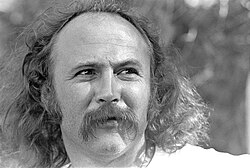
Following completion of the album, Crosby persuaded McGuinn to dissolve the Columbia version of the Byrds, who were still touring at that time.243 Crosby had long been vocal regarding his displeasure over McGuinn's decision to recruit new band members following his dismissal from the group in 1967, and had stated in a number of interviews that in his opinion "there were only ever five Byrds".249 In keeping with the new spirit of reconciliation that the reunion fostered, McGuinn permanently disbanded the Columbia lineup of the group in February 1973.16
The reunion album, titled simply Byrds, was released on March 7, 1973, to mixed reviews.246 As a result, a planned tour in support of the album failed to materialize.17 Among the album's shortcomings, critics made note of a lack of sonic unity and the absence of the Byrds' signature jangly guitar sound.246 The album managed to climb to number 20 on the Billboard Top LPs & Tape chart and number 31 in the UK.246 In the United States, the album became the band's highest charting LP of new material since 1965's Turn! Turn! Turn!, which had also been the last Byrds' album to feature Gene Clark as a full member.17 Among the tracks included on the album were McGuinn's folk-flavored "Sweet Mary", the Joni Mitchell cover "For Free", a re-recording of Crosby's song "Laughing" (which had originally appeared on his 1971 solo album, If I Could Only Remember My Name), and a pair of Neil Young songs.17 The album also featured the Gene Clark compositions "Changing Heart" and "Full Circle", the latter of which had provided the reunion album with its working title and was subsequently released as a single, although it failed to chart.246251
The negative critical reception that Byrds received in the music press resulted in the band losing faith in the idea of an ongoing series of reunions.17 In the years following its release, all five band members were openly critical of the album, with the general consensus being that the material included on it was weak and that the recording sessions had been rushed and ill-thought out.17 In addition, McGuinn and Hillman have both suggested that with the exception of Gene Clark, the songwriting members of the band were reluctant to bring their strongest compositions to the recording sessions, preferring instead to hold those songs back for their own solo projects.17249 In the wake of the reunion, the five original Byrds quietly returned to their own careers,17 with the June 1973 release of McGuinn's eponymously titled solo album serving to effectively mark the end of the Byrds.
Following the reunion of 1972/1973, the Byrds remained disbanded throughout the rest of the decade.1 Roger McGuinn turned his attention to establishing his own career, releasing a series of solo albums between 1973 and 1977, and making a high-profile appearance with Bob Dylan's Rolling Thunder Revue.2 Chris Hillman worked as part of the Souther–Hillman–Furay Band following the Byrds reunion and released a pair of solo albums entitled Slippin' Away and Clear Sailin' in 1976 and 1977 respectively.42 David Crosby returned to the supergroup Crosby, Stills, Nash & Young for their 1974 tour and subsequently continued to produce albums with Graham Nash.27 He also took part in a 1977 reunion of Crosby, Stills & Nash, which saw the group release their multi-platinum selling CSN album.27 Michael Clarke also found success following the Byrds reunion as the drummer for soft rock group Firefall,21 while Gene Clark returned to his solo career, producing the critically acclaimed but commercially unsuccessful albums No Other (1974) and Two Sides to Every Story (1977).114
McGuinn, Clark and Hillman (1977–1981)
Between 1977 and 1980, McGuinn, Clark and Hillman worked on and off together as a trio, modeled after Crosby, Stills, Nash & Young and, to a lesser extent, the Eagles.252253 This supergroup made up of former Byrds was reasonably successful commercially and managed to score a Top 40 hit with the single "Don't You Write Her Off" in March 1979.254255 The trio toured internationally and recorded the albums McGuinn, Clark & Hillman and City.254 Clark departed the group in late 1979, resulting in a third and final album being billed as McGuinn-Hillman.254 The two former Byrds continued to play low-key gigs after the release of the McGuinn/Hillman album, but they split up in early 1981.256
Ersatz Byrds and further reunions (1989–1991; 2000)
In 1984, Gene Clark approached McGuinn, Crosby, and Hillman in an attempt to reform the Byrds in time for the 20th anniversary of the release of the "Mr. Tambourine Man" single in 1985.257 None of these three original members was interested in the venture and so Clark instead assembled a group of musicians and friends, including Rick Roberts, Blondie Chaplin, Rick Danko, Richard Manuel, and the ex-Byrds Michael Clarke and John York, under the banner of "The 20th Anniversary Tribute to the Byrds".258 This tribute act began performing on the lucrative nostalgia circuit in early 1985, but a number of concert promoters began to shorten the band's name to the Byrds in advertisements and promotional material.257 As the band continued to tour throughout 1985, they eventually decided to shorten their name to the Byrds themselves, prompting McGuinn, Crosby and Hillman to berate the tribute group in interviews, with McGuinn deriding the act as "a cheap show".257
After the tour wound down in late 1985, Clark returned to his solo career, leaving Michael Clarke to soldier on with a band that was now billed as "A Tribute to the Byrds" (although again, it was often shortened to the Byrds by promoters).259 Gene Clark returned to the group following the release of his and Carla Olson's So Rebellious a Lover album, and the tribute band continued to work on and off in 1987 and 1988.260 Author Johnny Rogan has stated that most die-hard fans of the Byrds were mortified by the existence of this ersatz version of the group, while Byrds expert Tim Connors has commented that "no chapter in the history of the Byrds caused as much consternation and controversy among fans".257259
In June 1988, McGuinn, Crosby and Hillman appeared at a concert celebrating the reopening of the Ash Grove folk club in Los Angeles.259 Although they were billed as solo artists, the three musicians came together for an on-stage reunion during the show, performing a string of Byrds hits including "Mr. Tambourine Man" and "Eight Miles High".259 Although Clark and Clarke's Byrds tribute group was inactive at the time of this high-profile get-together of McGuinn, Crosby, and Hillman, Michael Clarke did mount another tribute tour shortly afterwards, this time featuring former Byrd Skip Battin and newcomers Terry Jones Rogers and Jerry Sorn, under the banner of "the Byrds featuring Michael Clarke".259261 In addition, the drummer also sought to trademark the name the Byrds for his own use.257
First Gene went around with a very, very bad band, calling it the Byrds. Well, okay. Gene was one of the original writer/singer guys. But when it gets to be Michael Clarke the drummer -- who never wrote anything or sang anything – going out there with an even worse band, and claiming to be the Byrds ... and they can't play the stuff. It was dragging the name in the dirt.
In retaliation against Clarke's trademark application, McGuinn, Crosby and Hillman submitted their own counter-claim to gain ownership of the band's name.261 McGuinn had actually attempted to trademark the Byrds name himself during the 1970s, to prevent its misuse, but his application had been turned down.259 To strengthen their case, the three musicians announced in December 1988 that they would be performing a series of concerts in January 1989 as the Byrds.259261 Although he was no longer connected with Clarke's tribute act, Gene Clark was not invited to participate in these official Byrds reunion concerts due to residual ill-feeling stemming from his earlier "20th Anniversary Tribute to the Byrds".261
The reunion concerts were a resounding success, but with Michael Clarke continuing to tour with his Byrds tribute, McGuinn, Crosby and Hillman filed a lawsuit against the drummer in the spring of 1989, suing him for allegedly false advertising, unfair competition and deceptive trade practices, as well as seeking a preliminary injunction against Clarke's use of the name.259261 At the court hearing in May 1989, the judge denied the injunction, ruling that McGuinn, Crosby and Hillman had failed to show that they would be irreparably damaged by Clarke's actions.261 As a result, Clarke gained full legal ownership of the name the Byrds.263 In the wake of this ruling, McGuinn, Crosby and Hillman dropped their lawsuit, but to demonstrate that they had not wholly surrendered the Byrds name to Clarke, the three musicians appeared under the banner of the Original Byrds at a Roy Orbison tribute concert on February 24, 1990, where they were joined on-stage by Bob Dylan for a rendition of "Mr. Tambourine Man".261264 Later that year, McGuinn, Crosby and Hillman entered Treasure Isle Recorders in Nashville to record four new Byrds tracks for inclusion on the forthcoming The Byrds box set.244
On January 16, 1991, the five original members of the Byrds put aside their differences to appear together at the Waldorf-Astoria Hotel in New York City for their induction into the Rock and Roll Hall of Fame.18 The ceremony honored the original lineup of Roger McGuinn, Gene Clark, David Crosby, Chris Hillman, and Michael Clarke, while later configurations of the group featuring such key personnel as Gram Parsons and Clarence White were quietly passed over.18 The occasion, which saw the band come together on stage to perform the songs "Turn! Turn! Turn! (to Everything There Is a Season)", "Mr. Tambourine Man", and "I'll Feel a Whole Lot Better", represented the first time that all five original Byrds had stood together since 1973.18 Unfortunately, it would also represent the last time that the five original members were gathered together.19 Clark died later that year of heart failure, and on December 19, 1993, Clarke succumbed to liver disease brought on by alcoholism.263
Following Clarke's death, Terry Jones Rogers resurrected the Byrds tribute act, with guitarist Scott Nienhaus and former Byrds Skip Battin and Gene Parsons on bass and drums respectively.265 Performing under the banner of the Byrds Celebration, the tribute group toured extensively throughout the remainder of the 1990s, although Parsons was replaced by session drummer Vince Barranco in 1995 and Battin was forced to retire due to ill-health in 1997.265 Since 2002, Rogers and Nienhaus have continued to tour as part of the band Younger Than Yesterday: A Tribute to the Byrds, along with bassist Michael Curtis and drummer Tim Politte.265

McGuinn, Crosby and Hillman all returned to their individual solo careers following the Rock and Roll Hall of Fame ceremony.263 The Byrds did reunite for a third time on August 8, 2000, to give an impromptu, one-off performance at a tribute concert for Fred Walecki, the owner of a Los Angeles music equipment store who was suffering from throat cancer.266 Crosby and Hillman were booked to appear at the event separately, but McGuinn, who was not listed on the bill, made a surprise appearance and joined his two former partners on stage.266 McGuinn introduced the hastily reformed trio with the words, "And now, ladies and gentlemen, the Byrds", as the group launched into renditions of "Mr. Tambourine Man" and "Turn! Turn! Turn! (to Everything There Is a Season)".266 According to contemporary press reports, the reunion was an unmitigated success, with the audience giving the band multiple standing ovations and shouting for more as they left the stage.266
During the 2000s, two more ex-members of the Byrds died when drummer Kevin Kelley succumbed of natural causes in 2002267 and bassist Skip Battin, who was suffering from Alzheimer's disease, died at his home in 2003.263 Former members Gene Parsons and John York both remain active and continue to perform and record various musical projects.263
Perhaps the most surprising development in the Byrds' story during the 2000s was the acquisition by David Crosby of the rights to the band's name in 2002.268269 Ownership of the Byrds' name had reverted to Clarke's estate upon his death in 1993 and Crosby's purchase served to effectively bring the convoluted battle for control of the group's name to an end.
To date, the Fred Walecki tribute concert appearance in 2000 was the last performance by the Byrds. However, Hillman and Crosby both expressed an interest in working with McGuinn again on Byrds projects, but the lead guitarist and head Byrd remained adamant that he was not interested in another full reunion.263 During an interview with music journalist John Nork, McGuinn replied "absolutely not", when asked if he had any plans to revive the Byrds, explaining, "No, I don't want to do that. I just want to be a solo artist. The Byrds are well documented. I don't think we need anymore from the Byrds."263
In spite of McGuinn's comments, he and Hillman undertook a series of concerts together in 2018 to celebrate the 50th anniversary of the Byrds' Sweetheart of the Rodeo album.270 Though not billed as the Byrds, the duo, together with backing band Marty Stuart and his Fabulous Superlatives, played some earlier Byrds' material before performing all of the songs from the album and telling stories about its creation.271 An album of live recordings from the 50th Anniversary concerts was released for Record Store Day 2024.272
On January 18, 2023, David Crosby died in his sleep at age 81, following years of health issues.273274 His death left McGuinn and Hillman as the two remaining original members.
Legacy
Since the band's 1960s heyday, the influence of the Byrds on successive generations of rock and pop musicians has grown steadily, with acts such as the Eagles, Big Star, Tom Petty & the Heartbreakers, R.E.M., the Bangles, the Smiths, and innumerable alternative rock bands of the post-punk era all exhibiting signs of their influence.15263275276 Musician and author Peter Lavezzoli described the Byrds in 2007 as "one of the few bands to exert a decisive influence on the Beatles", while also noting that they helped to persuade Bob Dylan to begin recording with electric instrumentation.277 Lavezzoli concluded that "like it or not, terms like 'folk rock', 'raga rock' and 'country rock' were coined for a reason: the Byrds did it first, and then kept moving, never staying in the 'raga' or 'country' mode for very long. This is precisely what made the Byrds such a rewarding band to follow from one record to the next".277
In their book Beyond and Before: Progressive Rock Since the 1960s, academics Paul Hegarty and Martin Halliwell placed the Byrds among a list of bands that they included in the book "not merely as precursors of prog but as essential developments of progressiveness in its early days".278 In The Great Rock Discography, music researcher Martin C. Strong describes the Byrds' cover of "Mr. Tambourine Man" as "a timeless slice of hypnotic, bittersweet pop" and a record that "did nothing less than change the course of pop/rock history".279 Author and musician Bob Stanley, writing in his 2013 book Yeah Yeah Yeah: The Story of Modern Pop, has called the Byrds' music "a phenomenon, a drone, genuinely hair-raising and totally American".280
Music historian Domenic Priore attempted to sum up the band's influence in his book Riot on Sunset Strip: Rock 'n' Roll's Last Stand in 60s Hollywood, by stating: "Few of The Byrds' contemporaries can claim to have made such a subversive impact on popular culture. The band had a much larger, more positive impact on the world at large than any Billboard chart position or album sales or concert attendance figure could possibly measure."281
In 2004, Rolling Stone magazine ranked the Byrds at number 45 on their list of the 100 Greatest Artists of All Time.282 In 2006, they were inducted into the Vocal Group Hall of Fame.283
Members
Original members
- Roger McGuinn – lead guitar, banjo, Moog synthesizer, vocals (1964–1973, 1989–1991, 2000)
- Gene Clark – tambourine, rhythm guitar, harmonica, vocals (1964–1966, 1967, 1972–1973, 1991; died 1991)
- David Crosby – rhythm guitar, vocals (1964–1967, 1972–1973, 1989–1991, 2000; died 2023)
- Michael Clarke – drums (1964–1967, 1972–1973, 1991; died 1993)
- Chris Hillman – bass guitar, rhythm guitar, mandolin, vocals (1964–1968, 1972–1973, 1989–1991, 2000)
Subsequent members
- Kevin Kelley – drums (1968; died 2002)
- Gram Parsons – rhythm guitar, piano, organ, vocals (1968; died 1973)
- Clarence White – lead guitar, mandolin, vocals (1968–1973; died 1973)
- Gene Parsons – drums, banjo, harmonica, pedal steel guitar, rhythm guitar, vocals (1968–1972)
- John York – bass guitar, vocals (1968–1969)
- Skip Battin – bass guitar, piano, vocals (1969–1973; died 2003)
Membership timeline (1964–1973)
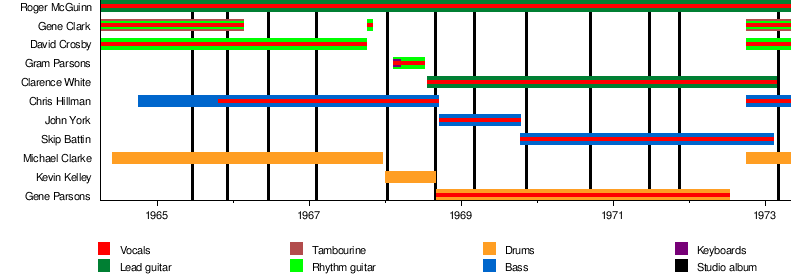
Discography
- Mr. Tambourine Man (1965)
- Turn! Turn! Turn! (1965)
- Fifth Dimension (1966)
- Younger Than Yesterday (1967)
- The Notorious Byrd Brothers (1968)
- Sweetheart of the Rodeo (1968)
- Dr. Byrds & Mr. Hyde (1969)
- Ballad of Easy Rider (1969)
- (Untitled) (1970)
- Byrdmaniax (1971)
- Farther Along (1971)
- Byrds (1973)
Notes
Notes
- Jim McGuinn changed his name to Roger McGuinn in 1967.
References
References
- Unterberger, Richie. "Biography of The Byrds". AllMusic. Archived from the original on July 12, 2018. Retrieved May 25, 2010.
- Ankeny, Jason. "Biography of Roger McGuinn". Allmusic. Archived from the original on January 20, 2023. Retrieved May 25, 2010.
- Einarson, John. (2005). Mr. Tambourine Man: The Life and Legacy of the Byrds' Gene Clark. Backbeat Books. pp. 72–75. ISBN 0-87930-793-5.
- Menck, Ric. (2007). The Notorious Byrd Brothers (33⅓ series). Continuum Books. p. 44. ISBN 978-0-8264-1717-6.
- Smith, Chris. (2009). 101 Albums That Changed Popular Music. Oxford University Press. pp. 32–34. ISBN 978-0-19-537371-4.
- Ruhlmann, William. "Mr. Tambourine Man song review". Allmusic. Archived from the original on April 9, 2011. Retrieved May 31, 2010.
- Ruhlmann, William. "Turn! Turn! Turn! song review". Allmusic. Archived from the original on December 16, 2010. Retrieved May 31, 2010.
- Richie Unterberger. "Mr. Tambourine Man album review". Allmusic. Archived from the original on May 31, 2012. Retrieved May 31, 2010.
- "Folk-Rock Overview". Allmusic. Archived from the original on September 3, 2017. Retrieved October 26, 2017.
- "Psychedelic Rock Overview". Allmusic. Archived from the original on October 16, 2011. Retrieved January 30, 2010.
- Bellman, Jonathan. (1997). The Exotic In Western Music. Northeastern Publishing. p. 351. ISBN 1-55553-319-1.
- Fricke, David (1997). "A Trip to the Country". Sweetheart of the Rodeo (CD booklet). The Byrds. Columbia/Legacy.
- Buckley, Peter. (2003). The Rough Guide to Rock. Rough Guides. pp. 155–156. ISBN 1-84353-105-4.
- Einarson, John. (2005). Mr. Tambourine Man: The Life and Legacy of the Byrds' Gene Clark. Backbeat Books. pp. 87–89. ISBN 0-87930-793-5. Archived from the original on January 20, 2023. Retrieved February 20, 2016.
- Hjort, Christopher. (2008). So You Want To Be A Rock 'n' Roll Star: The Byrds Day-By-Day (1965–1973). Jawbone Press. p. 117. ISBN 978-1-906002-15-2.
- Fricke, David (2000). "Farther Along: The Byrds at Twilight". Farther Along (CD booklet). The Byrds. Columbia/Legacy.
- Connors, Tim. "Byrds". ByrdWatcher: A Field Guide to the Byrds of Los Angeles. Archived from the original on May 25, 2009. Retrieved May 25, 2010.
- Einarson, John. (2005). Mr. Tambourine Man: The Life and Legacy of the Byrds' Gene Clark. Backbeat Books. pp. 293–294. ISBN 0-87930-793-5.
- Rogan, Johnny. (1998). The Byrds: Timeless Flight Revisited (2nd ed.). Rogan House. pp. 445–447. ISBN 0-9529540-1-X.
- Rogan, Johnny (2012). Requiem for the Timeless, Volume 1. Rogan House. p. 779. ISBN 978-0-95295-408-8.
- Unterberger, Richie. "Biography of Michael Clarke". Allmusic. Archived from the original on January 20, 2023. Retrieved May 25, 2010.
- Willman, Chris; Morris, Chris (January 19, 2023). "David Crosby, Byrds and Crosby, Stills & Nash Co-Founder, Dies at 81". Variety. Penske Media Corporation. Retrieved January 19, 2023.
- Rogan, Johnny (1998). The Byrds: Timeless Flight Revisited (2nd ed.). Rogan House. pp. 33–36. ISBN 0-9529540-1-X.
- Hjort, Christopher (2008). So You Want To Be A Rock 'n' Roll Star: The Byrds Day-By-Day (1965-1973). Jawbone Press. pp. 16–17. ISBN 978-1-906002-15-2.
- Russel, Richard E. "Roger McGuinn: Founder of The Byrds". Roger McGuinn Home Page. Archived from the original on May 16, 2010. Retrieved May 26, 2010.
- Connors, Tim. "Musicians Associated with the Byrds: The New Christy Minstrels". ByrdWatcher: A Field Guide to the Byrds of Los Angeles. Archived from the original on October 28, 2010. Retrieved May 26, 2010.
- Ankeny, Jason. "Biography of David Crosby". Allmusic. Archived from the original on December 3, 2010. Retrieved November 28, 2010.
- Hjort, Christopher (2008). So You Want To Be A Rock 'n' Roll Star: The Byrds Day-By-Day (1965–1973). Jawbone Press. p. 11. ISBN 978-1-906002-15-2.
- Rogan, Johnny (1998). The Byrds: Timeless Flight Revisited (2nd ed.). Rogan House. p. 31. ISBN 0-9529540-1-X.
- Einarson, John; Hillman, Chris (2008). Hot Burritos: The True Story of the Flying Burrito Brothers. Jawbone Press. p. 42. ISBN 978-1-906002-16-9.
- Fricke, David (2001). The Preflyte Sessions (CD booklet). The Byrds. Sundazed Music.
- Connors, Tim. "In The Beginning". ByrdWatcher: A Field Guide to the Byrds of Los Angeles. Archived from the original on May 24, 2009. Retrieved May 26, 2010.
- Fricke, David (1990). The Byrds (booklet). The Byrds. Columbia Records.
- Hjort, Christopher (2008). So You Want To Be A Rock 'n' Roll Star: The Byrds Day-By-Day (1965–1973). Jawbone Press. pp. 19–20. ISBN 978-1-906002-15-2.
- Rogan, Johnny (1998). The Byrds: Timeless Flight Revisited (2nd ed.). Rogan House. pp. 38–40. ISBN 0-9529540-1-X.
- Rogan, Johnny (1998). The Byrds: Timeless Flight Revisited (2nd ed.). Rogan House. pp. 541–548. ISBN 0-9529540-1-X.
- Rogan, Johnny (1998). The Byrds: Timeless Flight Revisited (2nd ed.). Rogan House. pp. 52–55. ISBN 0-9529540-1-X.
- Creswell, Toby (2006). 1001 Songs: The Great Songs of All Time and the Artists, Stories and Secrets Behind Them. Da Capo Press. p. 59. ISBN 1-56025-915-9.
- McGuinn, Roger. "Byrds FAQ: What instruments did they play?". Roger McGuinn Home Page. Archived from the original on May 16, 2010. Retrieved May 26, 2010.
- McGuinn, Roger. "Byrds FAQ: How and When did they get together?". Roger McGuinn Home Page. Archived from the original on May 16, 2010. Retrieved May 26, 2010.
- Hjort, Christopher (2008). So You Want To Be A Rock 'n' Roll Star: The Byrds Day-By-Day (1965–1973). Jawbone Press. p. 21. ISBN 978-1-906002-15-2.
- Ankeny, Jason. "Biography of Chris Hillman". Allmusic. Archived from the original on January 20, 2023. Retrieved May 26, 2010.
- Einarson, John (2005). Mr. Tambourine Man: The Life and Legacy of the Byrds' Gene Clark. Backbeat Books. pp. 56–57. ISBN 0-87930-793-5.
- Rogan, Johnny (1998). The Byrds: Timeless Flight Revisited (2nd ed.). Rogan House. pp. 56–57. ISBN 0-9529540-1-X.
- Hjort, Christopher (2008). So You Want To Be A Rock 'n' Roll Star: The Byrds Day-By-Day (1965–1973). Jawbone Press. p. 24. ISBN 978-1-906002-15-2.
- Fricke, David (1996). "The Chimes of Freedom". Mr. Tambourine Man (CD booklet). The Byrds. Columbia/Legacy.
- McGuinn, Roger. "Byrds FAQ: How and When did they get together?". Roger McGuinn Home Page. Archived from the original on May 16, 2010. Retrieved May 26, 2010.
- Hjort, Christopher (2008). So You Want To Be A Rock 'n' Roll Star: The Byrds Day-By-Day (1965–1973). Jawbone Press. pp. 27–30. ISBN 978-1-906002-15-2.
- Unterberger, Richie (2002). Turn! Turn! Turn!: The '60s Folk-Rock Revolution. Backbeat Books. pp. 113–117. ISBN 0-87930-703-X.
- Rogan, Johnny (1998). The Byrds: Timeless Flight Revisited (2nd ed.). Rogan House. pp. 67–70. ISBN 0-9529540-1-X.
- Schinder, Scott; Schwartz, Andy. (2007). Icons of Rock: An Encyclopedia of the Legends Who Changed Music Forever. Greenwood Press. p. 262. ISBN 978-0-313-33845-8.
- Kubernik, Harvey (2006). Hollywood Shack Job: Rock Music in Film and on Your Screen. University of New Mexico Press. p. 84. ISBN 0-8263-3542-X.
- Menck, Ric (2007). The Notorious Byrd Brothers (33⅓ series). Continuum Books. p. 43. ISBN 978-0-8264-1717-6.
- Hoffmann, Frank (2004). Encyclopedia of Recorded Sound (2nd ed.). Routledge. p. 148. ISBN 0-415-93835-X.
- Unterberger, Richie. "Folk Rock: An Overview". Richieunterberger.com. Archived from the original on November 9, 2013. Retrieved March 15, 2010.
- Kitts, Jeff; Tolinski, Brad. (2002). Guitar World Presents the 100 Greatest Guitarists of All Time. Hal Leonard. p. 85. ISBN 0-634-04619-5.
- Connors, Tim. "Mr. Tambourine Man". ByrdWatcher: A Field Guide to the Byrds of Los Angeles. Archived from the original on January 11, 2010. Retrieved May 31, 2010.
- Unterberger, Richie (2002). Turn! Turn! Turn!: The '60s Folk-Rock Revolution. Backbeat Books. p. 107. ISBN 0-87930-703-X.
- Dean, Maury (2003). Rock 'n' Roll Gold Rush: A Singles Un-Cyclopedia. Algora Publishing. p. 200. ISBN 0-87586-207-1.
- Whitburn, Joel. (2008). Top Pop Singles 1955-2006. Record Research Inc. p. 130. ISBN 978-0-89820-172-7.
- Brown, Tony (2000). The Complete Book of the British Charts. Omnibus Press. p. 130. ISBN 0-7119-7670-8.
- Unterberger, Richie (2002). Turn! Turn! Turn!: The '60s Folk-Rock Revolution. Backbeat Books. p. 133. ISBN 0-87930-703-X.
- Rogan, Johnny (1998). The Byrds: Timeless Flight Revisited (2nd ed.). Rogan House. pp. 83–87. ISBN 0-9529540-1-X.
- Whitburn, Joel (2002). Top Pop Albums 1955-2001. Record Research Inc. p. 121. ISBN 0-89820-147-0.
- Dimartino, Dave (1994). Singer-Songwriters: Pop Music's Performer-Composers, from A to Zevon. Billboard Books. p. 38. ISBN 0-8230-7629-6.
- Simmonds, Jeremy (2008). The Encyclopedia of Dead Rock Stars: Heroin, Handguns, and Ham Sandwiches. Chicago Review Press. p. 275. ISBN 978-1-55652-754-8.
- Einarson, John (2005). Mr. Tambourine Man: The Life and Legacy of the Byrds' Gene Clark. Backbeat Books. p. 65. ISBN 0-87930-793-5.
- Hjort, Christopher (2008). So You Want To Be A Rock 'n' Roll Star: The Byrds Day-By-Day (1965-1973). Jawbone Press. p. 39. ISBN 978-1-906002-15-2.
- Unterberer, Richie. "All I Really Want to Do song review". Allmusic. Archived from the original on January 20, 2023. Retrieved January 21, 2011.
- Rogan, Johnny (1998). The Byrds: Timeless Flight Revisited (2nd ed.). Rogan House. pp. 81–82. ISBN 0-9529540-1-X.
- Hjort, Christopher (2008). So You Want To Be A Rock 'n' Roll Star: The Byrds Day-By-Day (1965–1973). Jawbone Press. p. 57. ISBN 978-1-906002-15-2.
- Rogan, Johnny (1998). The Byrds: Timeless Flight Revisited (2nd ed.). Rogan House. pp. 78–80. ISBN 0-9529540-1-X.
- Luft, Eric V. D. (2009). Die at the Right Time!: A Subjective Cultural History of the American Sixties. Gegensatz Press. p. 135. ISBN 978-0-9655179-2-8.
- Scoppa, Bud (1971). The Byrds. Scholastic Book Services. p. 59.
- Rielly, Edward J. (2003). The 1960s. Greenwood Publishing Group. p. 87. ISBN 0-313-31261-3.
- Rogan, Johnny. (1998). The Byrds: Timeless Flight Revisited (2nd ed.). Rogan House. p. 96. ISBN 0-9529540-1-X.
- Hjort, Christopher (2008). So You Want To Be A Rock 'n' Roll Star: The Byrds Day-By-Day (1965–1973). Jawbone Press. p. 50. ISBN 978-1-906002-15-2.
- "The Problems of Being Roger McGuinn: Byrd Survivor". Hit Parader. September 1968. Retrieved May 9, 2025.
- Lavezzoli, Peter. (2007). The Dawn of Indian music in the West. Continuum International Publishing Group. p. 151. ISBN 978-0-8264-2819-6.
- Luft, Eric V. D. (2009). Die at the Right Time!: A Subjective Cultural History of the American Sixties. Gegensatz Press. p. 250. ISBN 978-0-9655179-2-8.
- Unterberger, Richie (2002). Turn! Turn! Turn!: The '60s Folk-Rock Revolution. Backbeat Books. p. 180. ISBN 0-87930-703-X.
- Scoppa, Bud (1971). The Byrds. Scholastic Book Services. p. 29.
- MacDonald, Ian (1995). Revolution In The Head: The Beatles' Records and The Sixties. Pimlico. p. 135. ISBN 0-7126-6208-1.
- Rogan, Johnny (1998). The Byrds: Timeless Flight Revisited (2nd ed.). Rogan House. pp. 123–124. ISBN 0-9529540-1-X.
- Rogan, Johnny (1998). The Byrds: Timeless Flight Revisited (2nd ed.). Rogan House. p. 128. ISBN 0-9529540-1-X.
- Unterberger, Richie (2002). Turn! Turn! Turn!: The '60s Folk-Rock Revolution. Backbeat Books. p. 183. ISBN 0-87930-703-X.
- Unterberger, Richie. "Turn! Turn! Turn! album review". Allmusic. Archived from the original on July 21, 2011. Retrieved June 1, 2010.
- Hjort, Christopher (2008). So You Want To Be A Rock 'n' Roll Star: The Byrds Day-By-Day (1965–1973). Jawbone Press. pp. 73–74. ISBN 978-1-906002-15-2.
- Schinder, Scott; Schwartz, Andy. (2007). Icons of Rock: An Encyclopedia of the Legends Who Changed Music Forever. Greenwood Press. pp. 266–267. ISBN 978-0-313-33845-8.
- Wadhams, Wayne; Nathan, David (2001). Inside the Hits: The Seduction of a Rock and Roll Generation. Berklee Press. p. 244. ISBN 0-634-01430-7.
- Rogan, Johnny (1996). Turn! Turn! Turn! (CD booklet). The Byrds. Columbia/Legacy.
- Einarson, John (2005). Mr. Tambourine Man: The Life and Legacy of the Byrds' Gene Clark. Backbeat Books. p. 80. ISBN 0-87930-793-5.
- Fricke, David (1996). "Turning Point: "Shindig", Scripture & "Oh! Susannah"". Turn! Turn! Turn! (CD booklet). The Byrds. Columbia/Legacy.
- Hjort, Christopher (2008). So You Want To Be A Rock 'n' Roll Star: The Byrds Day-By-Day (1965-1973). Jawbone Press. p. 79. ISBN 978-1-906002-15-2.
- Greenwald, Matthew. "Set You Free This Time song review". Allmusic. Archived from the original on January 20, 2023. Retrieved June 1, 2010.
- Rogan, Johnny. (1998). The Byrds: Timeless Flight Revisited (2nd ed.). Rogan House. pp. 147–149. ISBN 0-9529540-1-X.
- Hjort, Christopher. (2008). So You Want To Be A Rock 'n' Roll Star: The Byrds Day-By-Day (1965-1973). Jawbone Press. p. 75. ISBN 978-1-906002-15-2.
- Rogan, Johnny. (1998). The Byrds: Timeless Flight Revisited (2nd ed.). Rogan House. p. 152. ISBN 0-9529540-1-X.
- Rogan, Johnny. (1998). The Byrds: Timeless Flight Revisited (2nd ed.). Rogan House. p. 620. ISBN 0-9529540-1-X.
- Connors, Tim. "Fifth Dimension". ByrdWatcher: A Field Guide to the Byrds of Los Angeles. Archived from the original on May 4, 2009. Retrieved March 14, 2010.
- Fricke, David (1996). "The New Frontier". Fifth Dimension (CD booklet). The Byrds. Columbia/Legacy.
- Palmer, Robert. (1995). Rock & Roll: An Unruly History. Harmony. p. 165. ISBN 0-517-70050-6.
- Rounds, Dwight. (2007). The Year the Music Died: 1964-1972. Bridgeway Books. p. 59. ISBN 978-1-933538-69-3.
- Buckley, Peter. (2003). The Rough Guide to Rock. Rough Guides. p. 201. ISBN 1-84353-105-4.
- Einarson, John. (2005). Mr. Tambourine Man: The Life and Legacy of the Byrds' Gene Clark. Backbeat Books. pp. 85–86. ISBN 0-87930-793-5.
- Bellman, Jonathan. (1997). The Exotic In Western Music. Northeastern Publishing. p. 351. ISBN 1-55553-319-1.
- Lavezzoli, Peter. (2007). The Dawn of Indian music in the West. Continuum International Publishing Group. pp. 155–157. ISBN 978-0-8264-2819-6.
- Crosby, David. (1990). Long Time Gone: The Autobiography of David Crosby. Mandarin Paperbacks. p. 99. ISBN 0-7493-0283-6.
- Rogan, Johnny. (1998). The Byrds: Timeless Flight Revisited (2nd ed.). Rogan House. pp. 158–161. ISBN 0-9529540-1-X.
- Hjort, Christopher. (2008). So You Want To Be A Rock 'n' Roll Star: The Byrds Day-By-Day (1965-1973). Jawbone Press. p. 92. ISBN 978-1-906002-15-2.
- Hjort, Christopher. (2008). So You Want To Be A Rock 'n' Roll Star: The Byrds Day-By-Day (1965-1973). Jawbone Press. pp. 84–87. ISBN 978-1-906002-15-2.
- Einarson, John. (2005). Mr. Tambourine Man: The Life and Legacy of the Byrds' Gene Clark. Backbeat Books. pp. 87–89. ISBN 0-87930-793-5.
- Rogan, Johnny (1998). The Byrds: Timeless Flight Revisited (2nd ed.). Rogan House. pp. 165–167. ISBN 0-9529540-1-X.
- Deming, Mark. "Biography of Gene Clark". Allmusic. Archived from the original on February 17, 2011. Retrieved May 25, 2010.
- Einarson, John. (2005). Mr. Tambourine Man: The Life and Legacy of the Byrds' Gene Clark. Backbeat Books. pp. 313–314. ISBN 0-87930-793-5.
- Unterberger, Richie. "Fifth Dimension album review". Allmusic. Retrieved June 24, 2010.
- Hjort, Christopher. (2008). So You Want To Be A Rock 'n' Roll Star: The Byrds Day-By-Day (1965-1973). Jawbone Press. p. 97. ISBN 978-1-906002-15-2.
- Rogan, Johnny. (1998). The Byrds: Timeless Flight Revisited (2nd ed.). Rogan House. pp. 178–179. ISBN 0-9529540-1-X.
- Hjort, Christopher. (2008). So You Want To Be A Rock 'n' Roll Star: The Byrds Day-By-Day (1965–1973). Jawbone Press. p. 101. ISBN 978-1-906002-15-2.
- Scoppa, Bud. (1971). The Byrds. Scholastic Book Services. pp. 54–55.
- Scoppa, Bud. (1971). The Byrds. Scholastic Book Services. p. 64.
- Rogan, Johnny. (1998). The Byrds: Timeless Flight Revisited (2nd ed.). Rogan House. pp. 622–624. ISBN 0-9529540-1-X.
- Rogan, Johnny. (1998). The Byrds: Timeless Flight Revisited (2nd ed.). Rogan House. pp. 185–186. ISBN 0-9529540-1-X.
- Hjort, Christopher. (2008). So You Want To Be A Rock 'n' Roll Star: The Byrds Day-By-Day (1965-1973). Jawbone Press. p. 113. ISBN 978-1-906002-15-2.
- Fricke, David (1996). "Fame and Misfortune: The End of the First Golden Era". Younger Than Yesterday (CD booklet). The Byrds. Columbia/Legacy.
- Connors, Tim. "Younger Than Yesterday". ByrdWatcher: A Field Guide to the Byrds of Los Angeles. Archived from the original on December 26, 2014. Retrieved June 24, 2010.
- Hjort, Christopher. (2008). So You Want To Be A Rock 'n' Roll Star: The Byrds Day-By-Day (1965–1973). Jawbone Press. pp. 118–120. ISBN 978-1-906002-15-2.
- Erlewine, Stephen Thomas. "Pack Up the Plantation: Live! album review". Allmusic. Archived from the original on January 20, 2023. Retrieved November 28, 2010.
- Ruhlmann, William. "Wave album review". Allmusic. Archived from the original on November 15, 2010. Retrieved November 28, 2010.
- Unterberger, Richie. "Younger Than Yesterday album review". Allmusic. Archived from the original on December 31, 2010. Retrieved June 24, 2010.
- Ward, Thomas. "Everybody's Been Burned song review". Allmusic. Retrieved January 20, 2011.
- Rogan, Johnny. (1998). The Byrds: Timeless Flight Revisited (2nd ed.). Rogan House. pp. 221–225. ISBN 0-9529540-1-X.
- Lavezzoli, Peter. (2007). The Dawn of Indian music in the West. Continuum International Publishing Group. p. 148. ISBN 978-0-8264-2819-6.
- Hjort, Christopher. (2008). So You Want To Be A Rock 'n' Roll Star: The Byrds Day-By-Day (1965-1973). Jawbone Press. p. 138. ISBN 978-1-906002-15-2.
- Hjort, Christopher. (2008). So You Want To Be A Rock 'n' Roll Star: The Byrds Day-By-Day (1965-1973). Jawbone Press. p. 134. ISBN 978-1-906002-15-2.
- Menck, Ric. (2007). The Notorious Byrd Brothers (33⅓ series). Continuum Books. p. 129. ISBN 978-0-8264-1717-6.
- Hjort, Christopher. (2008). So You Want To Be A Rock 'n' Roll Star: The Byrds Day-By-Day (1965-1973). Jawbone Press. pp. 141–142. ISBN 978-1-906002-15-2.
- "The Byrds' Greatest Hits RIAA Awards". Recording Industry Association of America. Archived from the original on September 24, 2015. Retrieved November 1, 2010.
- Hjort, Christopher. (2008). So You Want To Be A Rock 'n' Roll Star: The Byrds Day-By-Day (1965-1973). Jawbone Press. p. 149. ISBN 978-1-906002-15-2.
- Unterberger, Richie. "The Notorious Byrd Brothers album review". Allmusic. Archived from the original on January 31, 2011. Retrieved January 8, 2011.
- Menck, Ric. (2007). The Notorious Byrd Brothers (33⅓ series). Continuum Books. pp. 91–92. ISBN 978-0-8264-1717-6.
- Deming, Mark. "Goin' Back song review". Allmusic. Archived from the original on January 20, 2023. Retrieved January 8, 2011.
- Connors, Tim. "The Notorious Byrd Brothers". ByrdWatcher: A Field Guide to the Byrds of Los Angeles. Archived from the original on May 6, 2009. Retrieved June 25, 2010.
- Fricke, David (1997). "The End of the Innocence". The Notorious Byrd Brothers (CD booklet). The Byrds. Columbia/Legacy.
- Hjort, Christopher. (2008). So You Want To Be A Rock 'n' Roll Star: The Byrds Day-By-Day (1965-1973). Jawbone Press. p. 152. ISBN 978-1-906002-15-2.
- Rogan, Johnny. (1998). The Byrds: Timeless Flight Revisited (2nd ed.). Rogan House. pp. 237–238. ISBN 0-9529540-1-X.
- Hjort, Christopher. (2008). So You Want To Be A Rock 'n' Roll Star: The Byrds Day-By-Day (1965-1973). Jawbone Press. pp. 157–158. ISBN 978-1-906002-15-2.
- Olsen, Bob. "The Byrds – The Notorious Byrd Brothers SACD review". Music Tap. Archived from the original on July 29, 2010. Retrieved January 15, 2010.
- Rogan, Johnny. (1998). The Byrds: Timeless Flight Revisited (2nd ed.). Rogan House. pp. 232–234. ISBN 0-9529540-1-X.
- Selvin, Joel. (1992). Monterey Pop. Chronicle Books. p. 54. ISBN 0-8118-0153-5.
- Menck, Ric. (2007). The Notorious Byrd Brothers (33⅓ series). Continuum Books. p. 75. ISBN 978-0-8264-1717-6.
- Hjort, Christopher. (2008). So You Want To Be A Rock 'n' Roll Star: The Byrds Day-By-Day (1965-1973). Jawbone Press. pp. 143–146. ISBN 978-1-906002-15-2.
- Rogan, Johnny. (1998). The Byrds: Timeless Flight Revisited (2nd ed.). Rogan House. p. 228. ISBN 0-9529540-1-X.
- Menck, Ric. (2007). The Notorious Byrd Brothers (33⅓ series). Continuum Books. pp. 80–82. ISBN 978-0-8264-1717-6.
- Eder, Bruce. "Crown of Creation album review". Allmusic. Archived from the original on January 20, 2023. Retrieved June 27, 2010.
- "David Crosby: Bio". David Crosby Home Page. Archived from the original on March 4, 2012. Retrieved April 3, 2012.
- Einarson, John. (2005). Mr. Tambourine Man: The Life and Legacy of the Byrds' Gene Clark. Backbeat Books. pp. 126–127. ISBN 0-87930-793-5.
- Connors, Tim. "Gram Parsons - The Byrds: 1968". ByrdWatcher: A Field Guide to the Byrds of Los Angeles. Archived from the original on October 28, 2010. Retrieved July 20, 2010.
- Connors, Tim. "Sweetheart of the Rodeo". ByrdWatcher: A Field Guide to the Byrds of Los Angeles. Archived from the original on October 28, 2010. Retrieved July 20, 2010.
- Rogan, Johnny. (1998). The Byrds: Timeless Flight Revisited (2nd ed.). Rogan House. pp. 253–254. ISBN 0-9529540-1-X.
- Brant, Marley (1990). GP/Grievous Angel (CD booklet). Gram Parsons. Reprise Records.
- Fricke, David (2003). Sweetheart of the Rodeo: Legacy Edition (CD booklet). The Byrds. Columbia/Legacy.
- Hjort, Christopher. (2008). So You Want To Be A Rock 'n' Roll Star: The Byrds Day-By-Day (1965-1973). Jawbone Press. pp. 164–165. ISBN 978-1-906002-15-2.
- Connors, Tim. "Dr. Byrds & Mr. Hyde". ByrdWatcher: A Field Guide to the Byrds of Los Angeles. Archived from the original on August 19, 2009. Retrieved October 31, 2010.
- Rogan, Johnny (1998). The Byrds: Timeless Flight Revisited (2nd ed.). Rogan House. p. 261. ISBN 0-9529540-1-X.
- Rogan, Johnny. (1998). The Byrds: Timeless Flight Revisited (2nd ed.). Rogan House. pp. 257–258. ISBN 0-9529540-1-X.
- Hjort, Christopher. (2008). So You Want To Be A Rock 'n' Roll Star: The Byrds Day-By-Day (1965-1973). Jawbone Press. p. 176. ISBN 978-1-906002-15-2.
- Rogan, Johnny (1997). Sweetheart of the Rodeo (CD booklet). The Byrds. Columbia/Legacy.
- Hjort, Christopher. (2008). So You Want To Be A Rock 'n' Roll Star: The Byrds Day-By-Day (1965-1973). Jawbone Press. pp. 177–180. ISBN 978-1-906002-15-2.
- Rogan, Johnny. (1998). The Byrds: Timeless Flight Revisited (2nd ed.). Rogan House. pp. 262–263. ISBN 0-9529540-1-X.
- Erlewine, Stephen Thomas. "Biography of Gram Parsons". Allmusic. Archived from the original on November 12, 2010. Retrieved November 9, 2010.
- Simmonds, Jeremy. (2008). The Encyclopedia of Dead Rock Stars: Heroin, Handguns, and Ham Sandwiches (Updated ed.). Chicago Review Press. p. 66. ISBN 978-1-55652-754-8.
- Rogan, Johnny. (1998). The Byrds: Timeless Flight Revisited (2nd ed.). Rogan House. pp. 264–266. ISBN 0-9529540-1-X.
- Rogan, Johnny. (1998). The Byrds: Timeless Flight Revisited (2nd ed.). Rogan House. pp. 274–275. ISBN 0-9529540-1-X.
- Hjort, Christopher. (2008). So You Want To Be A Rock 'n' Roll Star: The Byrds Day-By-Day (1965-1973). Jawbone Press. p. 167. ISBN 978-1-906002-15-2.
- Deming, Mark. "Sweetheart of the Rodeo album review". Allmusic. Archived from the original on November 2, 2010. Retrieved November 9, 2010.
- Smith, Chris. (2009). 101 Albums That Changed Popular Music. Oxford University Press. p. 63. ISBN 978-0-19-537371-4.
- Erlewine, Stephen Thomas. "Nashville Skyline album review". Allmusic. Archived from the original on November 10, 2010. Retrieved November 9, 2010.
- Rogan, Johnny. (1998). The Byrds: Timeless Flight Revisited (2nd ed.). Rogan House. p. 269. ISBN 0-9529540-1-X.
- Hjort, Christopher. (2008). So You Want To Be A Rock 'n' Roll Star: The Byrds Day-By-Day (1965-1973). Jawbone Press. p. 188. ISBN 978-1-906002-15-2.
- Scoppa, Bud. (1971). The Byrds. Scholastic Book Services. p. 85.
- Connors, Tim. "Clarence White: With the Byrds and After, 1968–1973". ByrdWatcher: A Field Guide to the Byrds of Los Angeles. Archived from the original on April 13, 2009. Retrieved November 21, 2010.
- Rogan, Johnny. (1998). The Byrds: Timeless Flight Revisited (2nd ed.). Rogan House. pp. 276–278. ISBN 0-9529540-1-X.
- Hjort, Christopher. (2008). So You Want To Be A Rock 'n' Roll Star: The Byrds Day-By-Day (1965-1973). Jawbone Press. pp. 189–190. ISBN 978-1-906002-15-2.
- Rogan, Johnny. (1998). The Byrds: Timeless Flight Revisited (2nd ed.). Rogan House. p. 268. ISBN 0-9529540-1-X.
- Fricke, David (1997). "The Byrds Reborn: McGuinn Takes The Reins". Dr. Byrds & Mr. Hyde (CD booklet). The Byrds. Columbia/Legacy.
- Scoppa, Bud. (1971). The Byrds. Scholastic Book Services. p. 111.
- Hjort, Christopher. (2008). So You Want To Be A Rock 'n' Roll Star: The Byrds Day-By-Day (1965-1973). Jawbone Press. p. 193. ISBN 978-1-906002-15-2.
- Deming, Mark. "Dr. Byrds & Mr. Hyde album review". Allmusic. Archived from the original on January 20, 2023. Retrieved November 23, 2010.
- Hjort, Christopher. (2008). So You Want To Be A Rock 'n' Roll Star: The Byrds Day-By-Day (1965-1973). Jawbone Press. p. 206. ISBN 978-1-906002-15-2.
- Rogan, Johnny. (1998). The Byrds: Timeless Flight Revisited (2nd ed.). Rogan House. pp. 282–283. ISBN 0-9529540-1-X.
- Hjort, Christopher. (2008). So You Want To Be A Rock 'n' Roll Star: The Byrds Day-By-Day (1965-1973). Jawbone Press. pp. 208–210. ISBN 978-1-906002-15-2.
- Gilliland, John (1969). "Show 9 - Tennessee Firebird: American country music before and after Elvis. [Part 1]" (audio). Pop Chronicles. University of North Texas Libraries.
- Greenwald, Matthew. "Nashville West song review". Allmusic. Archived from the original on April 11, 2011. Retrieved January 16, 2011.
- Fox, Pamela.; Ching, Barbara. (2008). Old Roots, New Routes: The Cultural Politics of Alt. Country Music. University of Michigan Press. p. 210. ISBN 978-0-472-05053-6.
- Connors, Tim. "Ballad Of Easy Rider". ByrdWatcher: A Field Guide to the Byrds of Los Angeles. Archived from the original on April 20, 2009. Retrieved November 28, 2010.
- Rogan, Johnny. (1998). The Byrds: Timeless Flight Revisited (2nd ed.). Rogan House. pp. 290–291. ISBN 0-9529540-1-X.
- Foster, Joe (2001). Preflyte (CD booklet). The Byrds. Poptones.
- Hjort, Christopher. (2008). So You Want To Be A Rock 'n' Roll Star: The Byrds Day-By-Day (1965-1973). Jawbone Press. pp. 218–219. ISBN 978-1-906002-15-2.
- Rogan, Johnny. (1998). The Byrds: Timeless Flight Revisited (2nd ed.). Rogan House. pp. 627–628. ISBN 0-9529540-1-X.
- Rogan, Johnny. (1998). The Byrds: Timeless Flight Revisited (2nd ed.). Rogan House. pp. 303–304. ISBN 0-9529540-1-X.
- Hjort, Christopher. (2008). So You Want To Be A Rock 'n' Roll Star: The Byrds Day-By-Day (1965-1973). Jawbone Press. p. 223. ISBN 978-1-906002-15-2.
- Rogan, Johnny (1997). Ballad of Easy Rider (CD booklet). The Byrds. Columbia/Legacy.
- Ruhlmann, William. "Easy Rider: Original Soundtrack album review". Allmusic. Archived from the original on March 24, 2012. Retrieved June 27, 2010.
- Hjort, Christopher. (2008). So You Want To Be A Rock 'n' Roll Star: The Byrds Day-By-Day (1965-1973). Jawbone Press. pp. 226–227. ISBN 978-1-906002-15-2.
- Hjort, Christopher. (2008). So You Want To Be A Rock 'n' Roll Star: The Byrds Day-By-Day (1965-1973). Jawbone Press. p. 229. ISBN 978-1-906002-15-2.
- Rogan, Johnny. (1998). The Byrds: Timeless Flight Revisited (2nd ed.). Rogan House. p. 301. ISBN 0-9529540-1-X.
- Fricke, David (1997). "After the Revolution: The Byrds' Great Escape". Ballad of Easy Rider (CD booklet). The Byrds. Columbia/Legacy.
- Rogan, Johnny. (1998). The Byrds: Timeless Flight Revisited (2nd ed.). Rogan House. pp. 295–296. ISBN 0-9529540-1-X.
- Fricke, David (2000). "The Byrds in 1970: "It's All Gonna Be All Right"". (Untitled)/(Unissued) (CD booklet). The Byrds. Columbia/Legacy.
- "Untitled". Snopes.com. April 27, 2004. Archived from the original on January 20, 2023. Retrieved January 8, 2011.
- Leggett, Steve. "Live at Royal Albert Hall 1971 album review". Allmusic. Archived from the original on January 20, 2023. Retrieved January 16, 2011.
- Schinder, Scott.; Schwartz, Andy. (2007). Icons of Rock: An Encyclopedia of the Legends Who Changed Music Forever. Greenwood Press. p. 277. ISBN 978-0-313-33845-8.
- Rogan, Johnny. (1998). The Byrds: Timeless Flight Revisited (2nd ed.). Rogan House. pp. 307–308. ISBN 0-9529540-1-X.
- Connors, Tim. "Musicians Associated with the Byrds: Da–Di - Jim Dickson". ByrdWatcher: A Field Guide to the Byrds of Los Angeles. Archived from the original on January 25, 2011. Retrieved January 11, 2011.
- Rogan, Johnny. (1998). The Byrds: Timeless Flight Revisited (2nd ed.). Rogan House. p. 310. ISBN 0-9529540-1-X.
- Hjort, Christopher. (2008). So You Want To Be A Rock 'n' Roll Star: The Byrds Day-By-Day (1965-1973). Jawbone Press. p. 254. ISBN 978-1-906002-15-2.
- Connors, Tim. "(Untitled)". ByrdWatcher: A Field Guide to the Byrds of Los Angeles. Archived from the original on August 21, 2009. Retrieved January 11, 2011.
- Rogan, Johnny (2000). (Untitled)/(Unissued) (CD booklet). The Byrds. Columbia/Legacy.
- Hjort, Christopher. (2008). So You Want To Be A Rock 'n' Roll Star: The Byrds Day-By-Day (1965-1973). Jawbone Press. p. 200. ISBN 978-1-906002-15-2.
- Hjort, Christopher. (2008). So You Want To Be A Rock 'n' Roll Star: The Byrds Day-By-Day (1965-1973). Jawbone Press. p. 257. ISBN 978-1-906002-15-2.
- Hartenbach, Brett. "Chestnut Mare song review". Allmusic. Retrieved January 11, 2011.
- Hjort, Christopher. (2008). So You Want To Be A Rock 'n' Roll Star: The Byrds Day-By-Day (1965-1973). Jawbone Press. pp. 264–265. ISBN 978-1-906002-15-2.
- Hjort, Christopher. (2008). So You Want To Be A Rock 'n' Roll Star: The Byrds Day-By-Day (1965-1973). Jawbone Press. pp. 268–269. ISBN 978-1-906002-15-2.
- Fricke, David (2000). "Byrdmaniax: Listen Again—Without Prejudice". Byrdmaniax (CD booklet). The Byrds. Columbia/Legacy.
- Deming, Mark. "Byrdmaniax album review". Allmusic. Archived from the original on January 20, 2023. Retrieved January 16, 2011.
- Connors, Tim. "Byrdmaniax". ByrdWatcher: A Field Guide to the Byrds of Los Angeles. Archived from the original on May 29, 2009. Retrieved January 16, 2011.
- Rogan, Johnny. (1998). The Byrds: Timeless Flight Revisited (2nd ed.). Rogan House. pp. 319–321. ISBN 0-9529540-1-X.
- Hjort, Christopher. (2008). So You Want To Be A Rock 'n' Roll Star: The Byrds Day-By-Day (1965-1973). Jawbone Press. p. 263. ISBN 978-1-906002-15-2.
- Hjort, Christopher. (2008). So You Want To Be A Rock 'n' Roll Star: The Byrds Day-By-Day (1965-1973). Jawbone Press. pp. 280–283. ISBN 978-1-906002-15-2.
- Hjort, Christopher. (2008). So You Want To Be A Rock 'n' Roll Star: The Byrds Day-By-Day (1965-1973). Jawbone Press. p. 279. ISBN 978-1-906002-15-2.
- Deming, Mark. "Farther Along album review". Allmusic. Archived from the original on January 20, 2023. Retrieved January 18, 2011.
- Rogan, Johnny. (1998). The Byrds: Timeless Flight Revisited (2nd ed.). Rogan House. pp. 328–329. ISBN 0-9529540-1-X.
- Hjort, Christopher. (2008). So You Want To Be A Rock 'n' Roll Star: The Byrds Day-By-Day (1965-1973). Jawbone Press. pp. 286–287. ISBN 978-1-906002-15-2.
- Hjort, Christopher. (2008). So You Want To Be A Rock 'n' Roll Star: The Byrds Day-By-Day (1965-1973). Jawbone Press. pp. 306–308. ISBN 978-1-906002-15-2.
- Hjort, Christopher. (2008). So You Want To Be A Rock 'n' Roll Star: The Byrds Day-By-Day (1965-1973). Jawbone Press. pp. 288–290. ISBN 978-1-906002-15-2.
- Rogan, Johnny (2000). Farther Along (CD booklet). The Byrds. Columbia/Legacy.
- Connors, Tim. "Farther Along". ByrdWatcher: A Field Guide to the Byrds of Los Angeles. Archived from the original on January 25, 2011. Retrieved January 28, 2011.
- Rogan, Johnny. (1998). The Byrds: Timeless Flight Revisited (2nd ed.). Rogan House. pp. 333–335. ISBN 0-9529540-1-X.
- Hjort, Christopher. (2008). So You Want To Be A Rock 'n' Roll Star: The Byrds Day-By-Day (1965-1973). Jawbone Press. p. 293. ISBN 978-1-906002-15-2.
- Rogan, Johnny. (1998). The Byrds: Timeless Flight Revisited (2nd ed.). Rogan House. pp. 336–337. ISBN 0-9529540-1-X.
- Hjort, Christopher. (2008). So You Want To Be A Rock 'n' Roll Star: The Byrds Day-By-Day (1965-1973). Jawbone Press. pp. 312–313. ISBN 978-1-906002-15-2.
- Rogan, Johnny. (1998). The Byrds: Timeless Flight Revisited (2nd ed.). Rogan House. pp. 341–342. ISBN 0-9529540-1-X.
- Rogan, Johnny. (1998). The Byrds: Timeless Flight Revisited (2nd ed.). Rogan House. pp. 630–632. ISBN 0-9529540-1-X.
- Hjort, Christopher. (2008). So You Want To Be A Rock 'n' Roll Star: The Byrds Day-By-Day (1965-1973). Jawbone Press. p. 304. ISBN 978-1-906002-15-2.
- Hjort, Christopher. (2008). So You Want To Be A Rock 'n' Roll Star: The Byrds Day-By-Day (1965-1973). Jawbone Press. pp. 316–318. ISBN 978-1-906002-15-2.
- Hjort, Christopher (2008). So You Want to Be a Rock 'n' Roll Star: The Byrds Day-by-Day (1965–1973). London: Jawbone Press. p. 321. ISBN 978-1-906002-15-2.
- Schinder, Scott.; Schwartz, Andy. (2007). Icons of Rock: An Encyclopedia of the Legends Who Changed Music Forever. Greenwood Press. p. 280. ISBN 978-0-313-33845-8.
- Einarson, John. (2005). Mr. Tambourine Man: The Life and Legacy of the Byrds' Gene Clark. Backbeat Books. pp. 178–180. ISBN 0-87930-793-5.
- Rogan, Johnny. (1998). The Byrds: Timeless Flight Revisited (2nd ed.). Rogan House. p. 340. ISBN 0-9529540-1-X.
- Rogan, Johnny. (1998). The Byrds: Timeless Flight Revisited (2nd ed.). Rogan House. p. 349. ISBN 0-9529540-1-X.
- Eder, Bruce. "McGuinn, Clark & Hillman Biography". AllMusic. Archived from the original on November 29, 2010. Retrieved April 19, 2011.
- Rogan, Johnny (2012). Requiem for the Timeless, Volume 1. Rogan House. pp. 664–667. ISBN 978-0-95295-408-8.
- Connors, Tim. "McGuinn, Clark & Hillman". ByrdWatcher: A Field Guide to the Byrds of Los Angeles. Archived from the original on May 14, 2011. Retrieved April 19, 2011.
- Whitburn, Joel. (2008). Top Pop Singles 1955-2006. Record Research Inc. p. 556. ISBN 978-0-89820-172-7.
- Rogan, Johnny (2012). Requiem for the Timeless, Volume 1. Rogan House. pp. 712–715. ISBN 978-0-95295-408-8.
- Connors, Tim. "Byrds v. Byrds: The 20th Anniversary Tribute to the Byrds 1984–1988". ByrdWatcher: A Field Guide to the Byrds of Los Angeles. Archived from the original on April 29, 2010. Retrieved May 25, 2010.
- Einarson, John. (2005). Mr. Tambourine Man: The Life and Legacy of the Byrds' Gene Clark. Backbeat Books. p. 255. ISBN 0-87930-793-5.
- Rogan, Johnny. (1998). The Byrds: Timeless Flight Revisited (2nd ed.). Rogan House. pp. 424–430. ISBN 0-9529540-1-X.
- Einarson, John. (2005). Mr. Tambourine Man: The Life and Legacy of the Byrds' Gene Clark. Backbeat Books. p. 261. ISBN 0-87930-793-5.
- Connors, Tim. "Byrds v. Byrds: The Battle for the Byrds' Name 1989–1990". ByrdWatcher: A Field Guide to the Byrds of Los Angeles. Archived from the original on October 28, 2010. Retrieved May 25, 2010.
- DiMartino, Dave (April 1991), "Byrd Watching", Spin, New York City, pp. 82–87.
- Hjort, Christopher. (2008). So You Want To Be A Rock 'n' Roll Star: The Byrds Day-By-Day (1965-1973). Jawbone Press. pp. 323–324. ISBN 978-1-906002-15-2.
- Rogan, Johnny. (1998). The Byrds: Timeless Flight Revisited (2nd ed.). Rogan House. p. 439. ISBN 0-9529540-1-X.
- "Younger Than Yesterday: A Tribute to the Byrds - Biography". byrdstribute.com. One Eyed Parrot. Archived from the original on November 29, 2014. Retrieved November 18, 2014.
- Baltin, Steve. "Byrds Reunite for L.A. Show". Rolling Stone. Archived from the original on November 27, 2011. Retrieved April 29, 2011.
- "Kevin Kelley Obituary". Los Angeles Times. May 2, 2002. Archived from the original on July 15, 2012. Retrieved April 24, 2011.
- Rogers, Terry Jones. "Younger Than Yesterday: Biography". terryjonesrogers.com. Archived from the original on July 16, 2011. Retrieved April 25, 2011.
- Varga, George. "CD Proves to Everything There Is a Season". The San Diego Union-Tribune. Retrieved April 25, 2011.
- "Byrds Co-Founders Plan 'Sweetheart of the Rodeo' 50th Anniversary Tour". Rolling Stone. Rolling Stone. Archived from the original on June 21, 2018. Retrieved June 5, 2018.
- BrooklynVegan Staff. "Byrds members played 'Sweetheart of the Rodeo' & more at Town Hall (pics, setlist)". BrooklynVegan. Town Square Media. Archived from the original on September 24, 2018. Retrieved September 25, 2018.
- "Sweetheart Of The Rodeo - RSD 2024". Rough Trade. Rough Trade. Retrieved February 27, 2024.
- Shepherd, Fiona (January 28, 2023). "David Crosby, founder member of The Byrds and legend with Crosby, Stills & Nash". The Scotsman. Archived from the original on January 28, 2023. Retrieved February 3, 2023.
- Dolan, Jon; Greene, Andy (January 19, 2023). "David Crosby, Iconoclastic Rocker, Dead at 81". Rolling Stone. Archived from the original on January 20, 2023. Retrieved January 19, 2023.
- Hoard, Joel. "The Byrds Biography". Rolling Stone. Archived from the original on May 11, 2011. Retrieved April 25, 2011.
- Rogan, Johnny. (1998). The Byrds: Timeless Flight Revisited (2nd ed.). Rogan House. p. 417. ISBN 0-9529540-1-X.
- Lavezzoli, Peter (2007). The Dawn of Indian music in the West. Continuum International Publishing Group. p. 162. ISBN 978-0-8264-2819-6.
- Hegarty, Paul; Halliwell, Martin (2011), Beyond and Before: Progressive Rock Since the 1960s, New York: The Continuum International Publishing Group, p. 11, ISBN 978-0-8264-2332-0
- Strong, Martin C (2004). The Great Rock Discography (7th ed.). Edinburgh: Canongate Books. p. 226. ISBN 1841955515.
- Stanley, Bob (2013). Yeah Yeah Yeah: The Story of Modern Pop. London: Faber and Faber. p. 177. ISBN 978-0-571-28197-8.
- Priore, Domenic (2007). Riot on Sunset Strip: Rock 'n' Roll's Last Stand in 60s Hollywood. Jawbone Press. p. 85. ISBN 978-1-906002-04-6.
- Petty, Tom. "100 Greatest Artists of All Time - No. 45: The Byrds". Rolling Stone. Archived from the original on October 19, 2012. Retrieved April 26, 2011.
- "The Byrds - Music Inductees". The Vocal Group Hall of Fame. Archived from the original on January 14, 2022. Retrieved January 14, 2022.
Further reading
Further reading
- Rogan, Johnny, Byrds: Requiem for the Timeless, Volume 1, Rogan House, 2011, ISBN 0-9529540-8-7.
- Hjort, Christopher, So You Want To Be A Rock 'n' Roll Star: The Byrds Day-By-Day (1965–1973), Jawbone Press, 2008, ISBN 1-906002-15-0.
- Menck, Ric, The Notorious Byrd Brothers (33⅓ series), Continuum Books, 2007, ISBN 0-8264-1717-5.
- Einarson, John, Mr. Tambourine Man: The Life and Legacy of the Byrds' Gene Clark, Backbeat Books, 2005, ISBN 0-87930-793-5.
- Unterberger, Richie, Turn! Turn! Turn!: The '60s Folk-Rock Revolution, Backbeat Books, 2002, ISBN 0-87930-703-X.
- Unterberger, Richie, Eight Miles High: Folk-Rock's Flight from Haight-Ashbury to Woodstock, Backbeat Books, 2003, ISBN 0-87930-743-9.
- Rogan, Johnny, The Byrds: Timeless Flight Revisited, Rogan House, 1998, ISBN 0-9529540-1-X.
- Scoppa, Bud, The Byrds, Scholastic Book Services, 1971.
External links
External links
- The Byrds' Fan Site
- Roger McGuinn's Official Byrds Homepage Archived May 11, 2011, at the Wayback Machine
- The Byrds biography at Rollingstone.com
- The Byrds interviewed on the Pop Chronicles (1969)
- "The Byrds". Rock and Roll Hall of Fame.
- The Byrds at IMDb