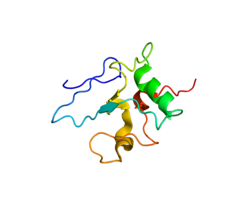
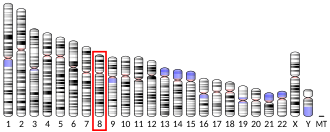



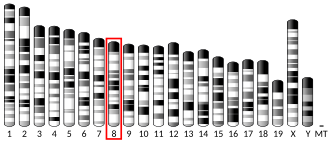

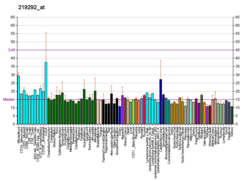
THAP domain-containing protein 1 is a protein that in humans is encoded by the THAP1 gene. The synonyme is DYT6 (Dystonia 6).567
Function
The protein encoded by this gene contains a THAP domain, a conserved DNA-binding domain. This protein colocalizes with the apoptosis response protein PAWR/PAR-4 in promyelocytic leukemia (PML) nuclear bodies, and functions as a proapoptotic factor that links PAWR to PML nuclear bodies. Alternatively spliced transcript variants encoding distinct isoforms have been observed.7
Interactions
THAP1 has been shown to interact with PAWR.6
Clinical significance
Thanatos-associated [THAP] domain-containing apoptosis-associated protein 1 (THAP1) is a DNA-binding protein that has been associated with DYT6 dystonia, a hereditary movement disorder involving sustained, involuntary muscle contractions.89
References
References
- GRCh38: Ensembl release 89: ENSG00000131931 – Ensembl, May 2017
- GRCm38: Ensembl release 89: ENSMUSG00000037214 – Ensembl, May 2017
- "Human PubMed Reference:". National Center for Biotechnology Information, U.S. National Library of Medicine.
- "Mouse PubMed Reference:". National Center for Biotechnology Information, U.S. National Library of Medicine.
- Roussigne M, Kossida S, Lavigne AC, Clouaire T, Ecochard V, Glories A, Amalric F, Girard JP (Feb 2003). "The THAP domain: a novel protein motif with similarity to the DNA-binding domain of P element transposase". Trends in Biochemical Sciences. 28 (2): 66–9. doi:10.1016/S0968-0004(02)00013-0. PMID 12575992.
- Roussigne M, Cayrol C, Clouaire T, Amalric F, Girard JP (Apr 2003). "THAP1 is a nuclear proapoptotic factor that links prostate-apoptosis-response-4 (Par-4) to PML nuclear bodies". Oncogene. 22 (16): 2432–42. doi:10.1038/sj.onc.1206271. PMID 12717420.
- "Entrez Gene: THAP1 THAP domain containing, apoptosis associated protein 1".
- Fuchs T, Gavarini S, Saunders-Pullman R, Raymond D, Ehrlich ME, Bressman SB, Ozelius LJ (Mar 2009). "Mutations in the THAP1 gene are responsible for DYT6 primary torsion dystonia". Nature Genetics. 41 (3): 286–8. doi:10.1038/ng.304. PMID 19182804. S2CID 205348799.
- Cem Sengel, Sophie Gavarini, Nutan Sharma, Laurie J Ozelius, D Cristopher Bragg (2011): Dimerization of the DYT6 dystonia protein, THAP1, requires residues within the coiled-coil domain. Journal of Neurochemistry. 2011 Jul 14;: 21752024
Further reading
Further reading
- Maruyama K, Sugano S (Jan 1994). "Oligo-capping: a simple method to replace the cap structure of eukaryotic mRNAs with oligoribonucleotides". Gene. 138 (1–2): 171–4. doi:10.1016/0378-1119(94)90802-8. PMID 8125298.
- Suzuki Y, Yoshitomo-Nakagawa K, Maruyama K, Suyama A, Sugano S (Oct 1997). "Construction and characterization of a full length-enriched and a 5'-end-enriched cDNA library". Gene. 200 (1–2): 149–56. doi:10.1016/S0378-1119(97)00411-3. PMID 9373149.
- Clouaire T, Roussigne M, Ecochard V, Mathe C, Amalric F, Girard JP (May 2005). "The THAP domain of THAP1 is a large C2CH module with zinc-dependent sequence-specific DNA-binding activity". Proceedings of the National Academy of Sciences of the United States of America. 102 (19): 6907–12. Bibcode:2005PNAS..102.6907C. doi:10.1073/pnas.0406882102. PMC 1100732. PMID 15863623.
- Rual JF, Venkatesan K, Hao T, Hirozane-Kishikawa T, Dricot A, Li N, Berriz GF, Gibbons FD, Dreze M, Ayivi-Guedehoussou N, Klitgord N, Simon C, Boxem M, Milstein S, Rosenberg J, Goldberg DS, Zhang LV, Wong SL, Franklin G, Li S, Albala JS, Lim J, Fraughton C, Llamosas E, Cevik S, Bex C, Lamesch P, Sikorski RS, Vandenhaute J, Zoghbi HY, Smolyar A, Bosak S, Sequerra R, Doucette-Stamm L, Cusick ME, Hill DE, Roth FP, Vidal M (Oct 2005). "Towards a proteome-scale map of the human protein-protein interaction network". Nature. 437 (7062): 1173–8. Bibcode:2005Natur.437.1173R. doi:10.1038/nature04209. PMID 16189514. S2CID 4427026.
- Lim J, Hao T, Shaw C, Patel AJ, Szabó G, Rual JF, Fisk CJ, Li N, Smolyar A, Hill DE, Barabási AL, Vidal M, Zoghbi HY (May 2006). "A protein-protein interaction network for human inherited ataxias and disorders of Purkinje cell degeneration". Cell. 125 (4): 801–14. doi:10.1016/j.cell.2006.03.032. PMID 16713569. S2CID 13709685.
External links
External links
- FactorBook THAP1
- Link to Wikigenes DYT6 - dystonia 6, torsion (autosomal dominant) [1]
- Link to Wikigenes THAP1 - THAP domain containing, apoptosis [2]