| Terafab | |
|---|---|
 Official logo | |
| Industry | Semiconductor industry |
| Products | Artificial intelligence hardware |
| Owners | |
| Website | Official website |
Terafab is a planned semiconductor fabrication plant jointly developed by Tesla, SpaceX, and Intel.12 The venture was announced by Elon Musk on March 21, 2026 and centers on the construction of a vertically integrated large-scale facility designed to produce more than one terawatt (one trillion watts) of artificial intelligence (AI) compute capacity per year. It aims to produce integrated circuits, memory modules and multi-chip modules under one roof by consolidating every stage of the semiconductor device production process, including chip design, fabrication (including lithography), memory production, advanced packaging, and testing.
Initial prototype fab operations are to be focused in Austin, Texas, in proximity to Tesla's existing Gigafactory Texas. In May 2026, SpaceX estimated an initial investment of US$55 billion and a total investment of $119 billion for all phases of the prototype fab.3214 SpaceX plans to build the full-scale Terafab manufacturing complex in Grimes County, Texas. Fully built-out, the facility is expected to cover up to 10,000,000 square metres (110,000,000 square feet), which would make it one of the largest factories in the world.5 Analysts estimate the costs for the full-scale facility at between $5-13 trillion.6
Background and development
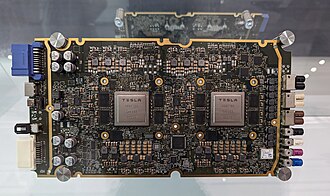
The project was first teased by Musk in early 2026 and officially announced on March 21, 2026 during a special event at the defunct Seaholm Power Plant in Austin, Texas.4 Musk described Terafab as a pivotal step toward humanity becoming a galactic civilization, with the announcement accompanied by a live SpaceX broadcast on X and conceptual imagery of a prototype 100 kW "AI Sat Mini".2 He said that the global chip industry cannot expand quickly enough to meet the demand that Tesla will have for "edge inference compute" for Tesla vehicle and Optimus humanoid robot production, nor for the special semiconductor characteristics required for orbital AI infrastructure. Musk said all the current fabrication facilities on Earth produce only about 2% of what Tesla and SpaceX will need across all projects:4 "We either build the Terafab, or we don't have the chips, and we need the chips, so we build the Terafab."7 The project integrates efforts under the SpaceX/xAI umbrella with Tesla's existing silicon development.
On April 7, 2026, Intel announced it would join the Terafab project to contribute manufacturing expertise.8 As of 2026, Intel is one of three manufacturers worldwide who are producing sub-5 nanometer (nm) chips at scale, the other two being TSMC and Samsung Electronics. In April 2026, Musk announced Intel's 14A (1.4 nm) manufacturing process would be used at the full-scale Terafab, saying that by the time Terafab scales up, the process "will be probably fairly mature or ready for prime time".6 He also announced a division of labour, with Tesla focusing on the prototype fabrication and SpaceX in the lead on the initial part of the full-scale Terafab.6
Prototype fabrication facility
Tesla plans to build a prototype "Advanced Technology Fabrication" facility at the existing Tesla GigaTexas site that will be capable of producing each of the parts of chip manufacturing in one facility in order to iterate rapidly—"make a chip, test it, revise the mask, and repeat without shipping wafers between sites"—a capability that does not currently exist in any other chip fabrication site globally. The aim is to manufacture chips for both AI edge inference and for AI model training with chips optimized for operation in space.7
The project targets 2-nanometer process technology and an initial output of 100,000 wafer starts per month,4 though this was later revised by Musk to "maybe a few thousand wafers per month, but it's really intended to try out ideas".6 Tesla's fifth-generation AI chip, AI5, is among the first products the pilot facility will be designed to produce, with small-batch production anticipated in 2026 and volume production in 2027.9
Grimes County facility
On June 3, 2026, Grimes County commissioners approved a full property tax abatement package to bring Terafab to the Gibbons Creek Reservoir, the former site of the Gibbons Creek Steam Electric Station.810
Once fully operational, the facility is expected to cover up to 10,000,000 square metres (110,000,000 square feet), which would make it one of the largest factories in the world. Some county residents have expressed concern about the scale of the project, its potential impact on the rural population, and its environmental consequences.5
Musk said that the long term goal is to have 1 million wafer starts per month and produce between 100 and 200 billion custom AI and memory chips per year.4
References
References
- "Why Tesla's Terafab Might Be Elon Musk's Biggest Challenge Yet". Business Insider. March 21, 2026.
- "SpaceX Terafab announcement". SpaceX. March 21, 2026.
- SpaceX files plan for $55 billion Terafab chip facility in Texas Reuters. (6 May 2026). Accessed on 7 May 2026.
- Lambert, Fred (March 22, 2026). "Tesla and SpaceX announce $25B 'Terafab' chip factory — here's why it reeks of desperation". Electrek. Retrieved March 22, 2026.
- Edmonds, Tom Carter, Lauren. "AI backlash has come for Elon Musk's massive Terafab chip factory in Texas". Business Insider. Retrieved June 13, 2026.
{{cite web}}: CS1 maint: multiple names: authors list (link) - "Elon Musk lays out Terafab AI chip project plan". Reuters. May 6, 2026. Retrieved May 8, 2026.
- "Elon Musk unveils $20 billion 'TeraFab' chip project to make chips, memory, and package processors all under one roof — targets a terawatt of annual compute". Tom's Hardware. March 22, 2026. Retrieved March 22, 2026.
- Sophia, Deborah Mary (April 7, 2026). "Intel joins Musk's Terafab AI chip project to power humanoid, data center goals". Reuters. Retrieved April 8, 2026.
- Mazza, Rosalia (March 14, 2026). "Tesla Terafab Project: Elon Musk Confirms Launch in Seven Days". Fintech Weekly. Retrieved March 24, 2026.
- https://www.kbtx.com/2026/06/03/grimes-county-approves-reinvestment-zone-massive-spacex-project-still-considering-tax-breaks/