| Tenebrio | |
|---|---|
| |
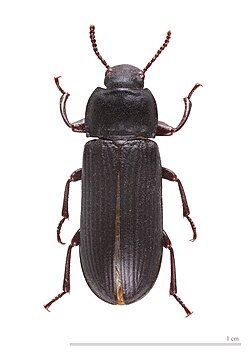
| Tenebrio molitor adult | |
Scientific classification 
| |
| Kingdom: | Animalia |
| Phylum: | Arthropoda |
| Clade: | Pancrustacea |
| Class: | Insecta |
| Order: | Coleoptera |
| Suborder: | Polyphaga |
| Infraorder: | Cucujiformia |
| Family: | Tenebrionidae |
| Subfamily: | Tenebrioninae |
| Tribe: | Tenebrionini |
| Genus: | Tenebrio Linnaeus, 1758 |
| Species | |
|
See text | |
Tenebrio is a genus of darkling beetles.23 Adults are 12–18 mm (0.47–0.71 in) long and can live for 1–2 years. The larvae are minor pests, but they are also widely reared and sold as pet food.3
Species
The genus contains the following extant species:234
- Tenebrio culinaris Linnaeus, 1758
- Tenebrio guineensis Imhoff, 1843
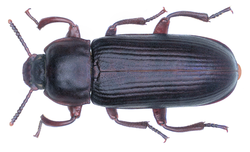
- Tenebrio giganteus (Gmelin, 1790)
- Tenebrio grandicollis (Fairmaire, 1897)
- Tenebrio molitor Linnaeus, 1758 – yellow mealworm
- Tenebrio obscurus Fabricius, 1792 – dark mealworm
- Tenebrio opacus Duftschmid, 1812
- Tenebrio patrizii Gridelli, 1958
- Tenebrio punctipennis Seidlitz, 1896
- Tenebrio zairensis Ferrer, 1998
Four species are known from fossils found in Germany and Canada:15
- Tenebrio calculensis Scudder, 1895 - (Pleistocene, Leda Clay, Canada)
- Tenebrio effossus Germar, 1837 - (Oligocene, Rott Formation, Germany)
- Tenebrio primigenius Scudder, 1879 - (Ypresian, Allenby Formation, Canada)
- Tenebrio senex Von Heyden, 1859 - (Oligocene, Rott Formation, Germany)
Gallery
-
-
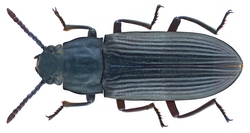 Tenebrio giganteus
 -
 Tenebrio opacus
References
References
- "†Tenebrio Linnaeus 1758". Paleobiology Database. Fossilworks. Retrieved 17 December 2021.
- "Tenebrio". Integrated Taxonomic Information System. Retrieved 4 January 2017.
- Rees, David (21 July 2004). Insects of Stored Products. CSIRO Publishing. pp. 112–113. ISBN 978-0-643-10263-7.
- "Genus Tenebrio". Insecta.pro. Insects catalog Insecta.pro, 2007—2022. 2017-08-16. Retrieved 2022-08-23.
- Scudder, S. H (1895). "Canadian fossil insects, myriapods and arachnids, Vol II. The Coleoptera hitherto found fossil in Canada". Geological Survey of Canada Contributions to Canadian Palaeontology. 2: 5–26.