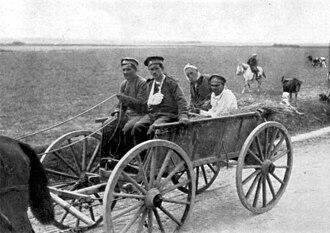
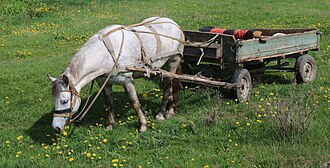
Telega (Russian: теле́га, IPA: [tʲɪˈlʲɛgə]) is a type of four-wheel horse-drawn vehicle, whose primary purpose is to carry loads, similar to a wain, known in Russia and other countries.123 It has been defined as "a special type commonly used in the southern and south-western provinces for the carriage of grain, hay and other agricultural products".4
It is described and spelled telga in Jules Verne's novel Michael Strogoff. It is spelled telyega in Leo Tolstoy's story "The Two Old Men" in Tolstoy: Tales of Courage and Conflict.5
References
References
- Телега in the Great Soviet Encyclopedia (in Russian) – via Great Scientific Library
- Smith, D.J.M. (1988). A Dictionary of Horse Drawn Vehicles. J. A. Allen & Co. Ltd. p. 160. ISBN 0851314686. OL 11597864M.
Telega. Russian passenger or stage coach. Crudely made and frequently unsprung or dead axle. A larger version of the Tarantass.
- Berkebile, Donald H. (1978). Carriage Terminology: An Historical Dictionary. Smithsonian Institution Scholarly Press. pp. 270, 273. ISBN 9781935623434. OL 4534466M.
TELEGA — A crude, springless, Russian passenger vehicle.
- "Telega carriage", an article from the Brockhaus and Efron Encyclopedic Dictionary (1890-1906)
- Charles Neider, ed., Nathan Haskell Dole, translator. New York: Carroll & Graf Publishers, Inc. (1985), p. 351.