  | |
| Observation data Epoch J2000.0 Equinox J2000.0 (ICRS) | |
|---|---|
| Constellation | Libra |
| Right ascension | 15h 38m 39.36950s1 |
| Declination | −29° 46′ 39.8956″1 |
| Apparent magnitude (V) | 3.682 |
| Characteristics | |
| Spectral type | B2.5 V3 + B9V + A1V-A2V4 |
| U−B color index | −0.7172 |
| B−V color index | −0.1792 |
| Astrometry | |
| Radial velocity (Rv) | +33.3±2.35 km/s |
| Proper motion (μ) | RA: −22.081 mas/yr Dec.: −24.461 mas/yr |
| Parallax (π) | 8.89±0.20 mas1 |
| Distance | 367 ± 8 ly (112 ± 3 pc) |
| Absolute magnitude (MV) | −1.596 |
| Orbit7 | |
| Period (P) | 3.2907 d |
| Semi-major axis (a) | 0.089 au4 |
| Eccentricity (e) | 0.28 |
| Inclination (i) | 554° |
| Longitude of the node (Ω) | 114° |
| Periastron epoch (T) | 2439272.312 JD |
| Semi-amplitude (K1) (primary) | 75 km/s |
| Semi-amplitude (K2) (secondary) | 167 km/s |
| Details | |
| τ Lib A | |
| Mass | 7.25±0.498 M☉ |
| Radius | 3.29 R☉ |
| Luminosity (bolometric) | 2,7058 L☉ |
| Surface gravity (log g) | 4.3310 cgs |
| Temperature | 17,99010 K |
| Metallicity [Fe/H] | +0.1710 dex |
| Rotational velocity (v sin i) | 1345 km/s |
| Age | 31.5±5.611 Myr |
| τ Lib B | |
| Mass | 2.754 M☉ |
| τ Lib C | |
| Mass | 2.14 M☉ |
| Other designations | |
| τ Lib, 40 Lib, CD−29°11837, HD 139365, HIP 76600, HR 5812, SAO 18364912 | |
| Database references | |
| SIMBAD | data |
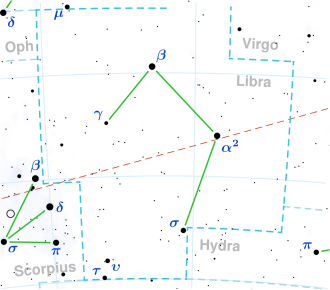
Tau Librae, Latinized from τ Librae, is a triple or quadruple system at the southern edge of the zodiac constellation of Libra. It can be seen with the naked eye, having an apparent visual magnitude of 3.68.2 The distance to this system is around 367 light years, as determined from an annual parallax shift of 8.89 mas.1
Judging by its motion through space and physical properties, this system is a member of the Upper Centaurus–Lupus group of the Scorpius–Centaurus association.5 It is a double-lined spectroscopic binary13 with an orbital period of just 3.3 days and an eccentricity of 0.28.7 The primary, component A, is a B-type main sequence star with a stellar classification of B2.5 V.3 It is estimated to hold more than seven times the mass of the Sun8 and have over three times the Sun's radius.9 It is only 31.5 million years old11 and is spinning relatively rapidly with a projected rotational velocity of 134 km/s.5 It is a heartbeat star system, with pulsations caused by tidal forces.14 The secondary, component B, is also a B-type main-sequence star, with a spectral type B9V and a mass 2.75 times that of the Sun.4
The third component, Tau Librae C, is an A-type main-sequence star with an estimated spectral type of A1V-A2V and a mass of 2.1 solar masses. It was initially detected through its astrometric signature in the Hipparcos data, and was later directly detected. The observations suggest that its orbit is highly-eccentric and/or seen nearly edge-on. Its angular separation is 60.2 mas, implying a projected separation of 6.8 au and, if close to the orbital semi-major axis, an orbital period of 5.3 years.4
There is also a wide common proper motion companion, named Gaia DR2 6209197287409304320, at 947″ (projected separation of 0.5 pc) with a temperature of 3,826 K.4
The system is emitting an infrared excess, suggesting the presence of a circumstellar disk of material.10
References
References
- van Leeuwen, F. (2007), "Validation of the new Hipparcos reduction", Astronomy and Astrophysics, 474 (2): 653–664, arXiv:0708.1752, Bibcode:2007A&A...474..653V, doi:10.1051/0004-6361:20078357, S2CID 18759600.
- Gutierrez-Moreno, Adelina; Moreno, Hugo (June 1968), "A photometric investigation of the Scorpio-Centaurus association", Astrophysical Journal Supplement, 15: 459, Bibcode:1968ApJS...15..459G, doi:10.1086/190168.
- Hiltner, W. A.; Garrison, R. F.; Schild, R. E. (July 1969), "MK Spectral Types for Bright Southern OB Stars", Astrophysical Journal, 157: 313–326, Bibcode:1969ApJ...157..313H, doi:10.1086/150069.
- Gratton, R.; Squicciarini, V.; Nascimbeni, V.; Janson, M.; Reffert, S.; Meyer, M.; Delorme, P.; Mamajek, E. E.; Bonavita, M.; Desidera, S.; Mesa, D.; Rigliaco, E.; D’Orazi, V.; Vigan, A.; Lazzoni, C.; Chauvin, G.; Langlois, M. (October 2023), "Multiples among B stars in the Scorpius-Centaurus association", Astronomy & Astrophysics, 678, arXiv:2308.09962, Bibcode:2023A&A...678A..93G, doi:10.1051/0004-6361/202346806, A93.
- Jilinski, E.; et al. (March 2006), "Radial velocity measurements of B stars in the Scorpius–Centaurus association", Astronomy and Astrophysics, 448 (3): 1001–1006, arXiv:astro-ph/0601643, Bibcode:2006A&A...448.1001J, doi:10.1051/0004-6361:20041614, S2CID 17818058.
- Anderson, E.; Francis, Ch. (2012), "XHIP: An extended hipparcos compilation", Astronomy Letters, 38 (5): 331, arXiv:1108.4971, Bibcode:2012AstL...38..331A, doi:10.1134/S1063773712050015, S2CID 119257644.
- Pourbaix, D.; et al. (2004), "SB9: The ninth catalogue of spectroscopic binary orbits", Astronomy and Astrophysics, 424 (2): 727–732, arXiv:astro-ph/0406573, Bibcode:2004A&A...424..727P, doi:10.1051/0004-6361:20041213, S2CID 119387088.
- Hohle, M. M.; et al. (April 2010), "Masses and luminosities of O- and B-type stars and red supergiants", Astronomische Nachrichten, 331 (4): 349, arXiv:1003.2335, Bibcode:2010AN....331..349H, doi:10.1002/asna.200911355, S2CID 111387483.
- Pasinetti-Fracassini, L. E.; et al. (February 2001), "Catalog of Apparent Diameters and Absolute Radii of Stars (CADARS)", Astronomy and Astrophysics, 367 (3rd ed.): 521–524, arXiv:astro-ph/0012289, Bibcode:2001A&A...367..521P, doi:10.1051/0004-6361:20000451, S2CID 425754.
- Saffe, C.; Gómez, M.; Pintado, O.; González, E. (October 2008), "Spectroscopic metallicities of Vega-like stars", Astronomy and Astrophysics, 490 (1): 297–305, arXiv:0805.3936, Bibcode:2008A&A...490..297S, doi:10.1051/0004-6361:200810260, S2CID 15059920.
- Tetzlaff, N.; Neuhäuser, R.; Hohle, M. M. (January 2011), "A catalogue of young runaway Hipparcos stars within 3 kpc from the Sun", Monthly Notices of the Royal Astronomical Society, 410 (1): 190–200, arXiv:1007.4883, Bibcode:2011MNRAS.410..190T, doi:10.1111/j.1365-2966.2010.17434.x, S2CID 118629873.
- "tau Lib". SIMBAD. Centre de données astronomiques de Strasbourg. Retrieved 2017-01-30.
{{cite web}}: CS1 maint: postscript (link) - Strom, Stephen E.; et al. (February 2005), "B Star Rotational Velocities in h and χ Persei: A Probe of Initial Conditions during the Star Formation Epoch?", The Astronomical Journal, 129 (2): 809–828, arXiv:astro-ph/0410337, Bibcode:2005AJ....129..809S, doi:10.1086/426748, S2CID 15059129.
- Sharma, Awshesh N.; Bedding, Timothy R.; Saio, Hideyuki; White, Timothy R. (2022). "Pulsating B stars in the Scorpius–Centaurus Association with TESS". Monthly Notices of the Royal Astronomical Society. 515 (1): 828–840. arXiv:2203.02582. Bibcode:2022MNRAS.515..828S. doi:10.1093/mnras/stac1816.
External links
External links
- Kaler, James B. (May 17, 2013), "Tau Librae", Stars, University of Illinois, retrieved 2017-02-02.