| TAS2R46 | |||||||||||||||||||||||||||||||||||||||||||||||||||
|---|---|---|---|---|---|---|---|---|---|---|---|---|---|---|---|---|---|---|---|---|---|---|---|---|---|---|---|---|---|---|---|---|---|---|---|---|---|---|---|---|---|---|---|---|---|---|---|---|---|---|---|
| Identifiers | |||||||||||||||||||||||||||||||||||||||||||||||||||
| Aliases | TAS2R46, T2R46, T2R54, taste 2 receptor member 46 | ||||||||||||||||||||||||||||||||||||||||||||||||||
| External IDs | OMIM: 612774; MGI: 2681256; HomoloGene: 135705; GeneCards: TAS2R46; OMA:TAS2R46 - orthologs | ||||||||||||||||||||||||||||||||||||||||||||||||||
| |||||||||||||||||||||||||||||||||||||||||||||||||||
| |||||||||||||||||||||||||||||||||||||||||||||||||||
| |||||||||||||||||||||||||||||||||||||||||||||||||||
| |||||||||||||||||||||||||||||||||||||||||||||||||||
| |||||||||||||||||||||||||||||||||||||||||||||||||||
| Wikidata | |||||||||||||||||||||||||||||||||||||||||||||||||||
| |||||||||||||||||||||||||||||||||||||||||||||||||||




Taste receptor type 2 member 46 is a protein that in humans is encoded by the TAS2R46 gene.56
Taste receptors for bitter substances (T2Rs/TAS2Rs) belong to the family of G-protein coupled receptors and are related to class A-like GPCRs. There are 25 known T2Rs in humans responsible for bitter taste perception.7
Gene
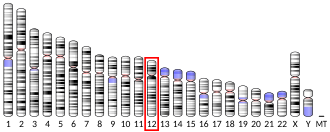
TAS2R46 gene (Taste receptor type 2 member 46) is a protein-coding gene. This gene maps to the taste receptor gene cluster on chromosome 12.8 hTAS2R46 is a bitter receptor broadly tuned to sesquiterpene lactones, related clerodane diterpenoids, labdane diterpenes and more.
Structure
In 2022, the solved structure of Tas2r469 was published in the scientific journal Science10 making it the first Tas2r with a solved structure. The structure of Tas2r46 was solved with cryo-EM and can be downloaded in the Protein Data Bank, under the following names:
7xp6- Cryo-EM structure of a class T GPCR in active state,7xp5- Cryo-EM structure of a class T GPCR in ligand-free state,7xp4- Cryo-EM structure of a class T GPCR in apo state.
There is also a prediction structure available in Alphafold, named Taste receptor type 2 member 46 this is a computational prediction and not an experimental structure.
Tissue distribution
TAS2R46 was shown to be expressed in other tissues in the human body apart from the oral cavity including human bone marrow stromal-derived cells (MSC) and their relatives, vascular smooth muscle cells (VSMC).11
Ligands
Up to now, 68 ligands were identified for T2R46 and are summarized in 9
Some of TAS2R46 ligands are approved as drugs;8 two of the more known ligands of TAS2R46 are atropine and strychnine.
Strychnine is known as a strong poison that suppresses the nerve system. Strychnine even makes an appearance in the famous Agatha Christie novel The Mysterious Affair at Styles.
Atropine injection is used to treat heart rate disorders of various types, and is used in drops to treat lazy eye condition.
Oligoporin D is one of the most potent agonists known for TAS2R46, and thus one of the most bitter substances known.12
Clinical significance
TAS2R46 was associated with Inflammatory Bowel Disease13
SNPs
Obtained from9
| Receptor | Location | BW number | Residue | MAF | dbSNP |
| TAS2R46 | IC3 | L228M | 0.3359 | rs2708380 |
Known mutations
Known mutations of TAS2R46 include the following:9
| Receptor | Location | BW number | Residue | References |
| TAS2R46 | TM2 | 2.6 | N65 | 1415 |
| TAS2R46 | TM2 | 2.61 | W66 | 141516 |
| TAS2R46 | TM2 | 2.64 | T69 | 1415 |
| TAS2R46 | TM2 | 2.65 | E70 | 14161517 |
| TAS2R46 | EC1 | 2.66 | L71 | 1718 |
| TAS2R46 | TM3 | 3.26 | I82 | 141517 |
| TAS2R46 | TM3 | 3.29 | Y85 | 1415 |
| TAS2R46 | TM3 | 3.3 | N86 | 1415 |
| TAS2R46 | TM3 | 3.32 | W88 | 1415 |
| TAS2R46 | TM3 | 3.33 | A89 | 141615 |
| TAS2R46 | TM3 | 3.36 | N92 | 141615191718 |
| TAS2R46 | TM3 | 3.37 | H93 | 141615 |
| TAS2R46 | TM3 | 3.4 | N96 | 141615 |
| TAS2R46 | TM4 | 4.6 | I147 | 1415 |
| TAS2R46 | EC2 | 4.65 | N150 | 17 |
| TAS2R46 | EC2 | 4.76 | N161 | 17 |
| TAS2R46 | TM5 | 5.38 | S175 | 14 |
| TAS2R46 | TM5 | 5.39 | N176 | 1416151718 |
| TAS2R46 | TM5 | 5.43 | T180 | 1415 |
| TAS2R46 | TM5 | 5.47 | N184 | 1415 |
| TAS2R46 | TM6 | 6.51 | Y241 | 14151718 |
| TAS2R46 | TM6 | 6.52 | F242 | 141519 |
| TAS2R46 | TM6 | 6.54 | S244 | 1415 |
| TAS2R46 | TM6 | 6.55 | I245 | 1415 |
| TAS2R46 | TM6 | 6.58 | S248 | 1415 |
| TAS2R46 | TM6 | 6.59 | V249 | 1415 |
| TAS2R46 | EC3 | 6.62 | E253 | 17 |
| TAS2R46 | TM7 | 7.35 | E261 | 141517 |
| TAS2R46 | TM7 | 7.39 | E265 | 14161517 |
| TAS2R46 | TM7 | 7.42 | A268 | 14161517 |
| TAS2R46 | TM7 | 7.43 | F269 | 141617 |
References
References
- ENSG00000262525, ENSG00000226761 GRCh38: Ensembl release 89: ENSG00000278111, ENSG00000262525, ENSG00000226761 – Ensembl, May 2017
- GRCm38: Ensembl release 89: ENSMUSG00000059382 – Ensembl, May 2017
- "Human PubMed Reference:". National Center for Biotechnology Information, U.S. National Library of Medicine.
- "Mouse PubMed Reference:". National Center for Biotechnology Information, U.S. National Library of Medicine.
- Bufe B, Hofmann T, Krautwurst D, Raguse JD, Meyerhof W (November 2002). "The human TAS2R16 receptor mediates bitter taste in response to beta-glucopyranosides". Nature Genetics. 32 (3): 397–401. doi:10.1038/ng1014. PMID 12379855. S2CID 20426192.
- "Entrez Gene: TAS2R46 taste receptor, type 2, member 46".
- Meyerhof W, Batram C, Kuhn C, Brockhoff A, Chudoba E, Bufe B, et al. (February 2010). "The molecular receptive ranges of human TAS2R bitter taste receptors". Chemical Senses. 35 (2): 157–170. doi:10.1093/chemse/bjp092. PMID 20022913.
- "TAS2R46". GeneCards.
- "hTAS2R46 - Taste receptor type 2 member 46". BitterDB. The Hebrew University of Jerusalem.
- Xu W, Wu L, Liu S, Liu X, Cao X, Zhou C, et al. (September 2022). "Structural basis for strychnine activation of human bitter taste receptor TAS2R46". Science. 377 (6612): 1298–1304. Bibcode:2022Sci...377.1298X. doi:10.1126/science.abo1633. PMID 36108005. S2CID 252310278. (This paper currently has an expression of concern, see doi:10.1126/science.adf8367, PMID 36413140, Retraction Watch)
- Lund TC, Kobs AJ, Kramer A, Nyquist M, Kuroki MT, Osborn J, et al. (2013). "Bone marrow stromal and vascular smooth muscle cells have chemosensory capacity via bitter taste receptor expression". PLOS ONE. 8 (3) e58945. Bibcode:2013PLoSO...858945L. doi:10.1371/journal.pone.0058945. PMC 3592821. PMID 23520545.
- Schmitz LM, Lang T, Steuer A, Koppelmann L, Di Pizio A, Arnold N, Behrens M (Feb 2025). "Taste-Guided Isolation of Bitter Compounds from the Mushroom Amaropostia stiptica Activates a Subset of Human Bitter Taste Receptors". J Agric Food Chem. 73 (8): 4850–4858. doi:10.1021/acs.jafc.4c12651. PMC 11869282. PMID 39945763.
- "Inflammatory Bowel Disease 11 (IBD11)". MalaCards-Human disease database. Weizmann Institute of Science.
- Sandal M, Behrens M, Brockhoff A, Musiani F, Giorgetti A, Carloni P, Meyerhof W (September 2015). "Evidence for a Transient Additional Ligand Binding Site in the TAS2R46 Bitter Taste Receptor". Journal of Chemical Theory and Computation. 11 (9): 4439–4449. doi:10.1021/acs.jctc.5b00472. PMID 26575934.
- Di Pizio A, Levit A, Slutzki M, Behrens M, Karaman R, Niv MY (2016). "Comparing Class a GPCRS to bitter taste receptors". G Protein-Coupled Receptors - Signaling, Trafficking and Regulation. Methods in Cell Biology. Vol. 132. pp. 401–427. doi:10.1016/bs.mcb.2015.10.005. ISBN 978-0-12-803595-5. PMID 26928553.
- Brockhoff A, Behrens M, Niv MY, Meyerhof W (June 2010). "Structural requirements of bitter taste receptor activation". Proceedings of the National Academy of Sciences of the United States of America. 107 (24): 11110–11115. Bibcode:2010PNAS..10711110B. doi:10.1073/pnas.0913862107. PMC 2890741. PMID 20534469.
- Fierro F, Suku E, Alfonso-Prieto M, Giorgetti A, Cichon S, Carloni P (2017). "Agonist Binding to Chemosensory Receptors: A Systematic Bioinformatics Analysis". Frontiers in Molecular Biosciences. 4: 63. doi:10.3389/fmolb.2017.00063. PMC 5592726. PMID 28932739.
- Suku E, Fierro F, Giorgetti A, Alfonso-Prieto M, Carloni P (March 2017). "Multi-scale simulations of membrane proteins: the case of bitter taste receptors". Journal of Science: Advanced Materials and Devices. 2 (1): 15–21. doi:10.1016/j.jsamd.2017.03.001. S2CID 56035188.
- Marchiori A, Capece L, Giorgetti A, Gasparini P, Behrens M, Carloni P, Meyerhof W (2013). "Coarse-grained/molecular mechanics of the TAS2R38 bitter taste receptor: experimentally-validated detailed structural prediction of agonist binding". PLOS ONE. 8 (5) e64675. Bibcode:2013PLoSO...864675M. doi:10.1371/journal.pone.0064675. PMC 3669430. PMID 23741366.
Further reading
Further reading
- Margolskee RF (January 2002). "Molecular mechanisms of bitter and sweet taste transduction". The Journal of Biological Chemistry. 277 (1): 1–4. doi:10.1074/jbc.R100054200. PMID 11696554.
- Montmayeur JP, Matsunami H (August 2002). "Receptors for bitter and sweet taste". Current Opinion in Neurobiology. 12 (4): 366–371. doi:10.1016/S0959-4388(02)00345-8. PMID 12139982. S2CID 37807140.
- Zhang Y, Hoon MA, Chandrashekar J, Mueller KL, Cook B, Wu D, et al. (February 2003). "Coding of sweet, bitter, and umami tastes: different receptor cells sharing similar signaling pathways". Cell. 112 (3): 293–301. doi:10.1016/S0092-8674(03)00071-0. PMID 12581520. S2CID 718601.
- Conte C, Ebeling M, Marcuz A, Nef P, Andres-Barquin PJ (2003). "Identification and characterization of human taste receptor genes belonging to the TAS2R family". Cytogenetic and Genome Research. 98 (1): 45–53. doi:10.1159/000068546. PMID 12584440. S2CID 1542970.
- Fischer A, Gilad Y, Man O, Pääbo S (March 2005). "Evolution of bitter taste receptors in humans and apes". Molecular Biology and Evolution. 22 (3): 432–436. doi:10.1093/molbev/msi027. PMID 15496549.
- Go Y, Satta Y, Takenaka O, Takahata N (May 2005). "Lineage-specific loss of function of bitter taste receptor genes in humans and nonhuman primates". Genetics. 170 (1): 313–326. doi:10.1534/genetics.104.037523. PMC 1449719. PMID 15744053.
This article incorporates text from the United States National Library of Medicine, which is in the public domain.