 | |
| Mission type | Technology demonstration Earth observation |
|---|---|
| Operator | Sputnix |
| COSPAR ID | 2014-033H |
| SATCAT no. | 40017 |
| Website | At sputnix.ru (Russian) |
| Mission duration | Elapsed: 12 years, 1 month |
| Spacecraft properties | |
| Launch mass | 26.2 kg (58 lb) |
| Start of mission | |
| Launch date | 19 June 2014, 19:11 (2014-06-19UTC19:11) UTC |
| Rocket | Dnepr |
| Launch site | Dombarovsky |
| Orbital parameters | |
| Reference system | Geocentric |
| Eccentricity | 0 |
| Perigee altitude | 620 km (390 mi) |
| Apogee altitude | 620 km (390 mi) |
| Inclination | 97.9° |
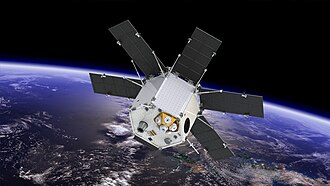
TabletSat-Aurora is a Russian micro-satellite launched in 2014. The satellite is built in shape of hexagonal prism, with 6 foldable solar panels.1 It is claimed to be the first privately developed satellite in the Russian Federation.
Launch
TabletSat-Aurora was launched from Dombarovsky site 13, Russia, on 19 June 2014 by a Dnepr rocket.2 Two-way communication with Earth was successfully established soon after launch.3
Mission
It intended to verify technologies for the future satellite constellation Earth observation technologies1 Main payload is the panchromatic photo camera capable of 15m resolution at nadir.4
References
References
- "TabletSat-Aurora". spaceflight101.com. Retrieved March 18, 2023.
- "First Russian Private Earth Remote Sensing Satellite". GIM International. Retrieved March 18, 2023.
- "Russian private satellite transmitted the first signal to Earth (translated from Russian)". June 19, 2014. Retrieved March 18, 2023.
- Krebs, Gunter D. "TabletSat-Aurora". Gunter's Space Page. Retrieved March 18, 2023.