| Tabanus sudeticus | |
|---|---|
| |
Scientific classification 
| |
| Kingdom: | Animalia |
| Phylum: | Arthropoda |
| Clade: | Pancrustacea |
| Class: | Insecta |
| Order: | Diptera |
| Family: | Tabanidae |
| Subfamily: | Tabaninae |
| Tribe: | Tabanini |
| Genus: | Tabanus |
| Species: | T. sudeticus
|
| Binomial name | |
| Tabanus sudeticus | |
| Synonyms | |
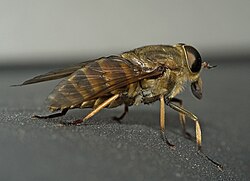
Tabanus sudeticus, also known as the dark giant horsefly, is a species of biting horse-fly.56 It is the heaviest fly in Europe.7
Description
The dark giant horsefly's length is around 20-25 millimeters.8 They have uniform dark brown eyes.8
Dark giant horseflies are a common species to be found buzzing around cows and horses.8 They usually only suck blood from horses and cows, avoiding humans.8 They fly with a very loud buzzing.89
Distribution

Tabanus sudeticus is found in many countries of Western Europe. It has a marked northern and western distribution; being found as far north as Southern Norway and the Western Isles of Scotland, and with an occasional record from Belarus.10
References
References
- Zeller, P.C. (1842). "Dipterologische Beytrage. Zweyte Abtheilung". Isis (Oken's). 1842: 807–847.
- Oldroyd, H. (1939). Tabanidae. In Edwards, F.W., Oldroyd, H. & Smart, J., British blood-sucking flies. Vol. 8. London. pp. 1–156.
{{cite book}}: CS1 maint: location missing publisher (link) - Goffe, E.R. (1931). "British Tabanidae (Diptera). With an account of the principal variation. With descriptions of a number of new forms, and of some additions to the British List". Transactions of the Entomological Society of the South of England. 6(1930): 43–114.
- Verrall, G.H. (1909). Stratiomyidae and succeeding families of the Diptera Brachycera of Great Britain In his British flies. Vol. 5. London: Gurney & Jackson. pp. 780 pp. Retrieved 14 October 2022.
- Moucha, J. (1976). "Horse-flies (Diptera: Tabanidae) of the World. Synoptic Catalogue" (PDF). Acta Entomologica Musei Nationalis Pragae Supplements. 7: 1–320. Retrieved 11 September 2022.
- Stubbs, A. & Drake, M. (2001). British Soldierflies and Their Allies: A Field Guide to the Larger British Brachycera. British Entomological & Natural History Society. pp. 512 pp. ISBN 1-899935-04-5.
- "Check out this massive fly". Naturenet. 7 June 2009. Retrieved 25 August 2020.
- THES, MoveCMS by. "Dark giant horsefly | Animal | Life Habitats". www.lifehabitats.com. Retrieved 2022-09-17.
- Chvála, Milan; Lyneborg, Leif; Moucha, Josef (1972). The Horse Flies of Europe (Diptera, Tabanidae). Copenhagen: Entomological Society of Copenhagen. pp. 598pp, 164figs. ISBN 978-09-00-84857-5.
- "Dark Giant Horse Fly Tabanus sudeticus". iNaturalist. Retrieved 10 June 2020.
