T9 is a predictive text technology for mobile phones (specifically those that contain a 3×4 numeric keypad), originally developed by Tegic Communications, now part of Nuance Communications.1 T9 stands for Text on 9 keys.
T9 was used on phones from Verizon, NEC, Nokia, Samsung Electronics, Siemens, Sony Mobile, Sanyo, SAGEM and others, as well as PDAs such as the Avigo2 during the late 1990s. The main competing technologies include iTap created by Motorola, SureType created by RIM, Eatoni's LetterWise and WordWise, and Intelab's Tauto. It is still used on niche products such as the Punkt mp-02.
As of 2010, the technology was present on more than four billion devices.34 T9 is available on certain phones without a touchscreen, and is available on Android and Apple iPhone (as of iOS 18)5 phones as a custom keyboard.
History
The development of T9 technology began in 1987 with the goal of creating an accessible text input system based on eye tracking. At the time that development was taking place, the eye tracking headsets in use could only identify eight distinct fixations. By grouping letters onto these eight target areas and constructing a database of commonly used words, the developers created a system for typing words by selecting one of each of the eight areas in sequence.6 In 1995, the inventors of T9 noticed that both their system of letter groupings and the numeric keypads on mobile phones used 8 inputs to represent every letter of the alphabet6 and chose to shift their development efforts towards mobile phones.7
In August 2007, Nuance Communications purchased Tegic Communications from its parent company AOL.18
Design
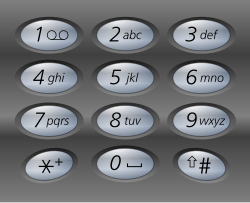
T9's objective is to make it easier to enter text messages. It allows words to be formed by a single keypress for each letter, which is an improvement over the multi-tap approach used in conventional mobile-phone text entry at the time, in which several letters are associated with each key, and selecting one letter often requires multiple keypresses. While multi-tap text entry relies on explicit disambiguation to specify each letter, T9 uses implicit disambiguation in order to identify words that are a potential match for the input of letter groupings.9
T9 combines the groups of letters on each phone key with a fast-access dictionary of words. It will then look up in the dictionary all words corresponding to the sequence of keypresses and order them by frequency of use.10 As T9 "gains familiarity" with the words and phrases the user commonly uses, it speeds up the process by offering the most frequently used words first and then letting the user access other choices with one or more presses of a predefined "Next" key.
The dictionary is expandable. After introducing a new word, the next time the user tries to produce that word, T9 adds it to the predictive dictionary. The user database (UDB) can be expanded via multi-tap. The implementation of the user database is dependent on the version of T9 and how T9 is actually integrated on the device. Some phone manufacturers supply a permanent user database, while others do so for the duration of the session.
Features
Some T9 implementations feature smart punctuation. This feature allows the user to insert sentence and word punctuation using the '1'-key. Depending on the context, smart punctuation inserts sentence punctuation (period or 'full stop') or embedded punctuation (period or hyphen) or word punctuation (apostrophe in can't, won't, isn't, and the possessive 's). Depending on the language, T9 also supports word breaking after punctuation to support clitics such as l' and n' in French and 's in English.
For words entered by the user, word completion can be enabled. When the user enters matching keypresses, in addition to words and stems, the system also provides completions.
In later versions of T9, the user can select a primary and secondary language and access matches from both languages. This enables users to write messages in their native language, as well as a foreign one.
Some implementations learn commonly used word pairs and provide word prediction (e.g. if one often writes "eat food", after entering "eat" the phone will suggest "food", which can be confirmed by pressing Next).
T9 can automatically recognize and correct typing/texting errors, by looking at neighboring keys on the keypad to determine an incorrect keypress. For example, the word "testing" is entered with the key combination "8378464". Entering the same number but with two incorrect keypresses of neighboring keys, e.g. "8278494", results in T9 suggesting the words "tasting" (8278464), "testing" (8378464), and "tapping" (8277464).
Algorithm
In order to achieve compression ratios of close to 1 byte per word, T9 uses an optimized algorithm that maintains word order and partial words (also known as stems); however, because of this compression, it over-generates words that are sometimes visible as "junk words". This is a side effect of the requirements for small database sizes on the lower end embedded devices.
Examples
On a phone with a numeric keypad, each time a key (1–9) is pressed (when in a text field), the algorithm returns a guess for what letters are most likely for the keys pressed to that point. For example, to enter the word 'the', the user would press 8 then 4 then 3, and the display would display 't' then 'th' then 'the'. If the less-common word 'fore' is intended (3673) the predictive algorithm may select 'Ford'. Pressing the 'next' key (typically the '*' key) might bring up 'dose', and finally 'fore'. If 'fore' is selected, then the next time the user presses the sequence 3673, fore will be more likely to be the first word displayed. If the word "Felix" is intended, however, when entering 33549, the display shows 'E', then 'De', 'Del', 'Deli', and 'Felix.' This is an example of a letter changing while entering words.
Successors
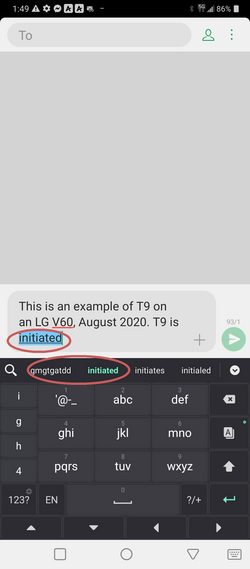
Many smart keyboards now exist, such as Gboard or Swiftkey, that have taken the idea of T9 and combined it with the advanced touchscreen technology found in Android phones and iPhones. These advances have made T9 obsolete in newer mobile phones for many users, since it is predicated on the use of a keypad with nothing besides numbers, the asterisk (*) and the pound/number/hash sign (#). Many features, such as predictive text, have been adopted by and improved by future generations of keyboard software. However, T9 remains viable. For example, those with larger fingertips still use the T9-based keyboard on smartphones for text entry, because key press accuracy increases with the larger screen area per key on a numeric-style 4×3 keyboard. Such T9 formats for text entry therefore remain available in all latest [as of August 2020] iterations of LG keyboards, certain Samsung keyboards, and third-party T9 keyboards such as Go keyboard for Androids and Type Nine for iPhones, as shown on this LG V60.
References
References
- "Nuance Closes Acquisition of Tegic Communications" (Press release). Burlington, Massachusetts. 24 August 2007. Archived from the original on 2007-10-13.
- Day, Rebecca (July 1998). "Keeping It Together". Popular Mechanics. Vol. 175, no. 7. p. 70. ISSN 0032-4558. Retrieved 2026-07-07.
- Wortham, Jenna (2010-06-20). "Phone Software Takes the Taps Out of Typing". The New York Times. ISSN 0362-4331. Retrieved 2026-07-07.
- Ganapati, Priya (2010-09-24). "T9 predictive text inventor dies". Wired. ISSN 1059-1028. Retrieved 2026-07-07.
- Mayo, Benjamin (16 September 2024). "iOS 18 finally adds T9 dialling on iPhone". 9to5Mac. Archived from the original on 18 September 2024. Retrieved 20 September 2024.
- Dornan, Andy (2002-04-01). The essential guide to wireless communications applications: from cellular systems to Wi-Fi (2nd ed.). Prentice Hall. p. 308. ISBN 978-0-13-009718-7.
- Hafner, Katie (1999-06-17). "NEWS WATCH; Speeding Up Communication By Saving Strokes on a Keypad". The New York Times. ISSN 0362-4331. Retrieved 2026-07-06.
- EX-99.7 UNAUDITED PRO FORMA COMBINED FINANCIAL STATEMENTS OF NUANCE COMMUNICATIONS, INC. United States Securities and Exchange Commission. Retrieved 2026-07-07.
- Davis, James Raymond. "Let Your Fingers do the Spelling: Implicit disambiguation of words spelled with the telephone keypad" (PDF). AVIOS Journal (9): 57–66.
- Guernsey, Lisa (2000-10-12). "Even for Those With All Thumbs, Help With Cell Phone Messaging". The New York Times. ISSN 0362-4331. Retrieved 2026-07-06.