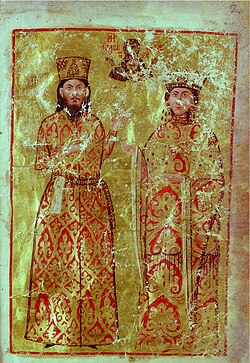
The Synadenos family (Greek: Συναδηνός), feminine form Synadene (Συναδηνή), was an important middle and late Byzantine aristocratic family, hailing from Synnada in Phrygia, in the Anatolic Theme.
History
The family name is attested in a 9th/10th century seal, but the first known family member is Philetos Synadenos, krites of Tarsus ca. 1000/6. During the 11th and 12th centuries, several family members appear as military commanders, connected to the great aristocratic families of Botaneiates and Komnenos; thus Basil Synadenos was governor of Dyrrhachium in the 1040s, a member of the family, daughter of commander Theodoulos Synadenos, was given as wife to the Hungarian king Géza I by her maternal uncle Nikephoros III Botaneiates, Irene Diplosynadene (meaning that both her parents hailed from the Synadenos family)1 was the second wife of Isaac Komnenos, and Andronikos Synadenos was governor of several provinces under Manuel I Komnenos, including Cyprus and Durazzo as a military governor and married Zoe Angelina, aunt of future emperors Isaac II Angelos and Alexios III Angelos, dying in 1180.
In the Empire of Nicaea, the Synadenoi were members of the aristocratic opposition to the ruling Laskaris dynasty. The family reached is peak under the Palaiologan emperors in the late 13th and first half of the 14th century: John Synadenos married Theodora Palaiologina, the niece of Emperor Michael VIII Palaiologos, and served as megas stratopedarches, and his sons John and Theodore likewise held senior military commands. The elder John and Theodora also founded the Convent of Bebaia Elpis, and commissioned a splendidly illustrated typikon, with portraits of the family's members. At this time, the Synadenoi intermarried with two other prominent aristocratic families, the Asen and the Raoul.
Sources
Sources
- Kazhdan, Alexander (1991). "Synadenos". In Kazhdan, Alexander (ed.). The Oxford Dictionary of Byzantium. Oxford and New York: Oxford University Press. p. 1990. ISBN 0-19-504652-8.
- Polemis, Demetrios I. (1968). The Doukai: A Contribution to Byzantine Prosopography. London: The Athlone Press. pp. 178–182.
- Varzos 1984a, pp. 396–398. sfn error: no target: CITEREFVarzos1984a (help)