In the mathematical field of category theory, a subobject classifier is a special object of a category such that, informally, the subobjects of any object correspond to the morphisms from to . This provides an analogue of the set of Booleans in categories other than the category of sets.
The main use of subobject classifiers is in topos theory, where an elementary topos is defined as a category with a subobject classifier and certain additional requirements. In the internal language of an elementary topos, the subobject classifier is used to interpret truth values, hence the alternative name “object of truth values”.
Introduction
Let be a set. A subset can be equivalently described by its indicator function
Informally, subsets of can be identified with functions . A subobject classifier of a category is an object which plays a similar role as does in the category of sets: subobjects of an object can be identified with morphisms from to the subobject classifier. To recover the subset with indicator function in a “purely categorical way”, one can take a pullback
where the function from to is the inclusion map. Indeed, the subset , equipped with the inclusion map (and the unique, constant map ) is such a pullback because it has the correct universal property since a map into which gives the constant function 1 when composed with is the same as a map into . A purely categorical characterization of “ is the subset with characteristic function ” is that the diagram above is a pullback.
Definition
For the general definition, we start with a category C that has a terminal object, which we denote by 1. The object Ω of C is a subobject classifier for C if there exists a morphism
- 1 → Ω
with the following property:
- For each monomorphism j: U → X there is a unique morphism χj: X → Ω such that the following commutative diagram
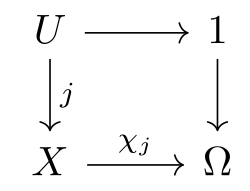
- is a pullback diagram—that is, U is the limit of the diagram:
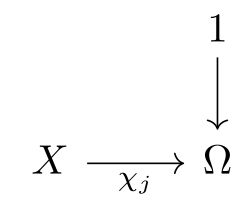
The morphism χ j is then called the classifying morphism for the subobject represented by j.
Further examples
Sheaves of sets
The category of sheaves of sets on a topological space X has a subobject classifier Ω which can be described as follows: For any open set U of X, Ω(U) is the set of all open subsets of U. The terminal object is the sheaf 1 which assigns the singleton {*} to every open set U of X. The morphism η:1 → Ω is given by the family of maps ηU : 1(U) → Ω(U) defined by ηU(*)=U for every open set U of X. Given a sheaf F on X and a sub-sheaf j: G → F, the classifying morphism χ j : F → Ω is given by the family of maps χ j,U : F(U) → Ω(U), where χ j,U(x) is the union of all open sets V of U such that the restriction of x to V (in the sense of sheaves) is contained in jV(G(V)).
Roughly speaking an assertion inside this topos is variably true or false, and its truth value from the viewpoint of an open subset U is the open subset of U where the assertion is true.
Presheaves
Given a small category , the category of presheaves (i.e. the functor category consisting of all contravariant functors from to ) has a subobject classifer given by the functor sending any to the set of sieves on . The classifying morphisms are constructed quite similarly to the ones in the sheaves-of-sets example above.
Elementary topoi
Both examples above are subsumed by the following general fact: every elementary topos, defined as a category with finite limits and power objects, necessarily has a subobject classifier.1 The two examples above are Grothendieck topoi, and every Grothendieck topos is an elementary topos.
Related concepts
A quasitopos has an object that is almost a subobject classifier; it only classifies strong subobjects.
Notes
Notes
- Pedicchio & Tholen (2004) p.8
References
References
- Artin, Michael; Alexander Grothendieck; Jean-Louis Verdier (1964). Séminaire de Géometrie Algébrique IV. Springer-Verlag.
- Barr, Michael; Wells, Charles (1985). Toposes, Triples and Theories. Springer-Verlag. ISBN 0-387-96115-1.
- Bell, John (1988). Toposes and Local Set Theories: an Introduction. Oxford: Oxford University Press.
- Goldblatt, Robert (1983). Topoi: The Categorial Analysis of Logic. North-Holland, Reprinted by Dover Publications, Inc (2006). ISBN 0-444-85207-7.
- Johnstone, Peter (2002). Sketches of an Elephant: A Topos Theory Compendium. Oxford: Oxford University Press.
- Johnstone, Peter (1977). Topos Theory. Academic Press. ISBN 0-12-387850-0.
- Mac Lane, Saunders (1998). Categories for the Working Mathematician. Graduate Texts in Mathematics. Vol. 5 (2nd ed.). New York, NY: Springer-Verlag. ISBN 0-387-98403-8. Zbl 0906.18001.
- Mac Lane, Saunders; Moerdijk, Ieke (1992). Sheaves in Geometry and Logic: a First Introduction to Topos Theory. Springer-Verlag. ISBN 0-387-97710-4.
- McLarty, Colin (1992). Elementary Categories, Elementary Toposes. Oxford: Oxford University Press. ISBN 0-19-853392-6.
- Pedicchio, Maria Cristina; Tholen, Walter, eds. (2004). Categorical foundations. Special topics in order, topology, algebra, and sheaf theory. Encyclopedia of Mathematics and Its Applications. Vol. 97. Cambridge: Cambridge University Press. ISBN 0-521-83414-7. Zbl 1034.18001.
- Taylor, Paul (1999). Practical Foundations of Mathematics. Cambridge: Cambridge University Press. ISBN 0-521-63107-6.