Article · Wikipedia archive · Last revised Aug 12, 2026

Subdivision (simplicial set)

In higher category theory in mathematics, the subdivision of simplicial sets is an endofunctor on the category of simplicial sets. It refines the structure of simplicial sets in a purely combinatorical way without changing constructions like the geometric realization. Furthermore, the subdivision of simplicial sets plays an important role in the extension of simplicial sets right adjoint to it.

Last revised
Aug 12, 2026
Read time
≈ 6 min
Length
1,309 w
Citations
8
Source
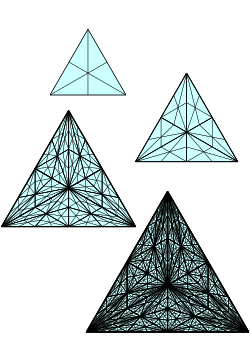
Process of subdivision of the standard 2 {\displaystyle 2} -simplex Δ 2 {\displaystyle \Delta ^{2}} : The partially ordered set [ 2 ] = { 0 , 1 , 2 } {\displaystyle [2]=\{0,1,2\}} with 0 1 {\displaystyle 0\leq 1} , 1 2 {\displaystyle 1\leq 2} and 0 2 {\displaystyle 0\leq 2} forms a triangle, while the partially ordered set s ( [ 2 ] ) = { { 0 } , { 1 } , { 2 } , { 0 , 1 } , { 1 , 2 } , { 0 , 2 } , { 0 , 1 , 2 } } {\displaystyle s([2])=\{\{0\},\{1\},\{2\},\{0,1\},\{1,2\},\{0,2\},\{0,1,2\}\}} forms its subdivision with { 0 } {\displaystyle \{0\}} , { 1 } {\displaystyle \{1\}} and { 2 } {\displaystyle \{2\}} being the original triangle, { 0 , 1 } {\displaystyle \{0,1\}} , { 1 , 2 } {\displaystyle \{1,2\}} and { 0 , 2 } {\displaystyle \{0,2\}} subdividing the edges and { 0 , 1 , 2 } {\displaystyle \{0,1,2\}} subdividing the face. source ↗

In higher category theory in mathematics, the subdivision of simplicial sets (subdivision functor or Sd functor) is an endofunctor on the category of simplicial sets. It refines the structure of simplicial sets in a purely combinatorical way without changing constructions like the geometric realization. Furthermore, the subdivision of simplicial sets plays an important role in the extension of simplicial sets right adjoint to it.

Definition

For a partially ordered set I {\displaystyle I} , let s ( I ) {\displaystyle s(I)} be the set of non-empty finite totally ordered subsets, which itself is partially ordered by inclusion. Every partially ordered set can be considered as a category. Postcomposition with the nerve N : C a t s S e t {\displaystyle N\colon \mathbf {Cat} \rightarrow \mathbf {sSet} } defines the subdivision functor Sd : Δ s S e t {\displaystyle \operatorname {Sd} \colon \Delta \rightarrow \mathbf {sSet} } on the simplex category by:

Sd ( Δ n ) := N ( s ( [ n ] ) ) . {\displaystyle \operatorname {Sd} (\Delta ^{n}):=N(s([n])).}

On the full category of simplicial sets, the subdivision functor Sd : s S e t s S e t {\displaystyle \operatorname {Sd} \colon \mathbf {sSet} \rightarrow \mathbf {sSet} } , similar to the geometric realization, is defined through an extension by colimits. For a simplicial set X {\displaystyle X} , one therefore has:1

Sd ( X ) := lim Δ n X Sd ( Δ n ) . {\displaystyle \operatorname {Sd} (X):=\varinjlim _{\Delta ^{n}\rightarrow X}\operatorname {Sd} (\Delta ^{n}).}

With the maximum max : s ( I ) I {\displaystyle \max \colon s(I)\rightarrow I} , which in partially ordered sets neither has to exist nor has to be unique, which both holds in totally ordered sets, there is a natural transformation a : Sd Id {\displaystyle a\colon \operatorname {Sd} \Rightarrow \operatorname {Id} } by extension. In particular there is a canonical morphism a X : Sd ( X ) X {\displaystyle a_{X}\colon \operatorname {Sd} (X)\rightarrow X} for every simplicial set X {\displaystyle X} .

Sd∞ functor

For a simplicial set X {\displaystyle X} , the canonical morphism a X : Sd ( X ) X {\displaystyle a_{X}\colon \operatorname {Sd} (X)\rightarrow X} indudes an N {\displaystyle \mathbb {N} } -shaped cocone Sd 3 ( X ) Sd 2 ( X ) Sd ( X ) X {\displaystyle \ldots \rightarrow \operatorname {Sd} ^{3}(X)\rightarrow \operatorname {Sd} ^{2}(X)\rightarrow \operatorname {Sd} (X)\rightarrow X} , whose colimit is denoted:

Sd ( X ) := lim n N Sd n ( X ) . {\displaystyle \operatorname {Sd} ^{\infty }(X):=\varprojlim _{n\in \mathbb {N} }\operatorname {Sd} ^{n}(X).}

Since limit and colimit are switched, there is no adjunction Sd Ex {\displaystyle \operatorname {Sd} ^{\infty }\dashv \operatorname {Ex} ^{\infty }} with the Ex∞ functor.

The natural transformation a : Sd Id {\displaystyle a\colon \operatorname {Sd} \Rightarrow \operatorname {Id} } induces a natural transformation α : Sd Id {\displaystyle \alpha \colon \operatorname {Sd} ^{\infty }\Rightarrow \operatorname {Id} } . In particular, there is a canonical morphism α X : Sd ( X ) X {\displaystyle \alpha _{X}\colon \operatorname {Sd} ^{\infty }(X)\rightarrow X} for every simplicial set X {\displaystyle X} .

Examples

Directly from the definition, one has:2

Sd ( Δ 0 ) = Δ 0 , {\displaystyle \operatorname {Sd} (\Delta ^{0})=\Delta ^{0},}
Sd ( Δ 1 ) = Λ 2 2 . {\displaystyle \operatorname {Sd} (\Delta ^{1})=\Lambda _{2}^{2}.}

Since Δ 1 Δ 0 + Δ 0 {\displaystyle \partial \Delta ^{1}\cong \Delta ^{0}+\Delta ^{0}} , it is fixed under (infinite) subdivision:

Sd ( Δ 1 ) = Δ 1 , {\displaystyle \operatorname {Sd} (\partial \Delta ^{1})=\partial \Delta ^{1},}
Sd ( Δ 1 ) = Δ 1 . {\displaystyle \operatorname {Sd} ^{\infty }(\partial \Delta ^{1})=\partial \Delta ^{1}.}

Properties

  • For every simplicial set X {\displaystyle X} , the canonical morphism a X : Sd ( X ) X {\displaystyle a_{X}\colon \operatorname {Sd} (X)\rightarrow X} is a weak homotopy equivalence.3
  • The subdivision functor Sd {\displaystyle \operatorname {Sd} } preserves monomorphisms and weak homotopy equivalences (which follows directly from the preceding property and their 2-of-3 property) as well as anodyne extensions in combination,4 hence cofibrations and trivial cofibrations of the Kan–Quillen model structure. This makes the adjunction Sd Ex {\displaystyle \operatorname {Sd} \dashv \operatorname {Ex} } even into a Quillen adjunction Sd : s S e t K Q s S e t K Q : Ex {\displaystyle \operatorname {Sd} \colon \mathbf {sSet} _{\mathrm {KQ} }\rightleftarrows \mathbf {sSet} _{\mathrm {KQ} }\colon \operatorname {Ex} } .
  • For a partially ordered set I {\displaystyle I} , one has with the nerve:5
    Sd ( N ( I ) ) N ( s ( I ) ) . {\displaystyle \operatorname {Sd} (N(I))\cong N(s(I)).}
Using I = [ n ] {\displaystyle I=[n]} with Δ n = N ( [ n ] ) {\displaystyle \Delta ^{n}=N([n])} results in the definition again.
  • Let Φ k n {\displaystyle \Phi _{k}^{n}} be the set of non-empty subsets of [ n ] {\displaystyle [n]} , which don't contain the complement of { k } {\displaystyle \{k\}} , and let Φ n {\displaystyle \partial \Phi ^{n}} be the set of non-empty proper subsets of [ n ] {\displaystyle [n]} , then:6
    Sd ( Λ k n ) N ( Φ k n ) , {\displaystyle \operatorname {Sd} (\Lambda _{k}^{n})\cong N(\Phi _{k}^{n}),}
    Sd ( Δ n ) N ( Φ n ) . {\displaystyle \operatorname {Sd} (\partial \Delta ^{n})\cong N(\partial \Phi ^{n}).}
  • The subdivision functor preserves the geometric realization. For a simplicial set X {\displaystyle X} , one has:7
    | Sd ( X ) | | X | . {\displaystyle |\operatorname {Sd} (X)|\cong |X|.}
Since both functors are defined through extension by colimits, it is sufficient to show | Sd ( Δ n ) | = | Δ n | {\displaystyle |\operatorname {Sd} (\Delta ^{n})|=|\Delta ^{n}|} .8
See also

See also

Literature

References

References

  1. Goerss & Jardine 1999, S. 183
  2. Cisinski 2019, 3.8.6.
  3. Cisinski 2019, Proposition 3.1.19.
  4. Cisinski 2019, Proposition 3.1.18.
  5. Cisinski 2019, Lemma 3.1.25.
  6. Cisinski 2019, Lemma 3.1.26.
  7. Lurie, Jacob. "Kerodon, Proposition 3.3.3.7". kerodon.net. Retrieved 2025-04-19.
  8. Goerss & Jardine 1999, S. 182
External links