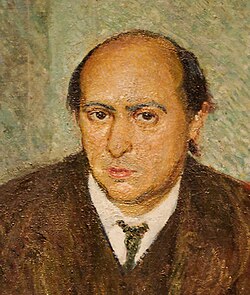
The Austrian composer Arnold Schoenberg published four string quartets, distributed over his lifetime: String Quartet No. 1 in D minor, Opus 7 (1905), String Quartet No. 2 in F♯ minor, Op. 10 (1908), String Quartet No. 3, Op. 30 (1927), and the String Quartet No. 4, Op. 37 (1936).
In addition to these, he wrote several other works for string quartet which were not published. The most notable was his early String Quartet in D major (1897). There was also a Presto in C major (c. 1895),1 a Scherzo in F major (1897),2 and later a Four-part Mirror Canon in A major (c. 1933).3 Finally, several string quartets exist in fragmentary form. These include String Quartet in F major (before 1897), String Quartet in D minor (1904), String Quartet in C major (after 1904), String Quartet Movement (1926), String Quartet (1926), String Quartet in C major (after 1927) and String Quartet No. 5 (1949).
Schoenberg also wrote a Concerto for String Quartet and Orchestra in B♭ major (1933): a recomposition of a work by the Baroque composer George Frideric Handel.
String Quartet in D major
This string quartet in four movements is Schoenberg's earliest extant work of large scale: average duration of recorded performances is about 27 minutes. Completed in 1897, it was premiered privately on March 17, 1898, and publicly later that same year on December 20 in Vienna. It was published posthumously in 1966 (Faber Music, London).
Schoenberg's friend Alexander von Zemlinsky gave him much advice and criticism during the composition of this work. Zemlinsky even showed an early draft of it to Johannes Brahms, whom Schoenberg very much admired. It was given the old master's approval.4
The string quartet is in four movements:
- Allegro molto
- Intermezzo (Andantino grazioso)
- Theme and Variations (Andante con moto)
- Allegro
The original second movement was the Scherzo in F which now exists as a separate piece. Schoenberg substituted the Intermezzo at Zemlinsky's suggestion.
String Quartet No. 1, Op. 7

A large work consisting of one movement which lasts longer than 45 minutes, Schoenberg's First String Quartet established his reputation as a composer. Begun in the summer of 1904 and completed in September 1905, the quartet is remarkable for its density of its orchestration.
The quartet is in D minor. The tonality is stretched to the limit as was common in late Romantic music. It also carries a small collection of themes which appear repeatedly in many guises. Instead of balanced phrase structures typical of string quartet writing up to that period, Schoenberg wrote asymmetrical phrases that build into larger cohesive groups.
According to Schoenberg, when he showed the score to Gustav Mahler, the composer exclaimed: "I have conducted the most difficult scores of Wagner; I have written complicated music myself in scores of up to thirty staves and more; yet here is a score of not more than four staves, and I am unable to read them."5
String Quartet No. 2, Op. 10
This work in four movements was written during a very emotional time in Schoenberg's life. Though it bears the dedication "to my wife", it was written during Mathilde Schoenberg's affair with their friend and neighbour, artist Richard Gerstl, in 1908. It was first performed by the Rosé Quartet and the soprano Marie Gutheil-Schoder.
The second movement quotes the Viennese folk song, "O du lieber Augustin".6 As musical settings of Stefan George's poetry, the third and fourth movements feature a soprano; a 1914 Vossische Zeitung critic called this innovation in genre Beethovenian (alluding to the Symphony No. 9, a choral symphony).7
On setting George, Schoenberg later wrote, "I was inspired by [his] poems ... and, surprisingly, without any expectation on my part, these songs showed a style quite different from everything I had written before. ... New sounds were produced, a new kind of melody appeared, a new approach to expression of moods and characters was discovered."8
The string quartet is in four movements:
- Mäßig (Moderate), F♯ minor
- Sehr rasch (Very brisk), D minor
- "Litanei", langsam ("Litany", slow), E♭ minor, though from a Schenkerian perspective, "in spite of the decisive bass reading, the upper voice fails to unfold a fundamental line from the structural
 "9 or G♭ major10
 - "Entrückung", sehr langsam ("Rapture", very slow)
Text
The latter two movements of the Second String Quartet are set to poems from Stefan George's collection Der siebente Ring (The Seventh Ring), which was published in 1907.
Litanei
Tief ist die trauer die mich umdüstert,
Ein tret ich wieder, Herr! in dein haus.
Lang war die reise, matt sind die glieder,
Leer sind die schreine, voll nur die qual.
Durstende zunge darbt nach dem weine.
Hart war gestritten, starr ist mein arm.
Gönne die ruhe schwankenden schritten,
Hungrigem gaume bröckle dein brot!
Schwach ist mein atem rufend dem traume,
Hohl sind die hände, fiebernd der mund.
Leih deine kühle, lösche die brände.
Tilge das hoffen, sende das licht!
Gluten im herzen lodern noch offen,
Innerst im grunde wacht noch ein schrei.
Töte das sehnen, schliesse die wunde!
Nimm mir die liebe, gib mir dein glück!
Litany
Deep is the sadness that gloomily comes over me,
Again I step, Lord, in your house.
Long was the journey, my limbs are weary,
The shrines are empty, only anguish is full.
My thirsty tongue desires wine.
The battle was hard, my arm is stiff.
Grudge peace to my staggering steps,
for my hungry gums break your bread!
Weak is my breath, calling the dream,
my hands are hollow, my mouth fevers.
Lend your coolness, douse the fires,
rub out hope, send the light!
Still active flames are glowing inside my heart;
in my deepest insides a cry awakens.
Kill the longing, close the wound!
Take love away from me, and give me your happiness!
Entrückung
Ich fühle luft von anderem planeten.
Mir blassen durch das dunkel die gesichter
Die freundlich eben noch sich zu mir drehten.
Und bäum und wege die ich liebte fahlen
Dass ich sie kaum mehr kenne und du lichter
Geliebter schatten—rufer meiner qualen—
Bist nun erloschen ganz in tiefern gluten
Um nach dem taumel streitenden getobes
Mit einem frommen schauer anzumuten.
Ich löse mich in tönen, kreisend, webend,
Ungründigen danks und unbenamten lobes
Dem grossen atem wunschlos mich ergebend.
Mich überfährt ein ungestümes wehen
Im rausch der weihe wo inbrünstige schreie
In staub geworfner beterinnen flehen:
Dann seh ich wie sich duftige nebel lüpfen
In einer sonnerfüllten klaren freie
Die nur umfängt auf fernsten bergesschlüpfen.
Der boden schüffert weiss und weich wie molke.
Ich steige über schluchten ungeheuer.
Ich fühle wie ich über letzter wolke
In einem meer kristallnen glanzes schwimme—
Ich bin ein funke nur vom heiligen feuer
Ich bin ein dröhnen nur der heiligen stimme.
Rapture
I feel air from another planet.
The faces that once turned to me in friendship
Pale in the darkness before me.
And trees and paths that I once loved fade away
So that I scarcely recognize them, and you bright
Beloved shadow—summoner of my anguish—
Are now extinguished completely in deeper flames
In order, after the frenzy of warring confusion,
To reappear in a pious display of awe.
I lose myself in tones, circling, weaving,
With unfathomable thanks and unnamable praise;
Bereft of desire, I surrender myself to the great breath.
A tempestuous wind overwhelms me
In the ecstasy of consecration where the fervent cries
Of women praying in the dust implore:
Then I see a filmy mist rising
In a sun-filled, open expanse
That includes only the farthest mountain retreats.
The land looks white and smooth like whey.
I climb over enormous ravines.
I feel like I am swimming above the furthest cloud
In a sea of crystal radiance—
I am only a spark of the holy fire
I am only a whisper of the holy voice.
String Quartet No. 3, Op. 30
Schoenberg's Third String Quartet dates from 1927, after he had worked out the basic principles of his twelve-tone technique. Schoenberg had followed the "fundamental classicistic procedure" by modeling this work on Schubert's String Quartet in A minor, Op. 29, without intending in any way to recall Schubert's composition.11 There is evidence that Schoenberg regarded his 12-tone sets—independent of rhythm and register—as motivic in the commonly understood sense, and this has been demonstrated with particular reference to the second movement of this quartet.12
Arts patron Elizabeth Sprague Coolidge, whose foundation materials are held at the Library of Congress,13 commissioned the Quartet, Op. 30 on March 2, 1927. The work had already been completed by this time, and its première was given in Vienna on September 19, 1927, by the Kolisch Quartet.
The string quartet is in four movements:
- Moderato
- Theme and Variations (Adagio)
- Intermezzo (Allegro moderato)
- Rondo (Molto moderato)
String Quartet No. 4, Op. 37
Schoenberg's Fourth String Quartet (April–June 1936, commissioned by Coolidge) marks his transition to a late style.14 It is freer than the Third,13 and he found it perhaps more "pleasant".15 He had relocated to Brentwood, Los Angeles13 to teach at the University of California, Los Angeles,16 and was revisiting tonal idioms while still working on the opera Moses und Aron13 (planned since 1923).17 He had last finished Three Songs, Op. 48 (Berlin, 1933) and begun the Violin Concerto (United States, 1934–36).16 After sketches, he wrote the Quartet in six weeks for $1,000,15 finishing the Concerto midway.16 The Concerto's first movement culminates in a structurally integrating passage like many in the Quartet,16 which is more cohesive.15 He did not finish another twelve-tone work until the Ode to Napoleon14 (1942).17
Movements
The Quartet has four motivically linked movements:16
- Allegro molto, energico
- Comodo
- Largo
- Allegro – agitato
They have the same twelve-tone row.16
I. Allegro molto, energico
The first movement, marked Allegro molto, energico (lit. 'Very fast, energetic'), is a march by turns calm and agitated.15 An abstract sonata form veiled by extensive thematic variation,13 Schoenberg wrote that it "resembles catalogued forms in only a few respects".18 Its musical argument is audible as two head-motives that accrue different structural associations, including
- row forms (source row forms P2 and I7),
- meters (broadly quadruple and triple),
- textures (generally thicker and thinner), and
- tonalities (primarily D minor and its submediant, B♭ major).19
This exemplifies Schoenberg's "musical idea" (Idee or musikalische Gedanke): "the totality ... its creator wanted to present."20a As a process, narrative, or dialectic, especially in tonal music, the idea is realized as the Grundgestalt (thesis). This basic shape generates tensions (the antithesis) during composition,22 which decisions reinforcing structural coherence may resolveb through synthesis (unity of opposites).23c
Exposition
Primary theme
The periodic13 Grundgestalt melody is shaped from P2, with trichords <2,1,9>, <10,5,3>, <4,0,8>, and <7,6,11>. Its first five pitches outline D minor crossing into B♭ major (solfège: do–ti–sol/ti–do–sol). Seminal dyads <2,1> (D–C♯) and <8,7> (A♭–G) are accented.25 Beethoven's "fate" motif is evoked rhythmically.15 The accompaniment first projects 4
4 via aggregate-completing trichord groups (mm. 1–3), but the heard meter is registrally conflicted and fluid. A D-major-seventh chord via {1,2,9} leads into a B♭ sonority via <10,5,3> at a quasi-cadence (mm. 4–5).25
Midway, a pickup introduces head-motive I7: <7,8,0>, rendered vertically in a dotted rhythm as if in 3
4 (mm. 6–7). B♭–oriented dominant–tonic motion follows (mm. 8–9).26 The accompaniment restores 4
4 (mm. 10–12), and a pitch-class palindrome (mm. 13–16) suggests similar D–focused harmonic motion, ending with <2,1,9> in the first violin's Hauptstimme (chief melody).27 In the continuation, <7,8,0> recurs in triplets across registers (mm. 21–22) and, amid B♭–oriented motion, in second violin's palindrome (<7,8,0,0,8,7>, mm. 23–24).28
Transition
The transition has two portions (mm. 27–42 and 42–62)29 and a cadence (mm. 62b–65),30 with modulation-like aggregate transpositions from home-key-like A2 through A7, A4, A10, and A6, to dominant-like A9.31
Building on earlier palindromic passages, a mirror in mm. 27–31 spans a succession of four row forms (P2, I7, R2, and RI7) in the violins, with the pitch-class retrograde in the lower strings. The row forms are partitioned into hexachords in the upper strings with complements in the lower strings.32d Mosaics, formed through the distribution of pitch-class sets in the violins, structure the trichord exchange relations
- P2: <2,19> (violins) and I7: <9,1,2> (cello), and then
- I7: <7,80> (violins) and P2: <0,8,7> (cello).
Midway, these exchange relations are paralleled in the second violin and lower strings.32 (A related pitch-class mirror in mm. 42–44 suggests B♭: ti–do–mi via <9,10,2> in the violin Hauptstimme.)34
In mm. 35–37, the violins' partition of P7 as <7,6,2,3,10,8,¦9,5,1,0,11,4> previews the development theme (mm. 116ff.), while the lower strings' related partition of I0 previews the start of the secondary theme (mm. 66–68), together prefiguring these themes' contrapuntal recapitulation (mm. 188ff.).35
Secondary theme
For the secondary theme (mm. 66–94),29 Schoenberg uses harmonies like an A minor-major seventh chord to allude to expository tonic–dominant modulation.e The cello Nebenstimme, or counter-melody, reprises the seminal dyads, transposed, in continuous chromatic descent, entering with <9,8> just before the theme and continuing with <7,6> beneath it (mm. 66–68).37
Development
The development (mm. 95–164) has five stages (mm. 95–104, 105–110, 111–139, 140–153, and 153–164).38
Recapitulation and coda
The concise recapitulation (mm. 165–238) recasts the primary theme (mm. 165–177) and secondary theme (mm. 188–195) separated by a transition (mm. 178–188). Both themes return in counterpoint: the first with another from m. 42 (the transition), and the second with one from m. 116 (the development).39
Following a transition (mm. 195–238), the coda (mm. 239–284) has two stages based on the primary theme (mm. 239–257) and the secondary theme (mm. 258–273), followed by a final section and cadence (mm. 274–284).40
II. Comodo
The second movement, marked Comodo (lit. 'Leisurely'), is an intermezzo in ternary form.13 It begins as a gentle waltz with an arpeggio-like theme but turns more virtuosic, playful, and edgy15 as the middle section introduces new material and accrues textural density through motivic–thematic development. Elements of this carry into the return13 before it ends abruptly as if exhausted.15
III. Largo
The solemn third movement is marked Largo (lit. 'Broadly', as in very slowly and expansively). It is in binary form (ABAB).13 It opens with a unison theme in all instruments,15 which diverge into separate lines, and has the character of an operatic recitative. A diminuendo leads into the periodic, undulating secondary theme. The unison theme returns in inversion.13
IV. Allegro – agitato
The finale, marked Allegro (lit. 'Fast'), is a rondo dominated by variation.13 Returning to march-like material, it becomes agitated, not unlike the Violin Concerto's finale.15 The main theme is subsumed into extensive transformation, then gradually re-emerges,13 and the work ends morendo.15
Reception
Premiered by the Kolisch Quartet in Los Angeles in 1937, the Fourth Quartet was dedicated to them and Coolidge.13
Notes
Notes
- Expressive content or meaning may be included on some readings.21
- Moses und Aron dramatizes tension between Word and image, ending with the ineffability of God (Schoenberg did not compose past Moses's cry, "O Word, thou Word, that I lack!").23
- In German philosophy, particularly German idealism, and in music criticism since Eduard Hanslick, music is sometimes understood as an ineffable, coherent whole in which form and content are mediated, as in the dichotomy between absolute music and program music, among other dualisms. To clarify this context, musicologist Jack Boss rearticulates and expands Schoenberg's reaction to Rudolf Kolisch's labeling the Third Quartet's row forms:24SCHOENBERG'S REPLY
But do you think one's any better off for knowing it? The only ... analysis ... for me is one that throws the idea into relief and shows how it is presented and worked out.
SCHOENBERG'S REPLY, REARTICULATED AND EXPANDEDDon't just count the rows!! ... You know ... that a piece ... tonal or "atonal" or twelve-tone ... flow[s] out of its initial material [and] picks up conflicts or problems inherent in that Grundgestalt or between it and other elements, elaborates and intensifies them, and then solves them [for] the end, showing how what ... seemed foreign is ... connected [...]. For more than 200 years, German-speaking musicians and thinkers have understood music, art, and life in general in ways like this, from ... rhetoricians and the Idealist philosophers to [Adolf Bernhard] Marx and Hanslick, and I am certainly no exception. ... [T]ell me ... how the musical idea is presented.
- The opening bars are also hexachordal across registers.33
- He similarly suggests sonata-form tonal procedures in the first movement of the Wind Quintet, Op. 2636 (1923–1924).17
References
References
- Eike Feß (3 July 2018). "Presto für Streichquartett". Arnold Schönberg Center. Retrieved 1 April 2023.
- Eike Feß (3 July 2018). "Scherzo für Streichquartett". Arnold Schönberg Center. Retrieved 1 April 2023.
- "Canons and contrapuntal settings". Arnold Schönberg Center. 3 July 2018. Retrieved 1 April 2023., Kanons und kontrapunktische Sätze – Vierstimmiger Spiegelkanon für Streichquartett (A Dur) GA A 18.33 Kanon (vermutlich um 1930/35)
- MacDonald, Malcolm. 2001. Brahms. Oxford and New York: Oxford University Press. ISBN 0-19-816484-X
- Schoenberg, Arnold (1984). Style and Idea. Los Angeles: University of California Press. p. 42. ISBN 0-520-05294-3.
- Muxeneder.
- Brown, Julie (2014). Schoenberg and Redemption. New Perspectives in Music History and Criticism. Cambridge: Cambridge University Press. pp. 11, 203n9. ISBN 978-0-521-55035-2. Retrieved 17 September 2025.
- Simms, Bryan R. (2000). The Atonal Music of Arnold Schoenberg, 1908–1923. New York: Oxford University Press. p. 29. ISBN 978-0-19-535185-9. OCLC 252600219.
- Catherine Dale, "Schoenberg's Concept of Variation Form: A Paradigmatic Analysis of 'Litanei' from the Second String Quartet, Op. 10", Journal of the Royal Musical Association 118, No. 1 (1993): 94-120, citation on 101–102.
- Taruskin, Richard (2009). Music in the Early Twentieth Century. Oxford University Press. p. 315. ISBN 9780199796014.
- Rosen, Charles. 1996. Arnold Schoenberg, with a new preface. Chicago and London: University of Chicago Press. ISBN 0-226-72643-6. p. 89
- Peles, Stephen. "Interpretations of Sets in Multiple Dimensions: Notes on the Second Movement of Arnold Schoenberg's String Quartet Number 3". Perspectives of New Music, 22, nos. 1 & 2 (Fall/Winter 1983 – Spring/Summer 1984): 303–52. pp. 303–304.
- Palmer, John (n.d.). "String Quartet No. 4, Op. 37". AllMusic (Online music database). Ann Arbor: AllMusic, Netaktion LLC. Archived from the original on 13 April 2026. Retrieved 13 April 2026.
- Streichquartett Nr. 4. Arnold Schönberg Center.
- Sachs, Harvey (2023). "A Californian Finale". Schoenberg: Why He Matters (E-book ed.). New York: Liveright. ISBN 978-1-63149-758-2.
- Boss, Jack (2014). Schoenberg's Twelve-Tone Music: Symmetry and the Musical Idea. Music since 1900 (Music in the Twentieth Century). General editor, Arnold Whittall (Hardcover ed.). Cambridge: Cambridge University Press. p. 274. ISBN 978-1-107-04686-3. Retrieved 11 April 2026.
{{cite book}}: CS1 maint: url-status (link) - "Alle Werke n. Entstehungsdatum" Arnold Schönberg Center
- Boss 2014, 274–279.
- Boss 2014, 4–5, 274–279, 281–283, 290, 318–320, 326.
- Boss 2014, 1–10 quoting Schoenberg, 14–15, 26–30, 33–34, 274–279, 391–394.
- Auerbach, Brent (2021). "A History of Motives—Theory and Analysis". Musical Motives: A Theory and Method for Analyzing Shape in Music (Hardcover ed.). Oxford: Oxford University Press. p. 71–73, quoting Schoenberg, 331n18, 337n32. doi:10.1093/oso/9780197526026/001.0001. ISBN 978-0-19-752602-6. LCCN 2020025132.
- Auerbach 2021, 71–73; Boss 2014, 1–10 (quoting Schoenberg), 14–15, 26–30, 33–34, 274–279, 391–394.
- Boss 2014, 1–10, 14–15, 24–30, 33–34, 274–279, 391–394.
- Boss 2014, 1 (Schoenberg's reply); "Musical idea before Schoenberg", 10ff. (Boss's rearticulated and expanded quote, 34); "Musical idea since Schoenberg", 28ff..
- Boss 2014, 276–290.
- Boss 2014, 284, 286–287, 290.
- Boss 2014, 284, 286–288.
- Boss 2014, 279, 281, 284–290.
- Boss 2014, 280.
- Boss 2014, 299.
- Boss 2014, 281, 293–297, 301–302.
- Boss 2014, 277, 279, 281–293.
- Straus, Joseph N. (2018). "Ex. 6.2". Broken Beauty: Musical Modernism and the Representation of Disability (Companion website of hardcover ed.). New York: Oxford University Press. ISBN 978-0-19-087120-8. Retrieved 10 April 2026.
- Boss 2014, 296–298.
- Boss 2014, 280, 294–295.
- Boss 2014, 275.
- Boss 2014, 274–278, 299–302.
- Boss 2014, 282.
- Boss 2014, 274–276, 283.
- Boss 2014, 283.
Further reading
Further reading
- Babbitt, Milton. 2003. The Collected Essays of Milton Babbitt, edited by Stephen Peles, with Stephen Dembski, Andrew Mead, and Joseph N. Straus. Princeton and Oxford: Princeton University Press. ISBN 0-691-08966-3
- Barbier, Pierre E. 1997. String Quartets nos. 1, 2, "Historical Legitimacy", included booklet. Praga Digitals PRD 250 112 HMCD 90. Prague.
- Burkholder, J. Peter. 1999. "Schoenberg the Reactionary". In Schoenberg and his World, edited by Walter Frisch, . Princeton University Press. ISBN 0-691-04861-4
- Frisch, Walter (Summer 1988). "Thematic Form and the Genesis of Schoenberg's D-Minor Quartet, Opus 7". The Journal of the American Musicological Society. 41 (2): 289–314. doi:10.2307/831435. JSTOR 831435. S2CID 194093809.
- Harrison, Max. 1999. Schoenberg, the String Quartets, in booklet for "Four Staging Posts on Schoenberg's Musical Journey". Phillips Classics 464 046–2. Munich.
- Rauchhaupt, Ursula von, ed. (1971). Schoenberg, Berg, Webern: The String Quartets. A Documentary Study. Translated by Eugene Hartzell. Hamburg: Deutsche Grammophon. pp. 9–80.
- Roy, Adam J. 2021. "Motivic Metamorphosis: Modelling Intervallic Transformations in Schoenberg’s Early Works". PhD Dissertation. Western University.
- Schoenberg, Arnold. 1997. String Quartets nos. 1 and 2. Mineola, New York: Dover Publications, Inc. ISBN 0-486-29693-8
- Stolz, Nolan. 2008. "Contrapuntal Techniques in Schoenberg's Fourth String Quartet". Eunomios (August): 1–10.
External links
External links
- Eike Feß. "String Quartet in D major (1897)". Arnold Schönberg Center.
- Matthias Schmidt. "String Quartet No. 1" (PDF). Arnold Schönberg Center.
- Therese Muxeneder. "String Quartet No. 2" (PDF). Arnold Schönberg Center.
- Camille Crittenden. "String Quartet No. 3" (PDF). Arnold Schönberg Center.
- Mirjam Schlemmer. "String Quartet No. 4" (PDF). Arnold Schönberg Center.
- String Quartet No. 1, Op. 7, String Quartet No. 2, Op. 10, String Quartet No. 3, Op. 30, String Quartet No. 4, Op. 37: Scores at the International Music Score Library Project