- Stewartia as described by Philibert Commerçon is a synonym of Dombeya.
| Stewartia | |
|---|---|
| |
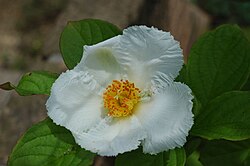
| Stewartia pseudocamellia | |
Scientific classification 
| |
| Kingdom: | Plantae |
| Clade: | Embryophytes |
| Clade: | Tracheophytes |
| Clade: | Spermatophytes |
| Clade: | Angiosperms |
| Clade: | Eudicots |
| Clade: | Asterids |
| Order: | Ericales |
| Family: | Theaceae |
| Genus: | Stewartia I.Lawson1 |
| Type species | |
| Stewartia malacodendron L.1 | |
| Species | |
|
See here | |
| Synonyms2 | |
| |
Stewartia (sometimes spelled Stuartia3456) is a genus of 8-20 species of flowering plants in the family Theaceae, related to Camellia. Most of the species are native to eastern Asia in China, Japan, Korea, Laos, Myanmar, Thailand, and Vietnam, with two (S. malacodendron, S. ovata) in southeast North America, from Virginia and Kentucky south to Florida and Louisiana.57
Description
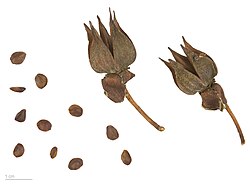
They are shrubs and trees, mostly deciduous, though some species (e.g. S. pteropetiolata) are evergreen; the evergreen species form a genetically distinct group and are split into a separate genus Hartia by some botanists,7 but others retain them within Stewartia.48 The Asian species include both shrubs and trees, growing to 3–20 m tall, while the American species are shrubs growing 3–5 m tall, rarely becoming small trees. The bark is very distinctive, smooth orange to yellow-brown, peeling in fine flakes. The leaves are alternately arranged, simple, serrated, usually glossy, and 3–14 cm long. The flowers are large and conspicuous, 3–11 cm diameter, with 5 (occasionally 6-8) white petals; flowering is in mid to late summer. The fruit is a dry five-valved capsule, with one to four seeds in each section.568
Taxonomy
The genus was described by Isaac Lawson in 1753192 with Stewartia malacodendron L. as the type species.1 The genus was named to honour John Stuart, 3rd Earl of Bute. Owing to a transcription error, Linnaeus was given the name as 'Stewart',5 and consequently spelled the name "Stewartia" (and continued to do so in all his subsequent publications). Some botanists and horticulturists, mainly in the past101112 but still widely in the UK3456 have interpreted Article 60 of the International Code of Botanical Nomenclature to consider "Stewartia" an orthographical error to be corrected to Stuartia, but this type of correction has been discouraged by changes to the code in recent times.
During the 19th century, the spelling Stuartia was "almost universally" used.5 However, the original spelling "Stewartia" has been accepted by virtually all systematic botanists in recent treatments of the family 1314 and genus 7151617 as well as in numerous influential horticultural publications.18
Species
As of March 2025, the following species are accepted:2
| Image | Scientific name | Distribution |
|---|---|---|
| Stewartia acutisepala P.L.Chiu & G.R.Zhong | China (Zhejiang) | |
| Stewartia calcicola T.L.Ming & J.Li | China (Yunnan, Guangxi), Vietnam | |
| Stewartia cordifolia (H.L.Li) J.Li & T.L.Ming | China (Guangxi, Guizhou, Hunan) | |
| Stewartia crassifolia (S.Z.Yan) J.Li & T.L.Ming | China (Guangdong, Guangxi, Hunan, Jiangxi) | |
| Stewartia densivillosa (Hu ex Hung T.Chang & C.X.Ye) J.Li & T.L.Ming | China (Yunnan) | |
| Stewartia laotica (Gagnep.) J.Li & T.L.Ming | China (Yunnan, Guangxi), Laos, Vietnam | |
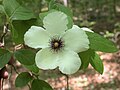 |
Stewartia malacodendron L. | United States (Alabama, Arkansas, Florida, Georgia, Louisiana, Mississippi, North Carolina, South Carolina, Texas, Virginia ) |
| Stewartia medogensis J.Li & T.L.Ming | China (Xizang) | |
| Stewartia micrantha (Chun) Sealy | China (Guangdong, Fujian) | |
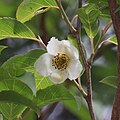 |
Stewartia monadelpha Siebold & Zucc. | Japan |
| Stewartia obovata (Chun ex Hung T.Chang) J.Li & T.L.Ming | China (N. Guangxi, SW. Guangdong) | |
 |
Stewartia ovata (Cav.) Weath. | United States (Alabama, Georgia, Kentucky, Mississippi, North Carolina, South Carolina, Tennessee, Virginia) |
 |
Stewartia pseudocamellia Maxim. | Japan, Korea |
| Stewartia pteropetiolata W.C.Cheng | China (Yunnan) | |
 |
Stewartia rostrata Spongberg | China (Anhui, Henan, Hubei, Hunan, Jiangxi, Zhejiang) |
| Stewartia rubiginosa Hung T.Chang | China (Guangdong, Hunan) | |
 |
Stewartia serrata Maxim. | Japan |
| Stewartia sichuanensis (S.Z.Yan) J.Li & T.L.Ming | China (Sichuan) | |
 |
Stewartia sinensis Rehder & E.H.Wilson | China (Anhui, Fujian, Guangxi, Guizhou, Henan, Hubei, Hunan, Jiangxi, Shaanxi, Sichuan, Yunnan, Zhejiang.) |
| Stewartia sinii (Y.C.Wu) Sealy | China (Guangxi) | |
| Stewartia tonkinensis (Merr.) C.Y.Wu ex J.Li | Vietnam | |
| Stewartia villosa Merr. | China (Guangdong, Guangxi, Jiangxi), Vietnam |
Cultivation
Several species of Stewartia are grown as ornamental plants for their very decorative smooth orange bark and their flowers produced at a time of year when few other trees are in flower.5 The species are adapted to acidic soils, and do not grow well on chalk or other calcium-rich soils. They also have a high rainfall requirement and will not tolerate drought.5
References
References
- Missouri Botanical Garden. (n.d.). Stewartia I. Lawson. Tropicos. Retrieved May 30, 2026, from https://www.tropicos.org/name/40006091
- "Stewartia I.Lawson". Plants of the World Online. 2020-07-17. Retrieved 2025-03-16.
- Sprague, T.A. (1928). The correct spelling of certain generic names. III. Kew Bulletin 1928: 337-365.
- Royal Botanic Gardens, Kew. Vascular Plant Families and Genera: Theaceae
- Bean, W. J. (1980). Trees and Shrubs Hardy in the British Isles 4: 507-513. ISBN 0-7195-2428-8.
- Rushforth, K. (1999). Collins Photographic Guide to Trees. ISBN 0-00-220013-9.
- Li, J., Del Tredici, P., Yang, S., & Donoghue, M. J. (2002). Phylogenetic relationships and biogeography of Stewartia (Camellioideae, Theaceae) inferred from nuclear ribosomal DNA ITS sequences. Rhodora 104: 117-133 (pdf file).
- Flora of China draft account of Theaceae
- Stewartia I.Lawson. (n.d.). International Plant Names Index. Retrieved May 30, 2026, from https://www.ipni.org/n/30074548-2
- L'Héritier de Brutelle, C. L. (1785). Stirpes Novae aut Minus Cognitae (cited by W. J. Bean 1980).
- Siebold, P. F. von, & Zuccarini, J. G. (1835). Flora Japonica 1: 181, t.96. Facsimile.
- Dippel, L. (1889). Handbuch der Laubholzkunde. Darmstadt. Facsimile.
- Chang, H. & Ren, S. (1998). Theaceae/Theoideae. Flora Reipublicae Popularis Sinicae 49 (3).
- Stevens, P. F., Dressler, S. & Weitzman, A. L. (2004). Theaceae. In K. Kubitzki (ed.), Families and Genera of Vascular Plants 6: 463-471.
- Spongberg, S. A. (1974). A review of deciduous-leaved Stewartia (Theaceae). Journal of the Arnold Arboretum 55: 182-214.
- Li, J. (1996). Systematic study on the genera Stewartia and Hartia (Theaceae). Acta Phytotaxonomica Sinica 34: 48–67.
- Prince, L. M. (2002). Circumscription and biogeographic patterns in the Eastern North American-East Asian genus Stewartia (Theaceae: Stewartieae): insight from chloroplast and nuclear DNA sequence data. Castanea 67: 290-301.
- Huxley, A., ed. (1992). New Royal Horticultural Society Dictionary of Gardening.