| Stefania roraimae | |
|---|---|
Scientific classification 
| |
| Kingdom: | Animalia |
| Phylum: | Chordata |
| Class: | Amphibia |
| Order: | Anura |
| Family: | Hemiphractidae |
| Genus: | Stefania |
| Species: | S. roraimae
|
| Binomial name | |
| Stefania roraimae | |
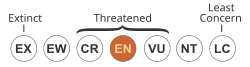
Stefania roraimae (common names: Roraima treefrog, Roraima stefania) is a species of frog in the family Hemiphractidae. It is endemic to Guyana. Its type locality is Mount Roraima; it is also known from Mount Ayanganna and Mount Wokomung.345 It presumably occurs in the adjacent Venezuela and Brazil too.3
Description
Male Stefania roraimae grow to snout–vent length of 36–46 mm (1.4–1.8 in) and females to 36–68 mm (1.4–2.7 in). The smallest recorded independent juveniles are 19 mm (0.75 in) in snout–vent length. Reproduction is not known for this species,6 but presumably the females carry eggs on their backs, with the juveniles developing fully there,1 as known for many other species of Stefania.7
Habitat and conservation
Stefania roraimae are found in primary forests at altitudes of 1,234–1,550 m (4,049–5,085 ft). Its habitats are relatively remote. What threat the frog faces comes from climate change, fires, and viral, bacterial, and fungal pathogens.1 Scientists recommend that the government allow fewer visitors to Mt. Roraima.1
References
References
- IUCN SSC Amphibian Specialist Group (2019). "Stefania roraimae". IUCN Red List of Threatened Species. 2019 e.T56034A120467639. doi:10.2305/IUCN.UK.2019-1.RLTS.T56034A120467639.en. Retrieved 15 November 2021.
- Duellman, William E.; Hoogmoed, Marinus S. (1984). "The taxonomy and phylogenetic relationships of the hylid frog genus Stefania". Miscellaneous Publication, Museum of Natural History, University of Kansas. 75: 1–39.
- Frost, Darrel R. (2017). "Stefania roraimae Duellman and Hoogmoed, 1984". Amphibian Species of the World: an Online Reference. Version 6.0. American Museum of Natural History. Retrieved 15 May 2017.
- MacCulloch, R.D. & A. Lathrop (2002). "Exceptional diversity of the genus Stefania (Anura: Hylidae) on Mount Ayanganna, Guyana; three new species and new distributional records". Herpetologica. 58: 327–346. doi:10.1655/0018-0831(2002)058[0327:edosah]2.0.co;2.
- MacCulloch, R.D.; A. Lathrop & S.Z. Khan (2006). "Exceptional diversity of Stefania (Anura: Cryptobatrachidae) II: six species from Mount Wokomung, Guyana". Phyllomedusa. 5: 31–41. doi:10.11606/issn.2316-9079.v5i1p31-41.
- MacCulloch, R.D.; Lathrop, A. (2006). "Stefania roraimae". Catalogue of American Amphibians and Reptiles. 828: 1–2.
- Means, D. Bruce; William E. Duellman; Valerie C. Clark (2008). "Ovipositing behavior in the egg-brooding frog Stefania ayangannae (Anura, Hemiphractidae)". Phyllomedusa. 7 (2): 143–148. doi:10.11606/issn.2316-9079.v7i2p143-148.