| Steacyite | |
|---|---|
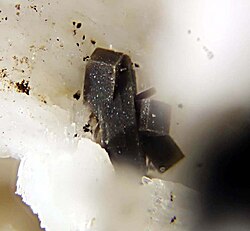 Steacyite crystals from the type locality of Mont-Saint-Hilaire, Quebec | |
| General | |
| Category | Cyclosilicate |
| Formula | Kvariable(Ca,Na)2(Th,U)Si8O20 |
| IMA symbol | Scy1 |
| Strunz classification | 9.CH.10 |
| Crystal system | Tetragonal |
| Crystal class | Ditetragonal dipyramidal (4/mmm) H-M symbol: (4/m 2/m 2/m) |
| Space group | P4/mcc |
| Identification | |
| Color | Gray, dark brown, green, beige |
| Mohs scale hardness | 5 |
| Luster | Vitreous, greasy, dull |
| Diaphaneity | Translucent, opaque |
| Other characteristics |  Radioactive Radioactive |
Steacyite is a complex silicate mineral containing thorium and uranium; formula Kvariable(Ca,Na)2(Th,U)Si8O20. It forms small brown or yellow green crystals, often cruciform twinned crystals. It is radioactive. It was discovered at Mont-Saint-Hilaire, Quebec in 1982 and is named after Harold Robert Steacy (1923–2012), mineralogist.2
References
References
Notes
- Warr, L.N. (2021). "IMA–CNMNC approved mineral symbols". Mineralogical Magazine. 85 (3): 291–320. Bibcode:2021MinM...85..291W. doi:10.1180/mgm.2021.43. S2CID 235729616.
- Dunn, P.J.; Fleischer, M.; Burns, R.G.; Pabst, A. (1983). "New mineral names" (PDF). American Mineralogist. 68: 471–000. Retrieved 14 March 2022.