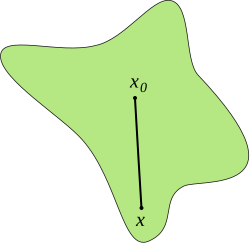

In geometry, a set in the Euclidean space is called a star domain (or star-convex set, star-shaped set1 or radially convex set) if there exists an such that for all the line segment from to lies in This definition is immediately generalizable to any real, or complex, vector space.
Intuitively, if one thinks of as a region surrounded by a wall, is a star domain if one can find a vantage point in from which any point in is within line-of-sight. A similar, but distinct, concept is that of a radial set.
Definition
Given two points and in a vector space (such as Euclidean space ), the convex hull of is called the closed interval with endpoints and and it is denoted by where for every vector
A subset of a vector space is said to be star-shaped at if for every the closed interval A set is star shaped and is called a star domain if there exists some point such that is star-shaped at
A set that is star-shaped at the origin is sometimes called a star set.2 Such sets are closely related to Minkowski functionals.
Examples
- Any line or plane in is a star domain.
- A line or a plane with a single point removed is not a star domain.
- If is a set in the set obtained by connecting all points in to the origin is a star domain.
- A cross-shaped figure is a star domain but is not convex.
- A star-shaped polygon is a star domain whose boundary is a sequence of connected line segments.
Properties
- Convexity: any non-empty convex set is a star domain. A set is convex if and only if it is a star domain with respect to each point in that set.
- Closure and interior: The closure of a star domain is a star domain, but the interior of a star domain is not necessarily a star domain.
- Contraction: Every star domain is a contractible set, via a straight-line homotopy. In particular, any star domain is a simply connected set.
- Shrinking: Every star domain, and only a star domain, can be "shrunken into itself"; that is, for every dilation ratio the star domain can be dilated by a ratio such that the dilated star domain is contained in the original star domain.3
- Union and intersection: The union or intersection of two star domains is not necessarily a star domain.
- Balance: Given the set (where ranges over all unit length scalars) is a balanced set whenever is a star shaped at the origin (meaning that and for all and ).
- Diffeomorphism: A non-empty open star domain in is diffeomorphic to
- Binary operators: If and are star domains, then so is the Cartesian product , and the sum .1
- Linear transformations: If is a star domain, then so is every linear transformation of .1
See also
See also
- Absolutely convex set – Convex and balanced set
- Absorbing set – Set that can be "inflated" to reach any point
- Art gallery problem – Mathematical problem
- Balanced set – Construct in functional analysis
- Bounded set (topological vector space) – Generalization of boundedness
- Convex set – In geometry, set whose intersection with every line is a single line segment
- Minkowski functional – Function made from a set
- Radial set – Topological set
- Star polygon – Regular non-convex polygon
- Symmetric set – Property of group subsets (mathematics)
- Star-shaped preferences
References
References
- Braga de Freitas, Sinval; Orrillo, Jaime; Sosa, Wilfredo (2020-11-01). "From Arrow–Debreu condition to star shape preferences". Optimization. 69 (11): 2405–2419. doi:10.1080/02331934.2019.1576664. ISSN 0233-1934.
- Schechter 1996, p. 303.
- Drummond-Cole, Gabriel C. "What polygons can be shrinked into themselves?". Math Overflow. Retrieved 2 October 2014.
- Ian Stewart, David Tall, Complex Analysis. Cambridge University Press, 1983, ISBN 0-521-28763-4, MR 0698076
- C.R. Smith, A characterization of star-shaped sets, American Mathematical Monthly, Vol. 75, No. 4 (April 1968). p. 386, MR 0227724, JSTOR 2313423
- Rudin, Walter (1991). Functional Analysis. International Series in Pure and Applied Mathematics. Vol. 8 (Second ed.). New York, NY: McGraw-Hill Science/Engineering/Math. ISBN 978-0-07-054236-5. OCLC 21163277.
- Schaefer, Helmut H.; Wolff, Manfred P. (1999). Topological Vector Spaces. GTM. Vol. 8 (Second ed.). New York, NY: Springer New York Imprint Springer. ISBN 978-1-4612-7155-0. OCLC 840278135.
- Schechter, Eric (1996). Handbook of Analysis and Its Foundations. San Diego, CA: Academic Press. ISBN 978-0-12-622760-4. OCLC 175294365.