| Staphylea pinnata | |
|---|---|
| |
Scientific classification 
| |
| Kingdom: | Plantae |
| Clade: | Embryophytes |
| Clade: | Tracheophytes |
| Clade: | Angiosperms |
| Clade: | Eudicots |
| Clade: | Rosids |
| Order: | Crossosomatales |
| Family: | Staphyleaceae |
| Genus: | Staphylea |
| Species: | S. pinnata
|
| Binomial name | |
| Staphylea pinnata L.
| |
Staphylea pinnata, the European bladdernut,1 is a species of bladdernut native to Europe and naturalized in Britain.2
Description
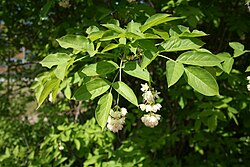
It is a deciduous shrub growing up to 6 m (20 ft).3 The species name pinnata refers to the pinnate leaves.4 Small, white, bell-shaped, fragrant flowers1 bloom from May to June,2 on panicles up to 13 cm (5.1 in) long.1 The flowers are bisexual and pollinated by flies.2 The fruits are inflated papery capsules, 2-3 lobed, up to 4 cm (1.6 in) long,1 ripening from September to November. The seeds are edible, and are said to taste like pistachios.2
Cultivation
Staphylea pinnata can be grown in full sun to partial shade, and tolerates a variety of soils. It is hardy in zones 6–8.1 It has low drought tolerance.3
References
References
- Missouri Botanical Garden—Staphylea pinnata
- Plants for a Future—Staphylea pinnata
- "Plant Database—Staphylea pinnata". Archived from the original on 2014-02-22. Retrieved 2014-02-12.
- Heiss, Andreas G.; Filipovic, Dragana; Nedelcheva, Anely; Ruß-Popa, Gabriela; Wanninger, Klaus; Schramayr, Georg; Perego, Renata; Jacomet, Stefanie (October 2014). "A Fistful of Bladdernuts: The Shifting Uses of Staphylea pinnata L. as Documented by Archaeology, History, and Ethnology" (pdf). Folk Life. 52 (2): 95–136. doi:10.1179/0430877814Z.00000000031. S2CID 163022862. Retrieved 17 August 2015.