| Stackhousia | |
|---|---|
| |
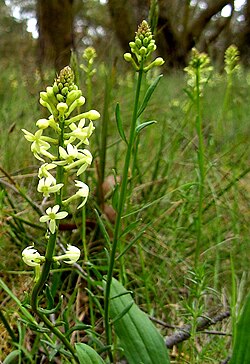
| Stackhousia monogyna | |
Scientific classification 
| |
| Kingdom: | Plantae |
| Clade: | Embryophytes |
| Clade: | Tracheophytes |
| Clade: | Spermatophytes |
| Clade: | Angiosperms |
| Clade: | Eudicots |
| Clade: | Rosids |
| Order: | Celastrales |
| Family: | Celastraceae |
| Genus: | Stackhousia Sm. |
| Species | |
|
See text | |
| Synonyms1 | |
|
Plokiostigma Schuch. | |
Stackhousia is a genus of annual and perennial plants in the family Celastraceae2 that are native to Australia, New Zealand, Malesia and Micronesia. The genus was first described by James Edward Smith in Transactions of the Linnean Society of London in 1798.
It was formerly placed in Stackhousiaceae, but under the APG II system this family has been folded into Celastraceae.
Species
20 species are accepted.1
- Stackhousia annua W.R.Barker
- Stackhousia aspericocca Schuch.
- Stackhousia clementii Domin
- Stackhousia dielsii Pamp. – yellow stackhousia
- Stackhousia georgei Diels
- Stackhousia huegelii Endl.
- Stackhousia intermedia F.M.Bailey
- Stackhousia megaloptera F.Muell.
- Stackhousia minima Hook.f.
- Stackhousia monogyna Labill. – Creamy candles, creamy stackhousia
- Stackhousia muricata Lindl.
- Stackhousia nuda Lindl.
- Stackhousia pubescens A.Rich. – downy stackhousia
- Stackhousia pulvinaris F.Muell. – alpine stackhousia
- Stackhousia scoparia Benth.
- Stackhousia spathulata Sieber ex Spreng.
- Stackhousia stratfordiae W.R.Barker & Cockerton
- Stackhousia subterranea W.R.Barker – Gunn's mignonette, grasslands candles
- Stackhousia umbellata C.A.Gardner & A.S.George
- Stackhousia viminea Sm. – Slender stackhousia
References
References
- "Stackhousia Sm". Plants of the World Online. Royal Botanic Gardens, Kew. Retrieved 2 April 2026.
- "Family: Celastraceae R. Br., nom. cons". Germplasm Resources Information Network (GRIN). United States Department of Agriculture, Agricultural Research Service, Beltsville Area. Archived from the original on 2009-05-06. Retrieved 2008-02-03.
- "Stackhousia". Australian Plant Name Index (APNI), IBIS database. Centre for Plant Biodiversity Research, Australian Government, Canberra. Retrieved 2008-02-03.
- "Stackhousia". PlantNET - New South Wales Flora Online. Royal Botanic Gardens & Domain Trust. Retrieved 2008-02-03.