| Stachys chamissonis | |
|---|---|
| |
Scientific classification 
| |
| Kingdom: | Plantae |
| Clade: | Embryophytes |
| Clade: | Tracheophytes |
| Clade: | Spermatophytes |
| Clade: | Angiosperms |
| Clade: | Eudicots |
| Clade: | Asterids |
| Order: | Lamiales |
| Family: | Lamiaceae |
| Genus: | Stachys |
| Species: | S. chamissonis
|
| Binomial name | |
| Stachys chamissonis | |
| Varieties1 | |
| |
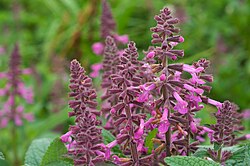
Stachys chamissonis is a species of flowering plant in the mint family known by the common name coastal hedgenettle. It is a perennial herb native to the west coast of North America, where it grows in moist coastal habitat from Alaska to central California.2 This mint produces an erect stem 1 to 2+1⁄2 meters (3.3 to 8.2 ft). It is hairy, glandular, and aromatic. The oppositely arranged leaves have pointed, wavy-edged blades up to 18 centimeters (7.1 in) long which are borne on petioles. The hairy, glandular inflorescence is made up of interrupted clusters of up to six flowers each. The flower has a deep pink tubular corolla which can be over 3 centimeters (1.2 in) long. The corollas are borne in hairy calyces of purple or purple-tinged sepals.3
Taxonomy
Stachys chamissonis was scientifically described by George Bentham in 1831. It has two accepted varieties.1
Stachys chamissonis var. chamissonis
The autonymic variety of the species only grows in California.4
Stachys chamissonis var. cooleyae
This variety grows in a wider area, from British Columbia to California.5
References
References
- "Stachys chamissonis Benth". Plants of the World Online. Royal Botanic Gardens, Kew. Retrieved 19 August 2024.
- NRCS. "Stachys chamissonis". PLANTS Database. United States Department of Agriculture (USDA). Retrieved 30 November 2015.
- Jepson Flora Project (ed.). "Stachys chamissonis". Jepson eFlora. The Jepson Herbarium, University of California, Berkeley.
- "Stachys chamissonis var. chamissonis". Plants of the World Online. Royal Botanic Gardens, Kew. Retrieved 19 August 2024.
- "Stachys chamissonis var. cooleyae (A.Heller) G.A.Mulligan & D.B.Munro". Plants of the World Online. Royal Botanic Gardens, Kew. Retrieved 19 August 2024.
External links
External links