| Observation data Epoch J2000 Equinox ICRS | |
|---|---|
| Constellation | Cepheus |
| Right ascension | 22h 30m 10.73791s1 |
| Declination | +57° 00′ 03.0712″1 |
| Apparent magnitude (V) | 7.75 - 8.902 |
| Characteristics | |
| Spectral type | M2Ia-Iab3 |
| B−V color index | 2.284 |
| Variable type | LC2 |
| Astrometry | |
| Radial velocity (Rv) | −66.65 km/s |
| Proper motion (μ) | RA: −3.5681 mas/yr Dec.: −3.0961 mas/yr |
| Parallax (π) | 0.2162±0.0239 mas1 |
| Distance | approx. 15,000 ly (approx. 4,600 pc) |
| Absolute magnitude (MV) | −3.736 |
| Details | |
| Mass | 97 M☉ |
| Radius | 1757 - 2904 R☉ |
| Luminosity | 12,2468 L☉ |
| Surface gravity (log g) | 0.927 cgs |
| Temperature | 42007 K |
| Metallicity [Fe/H] | 0.021 dex |
| Other designations | |
| BD+56°2793, HD 239978, SAO 345299 | |
| Database references | |
| SIMBAD | data |
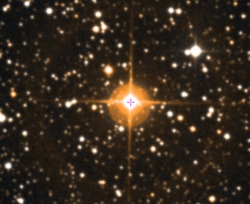
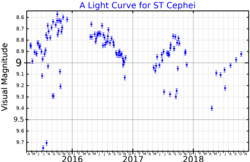
ST Cephei (ST Cep), also known as BD+56°2793,2 is a red supergiant and a variable star located in the constellation Cepheus. It has a variable apparent magnitude between 7.75 and 8.90, and is over a hundred times the radius of the Sun.7
Distance
ST Cephei is very far from the Solar System, and its parallax was not measured by the Hipparcos satellite. Its membership in the Cepheus OB2-B stellar association allows its distance to be estimated at 830 parsecs, or 2,715 light years.
Characteristics
ST Cephei is a red supergiant of spectral type M3I—previously cataloged as M2I—with an effective temperature of 3,600 Kelvin. It is a large supergiant; estimates of its radius range from 1757 to 290 solar radii.4 Considering an intermediate radius between both values, if it were in the place of the Sun, its surface would extend to the Earth's orbit. Despite this, its size is far from the two known hypergiants in this constellation, μ Cephei and VV Cephei.274
The bolometric luminosity of ST Cephei is 8,400 times greater than that of the Sun. It has a mass 9 times greater than the Sun, at the limit from which stars end their lives by exploding as supernovae. Like other analogous supergiants, it loses mass; Its loss of stellar mass—in the form of dust, since the atomic and molecular gas could not be evaluated—is quantified at 2.5×10⁻⁹ M☉/year.7
In 1910 it was announced that Evelyn Leland had discovered that the star is a variable star.11 That same year it was given its variable star designation, ST Cephei.12 Listed as an LC irregular variable star, the brightness of ST Cephei varies by about two magnitudes, with no period recognized.2
References
References
- Vallenari, A.; et al. (Gaia collaboration) (2023). "Gaia Data Release 3. Summary of the content and survey properties". Astronomy and Astrophysics. 674: A1. arXiv:2208.00211. Bibcode:2023A&A...674A...1G. doi:10.1051/0004-6361/202243940. S2CID 244398875. Gaia DR3 record for this source at VizieR.
- ST Cephei (General Catalogue of Variable Stars)
- Keenan, Philip C.; McNeil, Raymond C. (1989). "The Perkins Catalog of Revised MK Types for the Cooler Stars". The Astrophysical Journal Supplement Series. 71: 245. Bibcode:1989ApJS...71..245K. doi:10.1086/191373.
- Levesque, Emily M.; Massey, Philip; Olsen, K. A. G.; Plez, Bertrand; Josselin, Eric; Maeder, Andre; Meynet, Georges (2005). "The Effective Temperature Scale of Galactic Red Supergiants: Cool, but Not as Cool as We Thought". The Astrophysical Journal. 628 (2): 973. arXiv:astro-ph/0504337. Bibcode:2005ApJ...628..973L. doi:10.1086/430901.
- Deacon, N. R.; Henning, Th; Kossakowski, D. E. (2019). "Data-driven stellar parameters for southern TESS FGK targets". Monthly Notices of the Royal Astronomical Society. 486 (1): 251. arXiv:1903.03115. Bibcode:2019MNRAS.486..251D. doi:10.1093/mnras/stz722.
- Massey, Philip; Silva, David R.; Levesque, Emily M.; Plez, Bertrand; Olsen, Knut A. G.; Clayton, Geoffrey C.; Meynet, Georges; Maeder, Andre (2009). "Red Supergiants in the Andromeda Galaxy (M31)". The Astrophysical Journal. 703 (1): 420. arXiv:0907.3767. Bibcode:2009ApJ...703..420M. doi:10.1088/0004-637X/703/1/420.
- Josselin, E.; Plez, B. (2007). "Atmospheric dynamics and the mass loss process in red supergiant stars". Astronomy & Astrophysics. 469 (2): 671–680. arXiv:0705.0266. Bibcode:2007A&A...469..671J. doi:10.1051/0004-6361:20066353.
- Dorn-Wallenstein, Trevor Z.; Levesque, Emily M.; Neugent, Kathryn F.; Davenport, James R. A.; Morris, Brett M.; Gootkin, Keyan (2020). "Short-term Variability of Evolved Massive Stars with TESS. II. A New Class of Cool, Pulsating Supergiants". The Astrophysical Journal. 902 (1): 24. arXiv:2008.11723. Bibcode:2020ApJ...902...24D. doi:10.3847/1538-4357/abb318.
- "ST Cep". SIMBAD. Centre de données astronomiques de Strasbourg.
- "ASAS-SN Variable Stars Database". ASAS-SN Variable Stars Database. ASAS-SN. Retrieved 16 December 2024.
- Leland, E. F.; Pickering, Edward C. (January 1910). "20 New Variable Stars in Harvard Map, Nos. 2, 5, 32, 44, and 53". Harvard College Observatory Circular. 152: 1–3. Bibcode:1910HarCi.152....1L.
- Dunér, Nils Christofer; Hartwig, Ernst; Müller, G. (November 1910). "Benennung von neu entdeckten veränderlichen Sternen". Astronomische Nachrichten. 186 (17): 273–286. Bibcode:1910AN....186..273D. doi:10.1002/asna.19101861702.