| Spirurida | |
|---|---|
| |
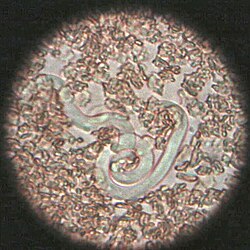
| Dirofilaria immitis larva Magnification 400× | |
Scientific classification 
| |
| Kingdom: | Animalia |
| Phylum: | Nematoda |
| Class: | Chromadorea |
| Order: | Rhabditida |
| Suborder: | Spirurida |
| Superfamilies | |
|
10, but see text | |
Spirurida falls under the phylum Nematoda class Chromadorea and order Rhabditida. They are characterized by their elongated, cylindrical bodies and unsegmented structure. Like all nematodes, they have neither a circulatory nor a respiratory system.
Some Spirurida, like the genus Gongylonema, can cause disease in humans. One such disease is a skin infection with Spirurida larvae, called "creeping disease". Some species are known as eyeworms and infect the orbital cavity of animal hosts.
Systematics
The Camallanida are sometimes included herein as a suborder, and the Drilonematida are sometimes placed here as a superfamily. There are doubts about the internal systematics of the Spirurida, and some groups placed herein might belong to other spirurian or even secernentean lineages.1
The following superfamilies are at least provisionally placed in the Spirurida:
- Acuarioidea
- Aproctoidea
- Diplotriaenoidea
- Filarioidea
- Gnathostomatoidea
- Habronematoidea
- Physalopteroidea
- Rictularioidea
- Spiruroidea
- Thelazioidea
References
References
Citations
- ToL (2002)
Sources
- Tree of Life Web Project (ToL) (2002): Nematoda. Version of 2002-JAN-01. Retrieved 2008-NOV-02.