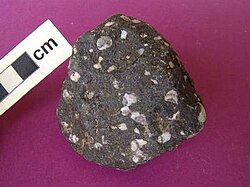
Spilite (from Greek: σπιλάς) is a fine-grained igneous rock, resulting particularly from alteration of oceanic basalt.
The term was introduced into the geological literature by Alexandre Brongniart in 1827.1 Spilite is formed when basaltic lava reacts with seawater, or from hydrothermal alteration when seawater circulates through hot volcanic rocks.2
It is a metasomatic rock with a microscopic or very-fine grain size produced by hydrothermal alteration of basalt, and composed of albite or oligoclase, together with chlorite, epidote, calcite, and actinolite.3 Spilite is veined by calcite or chalcedony, and vesicles and cavities are filled with secondary minerals.2 It is generally classed with basalts, and it often retains many textural and structural features characteristic of basalt.3
Notes
Notes
- Manfred Schidlowski: Spilite and the basal tables volcanism. Natural sciences, Bd. 56, No. 10, P. 488-493, Springer publishing house, Berlin/Heidelberg 1969, ISSN 0028-1042
- Monica Price, Kevin Walsh, Pocket Nature, Rocks and Minerals, page 63. Dorling Kindersley.
- McGraw-Hill encyclopedia of the geological sciences, page 793