 | |
 | |
| Names | |
|---|---|
| Preferred IUPAC name
(2S,3R,4E)-2-Aminooctadec-4-ene-1,3-diol | |
| Identifiers | |
| |
3D model (JSmol)
|
|
| ChEBI | |
| ChEMBL | |
| ChemSpider |
|
| ECHA InfoCard | 100.004.230 |
PubChem CID
|
|
| UNII | |
CompTox Dashboard (EPA)
|
|
| |
| |
| Properties | |
| C18H37NO2 | |
| Molar mass | 299.499 g·mol−1 |
Except where otherwise noted, data are given for materials in their standard state (at 25 °C [77 °F], 100 kPa).
| |


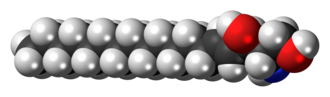
Sphingosine (2-amino-4-trans-octadecene-1,3-diol) is an 18-carbon amino alcohol with an unsaturated hydrocarbon chain, which forms a primary part of sphingolipids, a class of cell membrane lipids that include sphingomyelin, an important phospholipid.
Functions
Sphingosine can be phosphorylated in vivo via two kinases, sphingosine kinase type 1 and sphingosine kinase type 2. This leads to the formation of sphingosine-1-phosphate, a potent signaling lipid.
Sphingolipid metabolites, such as ceramides, sphingosine and sphingosine-1-phosphate, are lipid signaling molecules involved in diverse cellular processes.
Biosynthesis
Sphingosine is synthesized from palmitoyl CoA and serine in a condensation required to yield sphinganine (dihydrosphingosine).
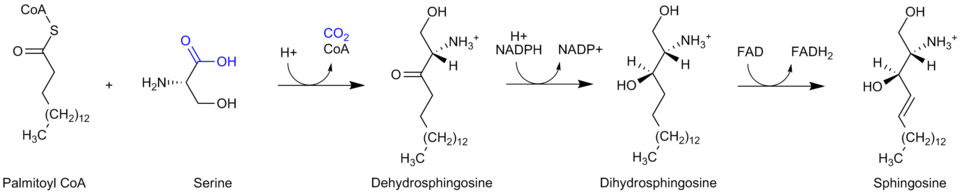
Dehydrosphingosine is then reduced by NADPH to sphinganine, acylated to dihydroceramide, and finally oxidized by FAD to ceramide. Sphingosine is then solely formed via degradation of sphingolipid in the lysosome.
Gallery
-
 Sphingolipidoses
 -
 General structures of sphingolipids
Literature
- Radin N (2003). "Killing tumours by ceramide-induced apoptosis: a critique of available drugs". Biochem J. 371 (Pt 2): 243–56. doi:10.1042/BJ20021878. PMC 1223313. PMID 12558497. article
- Carter, Herbert E.; Glick, Francis J.; Norris, William P.; Phillips, George E. (1947). "Biochemistry of the sphingolipides. III. Structure of sphingosine". J. Biol. Chem. 170 (1): 285–295. doi:10.1016/S0021-9258(17)34955-4.
External links
External links
- Sphingosine at the U.S. National Library of Medicine Medical Subject Headings (MeSH)