| Sphingomonas phyllosphaerae | |
|---|---|
| |
Scientific classification 
| |
| Domain: | Bacteria |
| Kingdom: | Pseudomonadati |
| Phylum: | Pseudomonadota |
| Class: | Alphaproteobacteria |
| Order: | Sphingomonadales |
| Family: | Sphingomonadaceae |
| Genus: | Sphingomonas |
| Species: | S. phyllosphaerae
|
| Binomial name | |
| Sphingomonas phyllosphaerae Rivas et al. 2004
| |
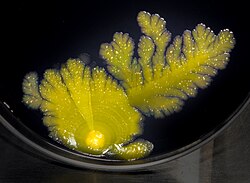
Sphingomonas phyllosphaerae is a species of bacterium.1 It was first isolated from the phyllosphere of a leguminous tree, Acacia caven, in central Argentina. It is Gram-negative, strictly aerobic, rod-shaped and motile. Its type strain is FA2(T) (=LMG 21958(T)=CECT 5832(T)). Sphingomonas phyllosphaerae tested negative for amylase activity, indicating its inability to digest starches. This aligns with many other Sphingomonas species 2. Other Sphingomonas species display motility by polar flagellation. Citrate testing shows that citrate is not a carbon source for most Sphingomonas species 1. There are Sphingomonas species that show resistance to many different antibiotics. In the lab, this aligns with Sphingomonas and its ability to resist antibiotics 3. Sphingomonas species are known to be cold-tolerant, which means the optimal temperature for growth is around 4 degrees Celsius 4
References
References
- Rivas R, Abril A, Trujillo ME, Velázquez E (November 2004). "Sphingomonas phyllosphaerae sp. nov., from the phyllosphere of Acacia caven in Argentina". International Journal of Systematic and Evolutionary Microbiology. 54 (Pt 6): 2147–50. doi:10.1099/ijs.0.63102-0. PMID 15545449. Retrieved 2013-07-18.
- Yan, Z.-F., Lin, P., Won, K.-H., Li, C.-T., Park, G., Chin, B., Kook, M., Wang, Q.-J., & Yi, T.-H. (2018a). Sphingomonas rhizophila sp. nov., isolated from rhizosphere of Hibiscus syriacus. INTERNATIONAL JOURNAL of SYSTEMATIC and EVOLUTIONARY MICROBIOLOGY, 68(2), 681–686. https://doi.org/10.1099/ijsem.0.002566
- Yabuuchi, E., Yano, I., Oyaizu, H., Hashimoto, Y., Ezaki, T., & Yamamoto, H. (1990). Proposals ofSphingomonas paucimobilisgen. nov. and comb. nov.,Sphingomonas parapaucimobilissp. nov.,Sphingomonas yanoikuyaesp. nov.,Sphingomonas adhaesivasp. nov.,Sphingomonas capsulatacomb, nov., and Two Genospecies of the GenusSphingomonas. Microbiology and Immunology, 34(2), 99–119. https://doi.org/10.1111/j.1348-0421.1990.tb00996.x
- Cha, I., Kang, H., Kim, H., & Joh, K. (2019a). Sphingomonas ginkgonis sp. nov., isolated from phyllosphere of Ginkgo biloba. International Journal of Systematic and Evolutionary Microbiology, 69(10), 3224–3229. https://doi.org/10.1099/ijsem.0.003613