The soil matrix is the solid phase of soils, and comprise the solid particles that make up soils. Soil particles can be classified by their chemical composition (mineralogy) as well as their size. The particle-size distribution of a soil, its texture, determines many of the properties of that soil, in particular hydraulic conductivity and water potential,1 but the mineralogy of those particles can strongly modify those properties. The mineralogy of the finest soil particles, clay, is especially important.2
Gravel, sand and silt
Gravel, sand and silt are the larger soil particles, and their mineralogy is often inherited from the parent material of the soil, but may include products of weathering (such as concretions of calcium carbonate or iron oxide), or residues of plant and animal life (such as silica phytoliths).34 Quartz is the most common mineral in the sand or silt fraction as it is resistant to chemical weathering, except under hot climate;5 other common minerals are feldspars, micas and ferromagnesian minerals such as pyroxenes, amphiboles and olivines, which are dissolved or transformed in clay under the combined influence of physico-chemical and biological processes.36
Mineral colloids: soil clays
Due to its high specific surface area and its unbalanced negative electric charges, clay is the most active mineral component of soil.78 It is a colloidal and most often a crystalline phyllosilicate material.9 In soils, clay is a soil textural class and is defined in a physical sense as any mineral particle less than 2 μm (8×10⁻⁵ in) in effective diameter. Many soil minerals, such as gypsum, calcite, feldspar or quartz particles, are small enough to be classified as clay based on their physical size, but chemically they do not afford the same utility as do mineralogically defined clay minerals.10
Before the advent of X-ray diffraction clay was thought to be very small particles of quartz, feldspar, mica, hornblende or augite, but it is now known to be (with the exception of mica-based clays) a precipitate with a mineralogical composition that is dependent on but different from its parent materials and is classed as a secondary mineral.11 The type of clay that is formed is a function of the parent material and the composition of the minerals in solution.12 Clay minerals continue to be formed as long as the soil exists, whether by inheritance, neoformation, or transformation of pre-existing minerals.13 Mica-based clays result from a modification of the primary mica mineral in such a way that it behaves and is classed as a clay.14 Most clays are crystalline, but some clays or some parts of clay minerals are amorphous.15 The clays of a soil are a mixture of the various types of clay, but one type often predominates according to soil type.16
Typically there are four main groups of clay minerals: kaolinite, montmorillonite-smectite, illite, and chlorite.17 Most clays are crystalline and most are made up of three or four planes of oxygen held together by planes of aluminium and silicon by way of ionic bonds that together form a single layer of clay. The spatial arrangement of the oxygen atoms determines clay's structure.18 The layers of clay are sometimes held together through hydrogen bonds, sodium or potassium ionic bonds and as a result will swell less in the presence of water.19 Clays such as montmorillonite have layers that are loosely attached and will swell greatly when water intervenes between the layers.20
In a wider sense clays can be classified as:
- Layer Crystalline alumino-silica clays: montmorillonite, illite, vermiculite, chlorite, kaolinite.
- Crystalline Chain carbonate and sulfate minerals: calcite (CaCO3), dolomite (CaMg(CO3)2) and gypsum (CaSO4·2H2O).
- Amorphous clays: young mixtures of silica (SiO2-OH) and alumina (Al(OH)3) which have not had time to form regular crystals.
- Sesquioxide clays: old, highly leached clays which result in oxides of iron, aluminium and titanium.21
Alumino-silica clays
Alumino-silica clays or aluminosilicate clays are characterized by their regular crystalline or quasi-crystalline structure.22 Oxygen in ionic bonds with silicon forms a tetrahedral coordination (silicon at the center) which in turn forms sheets of silica. Two sheets of silica are bonded together by a plane of aluminium which forms an octahedral coordination, called alumina, with the oxygens of the silica sheet above and that below it.23 Hydroxyl ions (OH−) sometimes substitute for oxygen. During the clay formation process, Al3+ may substitute for Si4+ in the silica layer, and as much as one fourth of the aluminium Al3+ may be substituted by Zn2+, Mg2+ or Fe2+ in the alumina layer. The substitution of lower-valence cations for higher-valence cations (isomorphous substitution) gives clay a local negative charge on an oxygen atom23 that attracts and holds water and positively charged soil cations, some of which are of value for plant growth.24 Isomorphous substitution occurs during the clay's formation and does not change with time.25
- Montmorillonite clay is made of four planes of oxygen with two silicon and one central aluminium plane intervening. The aluminosilicate montmorillonite clay is thus said to have a 2:1 ratio of silicon to aluminium, in short it is called a 2:1 clay mineral.26 The seven planes together form a single crystal of montmorillonite. The crystals are weakly held together and water may intervene, causing the clay to swell up to ten times its dry volume.27 It occurs in soils which have had little leaching, hence it is found in arid regions, although it may also occur in humid climates, depending on its mineralogical origin.28 As the crystals are not bonded face to face, the entire surface is exposed and available for surface reactions, hence it has a high cation exchange capacity (CEC).29
- Illite is a 2:1 clay similar in structure to montmorillonite but has potassium bridges between the faces of the clay crystals and the degree of swelling depends on the degree of weathering of potassium-feldspar.30 The active surface area is reduced due to the potassium ionic bonds. Illite originates from the modification of mica, a primary mineral. It is often found together with montmorillonite and its primary minerals. It has moderate CEC.31
- Vermiculite is a mica-based clay similar to illite, but the crystals of clay are held together more loosely by hydrated magnesium and it will swell, but not as much as does montmorillonite.32 It has very high CEC.33
- Chlorite is similar to vermiculite, but the loose bonding by occasional hydrated magnesium, as in vermiculite, is replaced by a hydrated magnesium sheet, that firmly bonds the planes above and below it. It has two planes of silicon, one of aluminium and one of magnesium; hence it is a 2:2 clay.34 Chlorite does not swell and it has low CEC.35
- Kaolinite is a very common, highly weathered clay, and more common than montmorillonite in acid soils.36 It has one silica and one alumina plane per crystal; hence it is a 1:1 type clay. One plane of silica of montmorillonite is dissolved and is replaced with hydroxyls, which produces strong hydrogen bonds to the oxygen in the next crystal of clay.37 As a result, kaolinite does not swell in water and has a low specific surface area, and as almost no isomorphous substitution has occurred it has a low CEC.38 Where rainfall is high, acid soils selectively leach more silica than alumina from the original clays, leaving kaolinite.39 Even heavier weathering results in sesquioxide clays.40
Crystalline chain clays
The carbonate and sulfate clay minerals are much more soluble and hence are found primarily in desert soils where leaching is less active.41
Amorphous clays
Amorphous clays are young, and commonly found in recent volcanic ash deposits such as tephra.42 They are mixtures of alumina and silica which have not formed the ordered crystal shape of alumino-silica clays which time would provide.43 The majority of their negative charges originates from hydroxyl ions, which can gain or lose a hydrogen ion (H+) in response to soil pH, in such way as to buffer the soil pH. They may have either a negative charge provided by the attached hydroxyl ion (OH−), which can attract a cation, or lose the hydrogen of the hydroxyl to solution and display a positive charge which can attract anions. As a result, they may display either high CEC in an acid soil solution, or high anion exchange capacity in a basic soil solution.43
Sesquioxide clays
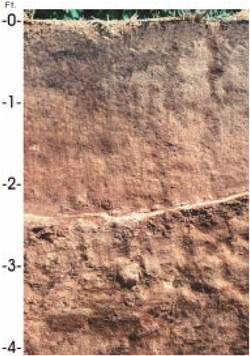
Sesquioxide clays or sesquioxides are a product of heavy rainfall that has leached most of the silica from alumino-silica clay, leaving the less soluble oxides iron hematite (Fe2O3), iron hydroxide (Fe(OH)3), aluminium hydroxide gibbsite (Al(OH)3), hydrated manganese birnessite (MnO2), as can be observed in most lateritic weathering profiles of tropical soils.44 It takes hundreds of thousands of years of leaching to create sesquioxide clays.45 Sesqui is Latin for "one and one-half": there are three parts oxygen to two parts iron or aluminium; hence the ratio is one and one-half (not true for all). They are hydrated and act as either amorphous or crystalline. They are not sticky and do not swell, and soils high in them (e.g. lateritic soils) behave much like sand and can rapidly pass water.46 They are able to hold large quantities of phosphates, a sorptive process which can at least partly be inhibited in the presence of decomposed (humified) organic matter.47 Sesquioxides have low CEC but these variable-charge minerals are able to hold anions as well as cations.48 Such soils range from yellow to red in colour according to the dominance of various iron oxides.49 Such clays tend to hold phosphorus so tightly that it is unavailable for absorption by plants, in proportion to their content in goethite.50
Organic colloids
Humus is one of the two final stages of decomposition of organic matter.51 It remains in the soil as the organic component of the soil matrix while the other stage, carbon dioxide, issuing from the mineralization of carbonaceous compounds, is freely liberated in the atmosphere or reacts with calcium to form the soluble calcium bicarbonate or precipitates as calcium carbonate according to pH.52 While humus may linger for a thousand years,53 on the larger scale of the age of the mineral soil components, it is temporary, being finally released as CO2.54 It is composed of the very stable lignins (30%) and complex sugars (polyuronides, 30%), proteins (30%), waxes, and fats that are resistant to breakdown by microbes and can form complexes with metals, facilitating their downward migration (podzolization).55 However, although originating for its main part from dead plant organs (wood, bark, foliage, roots), a large part of humus comes from organic compounds excreted by soil organisms (roots, microbes, animals) and from their decomposition upon death.56 Its chemical assay is 60% carbon, 2% nitrogen, some oxygen and the remainder hydrogen, sulfur, calcium, potassium, magnesium and phosphorus.57 On a dry weight basis, the CEC of humus is many times greater than that of clay.58
Humus plays a major role in the regulation of atmospheric carbon, through carbon sequestration in the soil profile, more especially in deeper horizons with reduced biological activity.59 Stocking and destocking of soil carbon are under strong climate influence.60 They are normally balanced through an equilibrium between production and mineralization of organic matter, but the balance is in favour of destocking under present-day climate warming,61 and more especially in permafrost.62
Carbon and terra preta
In the extreme environment of high temperatures and the leaching caused by the heavy rain of tropical rain forests, the clay and organic colloids are largely destroyed. The heavy rains wash the alumino-silicate clays from the soil leaving only sesquioxide clays of low CEC.63 The high temperatures and humidity allow bacteria and fungi to virtually decay any organic matter on the rain-forest floor overnight and much of the nutrients are volatilized or leached from the soil and lost,64 leaving only a thin root mat lying directly on the mineral soil.65 However, carbon in the form of finely divided charcoal, also known as black carbon, is far more stable than soil colloids and is capable of performing many of the functions of the soil colloids of sub-tropical soils.66 Soil containing substantial quantities of charcoal, of an anthropogenic origin, is called terra preta. In Amazonia it testifies for the agronomic knowledge of past Amerindian civilizations.67 The pantropical peregrine earthworm Pontoscolex corethrurus has been suspected to contribute to the fine division of charcoal and its mixing to the mineral soil in the frame of present-day slash-and-burn or shifting cultivation still practiced by Amerindian tribes.68 Research into terra preta is still young but is promising. Fallow periods "on the Amazonian Dark Earths can be as short as 6 months, whereas fallow periods on oxisols are usually 8 to 10 years long"69 The incorporation of charcoal to agricultural soil for improving water and nutrient retention has been called biochar, being extended to other charred or carbon-rich by-products, and is now increasingly used in sustainable tropical agriculture.70 Biochar also allows the irreversible sorption of pesticides and other pollutants, a mechanism by which their mobility, and thus their environmental risk, decreases.71 It has also been argued as a mean of sequestering more carbon in the soil, thereby mitigating the so-called greenhouse effect.72 However, the use of biochar is limited by the availability of wood or other products of pyrolysis and by risks caused by concomitent deforestation.73
References
References
- Saxton, Keith E.; Rawls, Walter J. (September 2006). "Soil water characteristic estimates by texture and organic matter for hydrologic solutions". Soil Science Society of America Journal. 70 (5): 1569–78. Bibcode:2006SSASJ..70.1569S. doi:10.2136/sssaj2005.0117. Archived (PDF) from the original on 2 September 2018. Retrieved 18 May 2026.
- College of Tropical Agriculture and Human Resources. "Soil mineralogy". University of Hawaiʻi at Mānoa. Retrieved 18 May 2026.
- Russell, E. Walter (1973). Soil conditions and plant growth (10th ed.). London, United Kingdom: Longman. pp. 67–70. ISBN 978-0-582-44048-7. Retrieved 18 May 2026.
- Mercader, Julio; Bennett, Tim; Esselmont, Chris; Simpson, Steven; Walde, Dale (January 2011). "Soil phytoliths from miombo woodlands in Mozambique". Quaternary Research. 75 (1): 138–50. Bibcode:2011QuRes..75..138M. doi:10.1016/j.yqres.2010.09.008. S2CID 140546854. Retrieved 18 May 2026.
- Sleep, Norman H.; Hessler, Angela M. (31 January 2006). "Weathering of quartz as an Archean climatic indicator" (PDF). Earth and Planetary Science Letters. 241 (3–4): 594–602. Bibcode:2006E&PSL.241..594S. doi:10.1016/j.epsl.2005.11.020. Retrieved 18 May 2026.
- Banfield, Jillian F.; Barker, William W.; Welch, Susan A.; Taunton, Anne (30 March 1999). "Biological impact on mineral dissolution: application of the lichen model to understanding mineral weathering in the rhizosphere". Proceedings of the National Academy of Sciences of the United States of America. 96 (7): 3404–11. Bibcode:1999PNAS...96.3404B. doi:10.1073/pnas.96.7.3404. PMC 34281. PMID 10097050.
- Santamarina, J. Carlos; Klein, Katherine A.; Wang, Yu-Hsing; Prencke, E. (February 2002). "Specific surface: determination and relevance". Canadian Geotechnical Journal. 39 (1): 233–41. doi:10.1139/t01-077. Archived (PDF) from the original on 30 September 2018. Retrieved 18 May 2026.
- Tombácz, Etelka; Szekeres, Márta (October 2006). "Surface charge heterogeneity of kaolinite in aqueous suspension in comparison with montmorillonite". Applied Clay Science. 34 (1–4): 105–24. Bibcode:2006ApCS...34..105T. doi:10.1016/j.clay.2006.05.009. Retrieved 18 May 2026.
- Brown, George (14 June 1984). "Crystal structures of clay minerals and related phyllosilicates". Philosophical Transactions of the Royal Society of London, Series A. 311 (1517): 221–40. Bibcode:1984RSPTA.311..221B. doi:10.1098/rsta.1984.0025. S2CID 124741431. Retrieved 18 May 2026.
- Hillier, Stephen (1978). "Clay mineralogy". In Middleton, Gerard V.; Church, Michael J.; Coniglio, Mario; Hardie, Lawrence A.; Longstaffe, Frederick J. (eds.). Encyclopedia of sediments and sedimentary rocks. Encyclopedia of Earth Science. Dordrecht, The Netherlands: Springer Science+Business Media B.V. pp. 223–8. doi:10.1007/3-540-31079-7_47. ISBN 978-0-87933-152-8. ISSN 1871-756X. Retrieved 18 May 2026.
- Bergaya, Faïza; Beneke, Klaus; Lagaly, Gerhard. "History and perspectives of clay science" (PDF). University of Kiel. Retrieved 18 May 2026.
- Wilson, M. Jeff (March 1999). "The origin and formation of clay minerals in soils: past, present and future perspectives". Clay Minerals. 34 (1): 7–25. Bibcode:1999ClMin..34....7W. doi:10.1180/000985599545957. S2CID 140587736. Archived (PDF) from the original on 29 March 2018. Retrieved 18 May 2026.
- Eberl, Dennis D. (14 June 1984). "Clay mineral formation and transformation in rocks and soils". Philosophical Transactions A. 311 (1517): 241–57. doi:10.1098/rsta.1984.0026. Retrieved 18 May 2026.
- Churchman, G. Jock (March 1980). "Clay minerals formed from micas and chlorites in some New Zealand soils". Clay Minerals. 15 (1): 59–76. Bibcode:1980ClMin..15...59C. doi:10.1180/claymin.1980.015.1.05. S2CID 129042178. Retrieved 18 May 2026.
- Ross, G. J. (February 1980). "Mineralogical, physical, and chemical characteristics of amorphous constituents in some podzolic soils from British Columbia". Canadian Journal of Soil Science. 60 (1): 31–43. doi:10.4141/cjss80-004.
- Ouyang, Ningxiang; Zhang, Yangzhu; Sheng, Hao; Zhou, Qing; Huang, Yunxiang; Yu, Zhan (January 2011). "Clay mineral composition of upland soils and its implication for pedogenesis and soil taxonomy in subtropical China". Scientific Reports. 11 9707. doi:10.1038/s41598-021-89049-y. PMC 8102496.
- "The clay mineral group". Orlando, Florida: Amethyst Galleries. Retrieved 18 May 2026.
- Schulze, Darrell G. (2005). "Clay minerals". In Hillel, Daniel (ed.). Encyclopedia of soils in the environment. Amsterdam, The Netherlands: Academic Press. pp. 246–54. doi:10.1016/b0-12-348530-4/00189-2. ISBN 978-0-12-348530-4. Retrieved 18 May 2026.
- Tambach, Tim J.; Bolhuis, Peter G.; Hensen, Emiel J. M.; Smit, Berend (31 December 2005). "Hysteresis in clay swelling induced by hydrogen bonding: accurate prediction of swelling states". Langmuir. 22 (3): 1223–34. doi:10.1021/la051367q. PMID 16430287. Archived (PDF) from the original on 3 November 2018. Retrieved 19 May 2026.
- Karaborni, Sami; Smit, Berend; Heidug, Wolf; Urai, Janos; Van Oort, Eric (23 February 1996). "The swelling of clays: molecular simulations of the hydration of montmorillonite". Science. 271 (5252): 1102–4. doi:10.1126/science.271.5252.1102. Retrieved 19 May 2026.
- Donahue, Roy L.; Miller, Raymond W.; Shickluna, John C. (1977). "Chemical and colloidal properties". In Donahue, Roy L.; Miller, Raymond W.; Shickluna, John C. (eds.). Soils: an introduction to soils and plant growth (4th ed.). Englewood, Cliffs, New Jersey: Prentice Hall. pp. 101–22. ISBN 978-0138219185. Retrieved 18 May 2026.
- Aylmore, L.A. Graham; Quirk, James P. (July–August 1971). "Domains and quasicrystalline regions in clay systems". Soil Science Society of America Journal. 35 (4): 652–4. Bibcode:1971SSASJ..35..652Q. doi:10.2136/sssaj1971.03615995003500040046x. Retrieved 19 May 2026.
- Barton, Christopher D.; Karathanasis, Anastasios D. (2002). "Clay minerals" (PDF). In Lal, Rattan (ed.). Encyclopedia of soil science (3rd ed.). New York, New York: Marcel Dekker. pp. 187–92. Retrieved 19 May 2026.
- Schoonheydt, Robert A.; Johnston, Cliff T. (2011). "The surface properties of clay minerals". In Brigatti, Maria Franca; Mottana, Annibale (eds.). Layered mineral structures and their application in advanced technologies. Twickenham, United Kingdom: Mineralogical Society of Great Britain & Ireland. pp. 337–73. doi:10.1180/EMU-notes.11.10. Retrieved 19 May 2026.
- Johns, William D.; Jonas, Edward C. (March 1954). "Some observations on the relation between isomorphism and properties of clays". The Journal of Geology. 62 (2): 163–71. doi:10.1086/626143. Retrieved 19 May 2026.
- Lagaly, Gerhard (1979). "The "layer charge" of regular interstratified 2:1 clay minerals". Clays and Clay Minerals. 27 (1): 1–10. Bibcode:1979CCM....27....1L. doi:10.1346/CCMN.1979.0270101. S2CID 46978307. Retrieved 19 May 2026.
- Eirish, M. V.; Tret'yakova, L. I. (1970). "The role of sorptive layers in the formation and change of the crystal structure of montmorillonite". Clay Minerals. 8 (3): 255–66. Bibcode:1970ClMin...8..255E. doi:10.1180/claymin.1970.008.3.03. S2CID 96728609. Retrieved 19 May 2026.
- Tardy, Yves; Bocquier, Gérard; Paquet, Hélène; Millot, Georges (1973). "Formation of clay from granite and its distribution in relation to climate and topography". Geoderma. 10 (4): 271–84. Bibcode:1973Geode..10..271T. doi:10.1016/0016-7061(73)90002-5. Retrieved 19 May 2026.
- Sperry, James M.; Peirce, J. Jeffrey (1 May 1999). "Ion exchange and surface charge on montmorillonite clay". Water Environment Research. 71 (3): 316–22. doi:10.2175/106143098X121798. Retrieved 19 May 2026.
- Meunier, Alain; Velde, Bruce (2004). "The geology of illite". In Meunier, Alain; Velde, Bruce (eds.). Illite: origins, evolution and metamorphism. Berlin, Germany: Springer. pp. 63–143. doi:10.1007/978-3-662-07850-1_3. ISBN 978-3-642-05806-6. Retrieved 19 May 2026.
- Hower, John; Mowatt, Thomas C. (May–June 1966). "The mineralogy of illites and mixed-layer illite/montmorillonites" (PDF). American Mineralogist. 51 (5–6): 825–54. Retrieved 19 May 2026.
- Parker, J. C.; Amos, D. F.; Zelazny, D. W. (May–June 1982). "Water adsorption and swelling of clay minerals in soil systems". Soil Science Society of America Journal. 46 (3): 450–6. doi:10.2136/sssaj1982.03615995004600030002x. Retrieved 19 May 2026.
- Barshad, Isaac; Kishk, Fawcy M. (1 July 2024). "Factors affecting potassium fixation and cation exchange capacities of soil vermiculite clays". Clays and Clay Minerals. 18 (3): 127–37. doi:10.1346/CCMN.1970.0180302. Retrieved 19 May 2026.
- Moore, Duane M.; Reynolds, Robert C. Jr (1997). X-ray diffraction and the identification and analysis of clay minerals (2nd ed.). Oxford, United Kingdom: Oxford University Press. Retrieved 19 May 2026.
- Durand, Claudine; Brosse, Étienne; Cerepi, Adrian (1 June 2001). "Effect of pore-lining chlorite on petrophysical properties of low-resistivity sandstone reservoirs". SPE Reservoir Evaluation & Engineering. 4 (3): 231–9. doi:10.2118/72179-PA. Retrieved 19 May 2026.
- Karathanasis, Anastasios D.; Hajek, Benjamin F. (January–February 1983). "Transformation of smectite to kaolinite in naturally acid soil systems: structural and thermodynamic considerations". Soil Science Society of America Journal. 47 (1): 158–63. Bibcode:1983SSASJ..47..158K. doi:10.2136/sssaj1983.03615995004700010031x. Retrieved 20 May 2026.
- Tombácz, Etelka; Szekeres, Márta (October 2006). "Surface charge heterogeneity of kaolinite in aqueous suspension in comparison with montmorillonite". Applied Clay Science. 34 (1–4): 105–24. Bibcode:2006ApCS...34..105T. doi:10.1016/j.clay.2006.05.009. Retrieved 20 May 2026.
- Coles, Cynthia A.; Yong, Raymond N. (November 2002). "Aspects of kaolinite characterization and retention of Pb and Cd". Applied Clay Science. 22 (1–2): 39–45. Bibcode:2002ApCS...22...39C. doi:10.1016/S0169-1317(02)00110-2. Retrieved 20 May 2026.
- Fisher, G. Burch; Ryan, Peter C. (1 October 2006). "The smectite-to-disordered kaolinite transition in a tropical soil chronosequence, Pacific coast, Costa Rica". Clays and Clay Minerals. 54 (5): 571–86. Bibcode:2006CCM....54..571F. doi:10.1346/CCMN.2006.0540504. S2CID 14578882. Retrieved 20 May 2026.
- Malpas, John; Duzgoren-Aydin, Nurdan S.; Aydin, Adnan (May 2001). "Behaviour of chemical elements during weathering of pyroclastic rocks, Hong Kong". Environment International. 26 (5–6): 359–68. doi:10.1016/S0160-4120(01)00013-7. Retrieved 20 May 2026.
- Hamdi-Aïssa, Belhadj; Vallès, Vincent; Aventurier, Alain; Ribolzi, Olivier (2004). "Soils and brine geochemistry and mineralogy of hyperarid Desert Playa, Ouargla Basin, Algerian Sahara". Arid Land Research and Management. 18 (2): 103–26. Bibcode:2004ALRM...18..103H. doi:10.1080/1532480490279656. S2CID 11444080. Retrieved 20 May 2026.
- Shoji, Sadao; Saigusa, Masahiko (1977). "Amorphous clay materials of Towada Ando soils". Soil Science and Plant Nutrition. 23 (4): 437–55. Bibcode:1977SSPN...23..437S. doi:10.1080/00380768.1977.10433063. Retrieved 20 May 2026.
- Wada, Koji; Harward, Moyle E. (1974). "Amorphous clay constituents of soils". In Brady, Nyle C. (ed.). Advances in Agronomy. Vol. 26. Amsterdam, The Netherlands: Elsevier. pp. 211–60. doi:10.1016/S0065-2113(08)60872-X. ISBN 978-0-12-000726-4. Retrieved 20 May 2026.
- Tardy, Yves; Nahon, Daniel (1 December 1985). "Geochemistry of laterites, stability of Al-goethite, Al-hematite, and Fe3+-kaolinite in bauxites and ferricretes: an approach to the mechanism of concretion formation" (PDF). American Journal of Science. 285 (10): 865–903. doi:10.2475/ajs.285.10.865. Retrieved 20 May 2026.
- Nieuwenhuyse, André; Verburg, Paul S.J.; Jongmans, Antoine G. (November 2000). "Mineralogy of a soil chronosequence on andesitic lava in humid tropical Costa Rica". Geoderma. 98 (1–2): 61–82. Bibcode:2000Geode..98...61N. doi:10.1016/S0016-7061(00)00052-5. Retrieved 20 May 2026.
- Ng, Charles Wang Wai; Owusu, Seth Tawiah; Zhou, Chao; Chiu, Abraham Chung Fai (5 March 2020). "Effects of sesquioxide content on stress-dependent water retention behaviour of weathered soils". Engineering Geology. 266 105455. doi:10.1016/j.enggeo.2019.105455. hdl:10397/89505. Retrieved 20 May 2026.
- Hunt, James F.; Ohno, Tsutomu; He, Zhongqi; Honeycutt, C. Wayne; Dail, D. Bryan (15 May 2007). "Inhibition of phosphorus sorption to goethite, gibbsite, and kaolin by fresh and decomposed organic matter". Biology and Fertility of Soils. 44 (2): 277–88. Bibcode:2007BioFS..44..277H. doi:10.1007/s00374-007-0202-1. S2CID 29681161. Archived from the original on July 9, 2020. Retrieved 20 May 2026.
- Shamshuddin, Jusop; Anda, Markus (November 2008). "Charge properties of soils in Malaysia dominated by kaolinite, gibbsite, goethite and hematite". Bulletin of the Geological Society of Malaysia. 54: 27–31. doi:10.7186/bgsm54200805.
- Duchaufour, Philippe (1982). "Sesquioxide-rich soils". In Duchaufour, Philippe (ed.). Pedology, translated by T.R. Paton. Dordrecht, The Netherlands: Springer. pp. 373–425. doi:10.1007/978-94-011-6003-2_13. ISBN 978-94-011-6003-2. Retrieved 20 May 2026.
- Bortoluzzi, Edson C.; Pérez, Carlos A. S.; Ardisson, José D.; Tiecher, Tales; Caner, Laurent (February 2015). "Occurrence of iron and aluminum sesquioxides and their implications for the P sorption in subtropical soils". Applied Clay Science. 104: 196–204. doi:10.1016/j.clay.2014.11.032. Retrieved 20 May 2026.
- Ponge, Jean-François (August 2022). "Humus: dark side of life or intractable "aether"?". Pedosphere. 32 (4): 660–4. doi:10.1016/S1002-0160(21)60013-9. Retrieved 20 May 2026.
- Manning, David A. C. (5 July 2018). "Biological enhancement of soil carbonate precipitation: passive removal of atmospheric CO2". Mineralogical Magazine. 72 (2): 639–49. doi:10.1180/minmag.2008.072.2.639. Retrieved 20 May 2026.
- Paul, Eldor A.; Campbell, Colin A.; Rennie, David A.; McCallum, Kenneth J. (1964). "Investigations of the dynamics of soil humus utilizing carbon dating techniques" (PDF). Transactions of the 8th International Congress of Soil Science, Bucharest, Romania, 1964. Bucharest, Romania: Publishing House of the Academy of the Socialist Republic of Romania. pp. 201–08. Retrieved 20 May 2026.
- Lehmann, Johannes; Kleber, Markus (23 November 2015). "The contentious nature of soil organic matter". Nature. 528 (7580): 60–8. doi:10.1038/nature16069. Retrieved 20 May 2026.
- Bin, Gao; Cao, Xinde; Dong, Yan; Luo, Yongming; Ma, Lena Q. (2 February 2011). "Colloid deposition and release in soils and their association with heavy metals". Critical Reviews in Environmental Science and Technology. 41 (4): 336–72. Bibcode:2011CREST..41..336B. doi:10.1080/10643380902871464. S2CID 32879709. Retrieved 21 May 2026.
- Six, Johan; Frey, Serita D.; Thiet, Rachel K.; Batten, Katherine M. (March 2006). "Bacterial and fungal contributions to carbon sequestration in agroecosystems". Soil Science Society of America Journal. 70 (2): 555–69. Bibcode:2006SSASJ..70..555S. doi:10.2136/sssaj2004.0347. S2CID 39575537. Archived (PDF) from the original on 22 July 2020. Retrieved 21 May 2026.
- De Vries, Wim; Leeters, E. E. J. M. (2001). "Chemical composition of the humus layer, mineral soil and soil solution of 150 forest stands in the Netherlands in 1990". Alterra. Wageningen, The Netherlands. Retrieved 21 May 2026.
- Parfitt, Roger L.; Giltrap, Donna J.; Whitton, J. S. (1995). "Contribution of organic matter and clay minerals to the cation exchange capacity of soils". Communications in Soil Science and Plant Analysis. 26 (9–10): 1343–55. doi:10.1080/00103629509369376. Retrieved 21 May 2026.
- Thornton, Peter E.; Doney, Scott C.; Lindsay, Konkel; Moore, J. Keith; Mahowald, Natalie; Randerson, James T.; Fung, Inez; Lamarque, Jean-François; Feddema, Johannes J.; Lee, Y. Hanna (8 October 2009). "Carbon-nitrogen interactions regulate climate-carbon cycle feedbacks: results from an atmosphere-ocean general circulation model". Biogeosciences. 6 (10): 2099–120. Bibcode:2009BGeo....6.2099T. doi:10.5194/bg-6-2099-2009. hdl:1808/9294.
- Morgan, Jack A.; Follett, Ronald F.; Allen Jr, Leon Hartwell; Del Grosso, Stephen; Derner, Justin D.; Dijkstra, Feike; Franzluebbers, Alan; Fry, Robert; Paustian, Keith; Schoeneberger, Michele M. (1 January 2010). "Carbon sequestration in agricultural lands of the United States". Journal of Soil and Water Conservation. 65 (1): 6A–13A. doi:10.2489/jswc.65.1.6A. Retrieved 21 May 2026.
- Parton, Willam J.; Scurlock, Jonathan M. O.; Ojima, Dennis S.; Schimel, David; Hall, David O.; The SCOPEGRAM Group (February 1995). "Impact of climate change on grassland production and soil carbon worldwide". Global Change Biology. 1 (1): 13–22. Bibcode:1995GCBio...1...13P. doi:10.1111/j.1365-2486.1995.tb00002.x. Retrieved 21 May 2026.
- Schuur, Edward A. G.; Vogel, Jason G.; Crummer, Kathryn G.; Lee, Hanna; Sickman, James O.; Osterkamp, Tom E. (28 May 2009). "The effect of permafrost thaw on old carbon release and net carbon exchange from tundra". Nature. 459 (7246): 556–9. Bibcode:2009Natur.459..556S. doi:10.1038/nature08031. PMID 19478781. S2CID 4396638. Retrieved 21 May 2026.
- Nortcliff, Stephen (2010). "Soils of the tropics". In Dion, Patrice (ed.). Soil biology and agriculture in the tropics. Soil biology. Berlin, Germany: Springer. pp. 1–15. doi:10.1007/978-3-642-05076-3_1. ISBN 978-3-642-05076-3. ISSN 2196-4831. Retrieved 21 May 2026.
- Wieder, William R.; Cleveland, Cory C.; Townsend, Alan R. (December 2009). "Controls over leaf litter decomposition in wet tropical forests". Ecology. 90 (12): 3333–41. Bibcode:2009Ecol...90.3333W. doi:10.1890/08-2294.1. PMID 20120803. Retrieved 21 May 2026.
- Stark, Nellie M.; Lordan, Carl F. (May 1978). "Nutrient retention by the root mat of an Amazonian rain forest". Ecology. 59 (3): 434–7. Bibcode:1978Ecol...59..434S. doi:10.2307/1936571. JSTOR 1936571. Archived (PDF) from the original on 31 March 2019. Retrieved 21 May 2026.
- Liang, Biqing; Lehmann, Johannes; Solomon, Dawit; Kinyangi, James; Grossman, Julie; O'Neill, Brendan; Skjemstad, Jan O.; Thies, Janice; Luizaõ, Flávio J.; Petersen, Julie; Neves, Eduardo G. (September 2006). "Black carbon increases cation exchange capacity in soils". Soil Science Society of America Journal. 70 (5): 1719–30. Bibcode:2006SSASJ..70.1719L. doi:10.2136/sssaj2005.0383. Retrieved 21 May 2026.
- Neves, Eduardo G.; Petersen, James B.; Bartone, Robert N.; da Silva, Carlos Augusto (2003). "Historical and socio-cultural origins of Amazonian Dark Earth". In Lehmann, Johannes; Kern, Dirse C.; Glaser, Bruno; Woods, William I. (eds.). Amazonian Dark Earths: origin, properties, management. Berlin, Germany: Springer Science & Business Media. pp. 29–50. Retrieved 21 May 2026.
- Ponge, Jean-François; Topoliantz, Stéphanie; Ballof, Sylvain; Rossi, Jean-Pierre; Lavelle, Patrick; Betsch, Jean-Marie; Gaucher, Philippe (July 2006). "Ingestion of charcoal by the Amazonian earthworm Pontoscolex corethrurus: a potential for tropical soil fertility". Soil Biology and Biochemistry. 38 (7): 2008–9. doi:10.1016/j.soilbio.2005.12.024. Retrieved 21 May 2026.
- "Terra Preta de Indio". Cornell University, Department of Crop and Soil Sciences. Archived from the original on 24 April 2013. Retrieved 21 May 2026.
- Lehmann, Johannes; Rondon, Marco (2006). "Bio-char soil management on highly weathered soils in the humid tropics". In Uphoff, Norman; Ball, Andrew S.; Fernandes, Erick; Herren, Hans; Husson, Olivier; Laing, Mark; Palm, Cheryl; Pretty, Jules; Sánchez, Pedro; Sanginga, Nteranya; Thies, Janice (eds.). Biological approaches to sustainable soil systems. Boca Raton, Florida: CRC Press. pp. 517–30. Retrieved 21 May 2026.
- Yu, Xiangyang; Pan, Ligang; Ying, Guangguo; Kookana, Rai S. (2010). "Enhanced and irreversible sorption of pesticide pyrimethanil by soil amended with biochars". Journal of Environmental Sciences. 22 (4): 615–20. Bibcode:2010JEnvS..22..615Y. doi:10.1016/S1001-0742(09)60153-4. PMID 20617740. Archived from the original on 22 July 2020. Retrieved 21 May 2026.
- Whitman, Thea; Lehmann, Johannes (November 2009). "Biochar: one way forward for soil carbon in offset mechanisms in Africa?" (PDF). Environmental Science and Policy. 12 (7): 1024–7. Bibcode:2009ESPol..12.1024W. doi:10.1016/j.envsci.2009.07.013. S2CID 14697278. Archived (PDF) from the original on 4 March 2019. Retrieved 21 May 2026.
- Mwampamba, Tuyeni Heita (August 2007). "Has the woodfuel crisis returned? Urban charcoal consumption in Tanzania and its implications to present and future forest availability". Energy Policy. 35 (8): 4221–34. Bibcode:2007EnPol..35.4221M. doi:10.1016/j.enpol.2007.02.010. Retrieved 21 May 2026.
Bibliography
Bibliography
- Donahue, Roy Luther; Miller, Raymond W.; Shickluna, John C. (1977). Soils: an introduction to soils and plant growth (4th ed.). Englewood Cliffs, New Jersey: Prentice-Hall. ISBN 978-0138219185. Retrieved 21 May 2026.
- "Arizona Master Gardener Manual". Arizona Cooperative Extension, College of Agriculture, University of Arizona. Retrieved 21 May 2026.
- Stefferud, Alfred (1957). Soil: The Yearbook of Agriculture 1957 (PDF). United States Department of Agriculture. OCLC 704186906. Retrieved 21 May 2026.