Sailors' Snug Harbor | |
 Temple Row | |
 | |
| Location | 1000 Richmond Terrace, Staten Island, New York, US1 |
|---|---|
| Coordinates | 40°38′33″N 74°06′10″W / 40.64250°N 74.10278°W / 40.64250; -74.10278 |
| Built | 1831–1833 (Building C), 1840–1917 (subsequent buildings) |
| Architect | Various, including:
|
| Architectural style | Greek Revival, Beaux Arts, Italianate, Victorian |
| NRHP reference No. | 72000909 |
| NYCL No. | 0022–0027, 0742–0743, 1204–1205 |
| Significant dates | |
| Added to NRHP | March 16, 19722 |
| Designated NHLD | December 8, 19763 |
| Designated NYCL | October 14, 1965 (landmarks 0022–0027: buildings A–E and chapel) May 15, 1973 (landmarks 0742–0743: iron fence and gatehouse) October 12, 1982 (landmarks 1204–1205: interiors of building C and chapel) |
Snug Harbor is an 83-acre (34 ha) campus containing more than two dozen architecturally significant buildings set along the Kill Van Kull on the North Shore of Staten Island in New York City, New York, US. It functioned as Sailors' Snug Harbor, a retirement home for sailors, during the 19th and 20th centuries. Since 1976, the buildings and grounds have been managed by Snug Harbor Cultural Center and Botanical Garden as a cultural center complex and used by various cultural and arts organizations. The entire complex is a National Historic Landmark district, and several structures are New York City designated landmarks.
Captain Robert Richard Randall bequeathed funds and land for a sailors' home upon his 1801 death. Fights over his will delayed the complex's development and forced its trustees to find a new site, where building C, the first structure at Snug Harbor, opened in 1833. Additional structures were built on the grounds in later years. Following a prolonged preservation dispute and several redevelopment proposals in the 1960s and 1970s, the institution moved to North Carolina. The Snug Harbor Cultural Center, a nonprofit organization affiliated with the Smithsonian Institution, has gradually renovated the grounds and many buildings over the years.
The buildings at Snug Harbor are designed in the Greek Revival, Beaux Arts, Italianate, and Victorian styles. Among those are buildings A–E, five interlocking Greek Revival structures known as Temple Row. The buildings are set in extensively landscaped grounds, surrounded by a cast iron fence. The grounds also include other structures such as a chapel and the Music Hall, along with the 55-acre (22 ha) Staten Island Botanical Garden. The Snug Harbor Cultural Center operates some of its own facilities and programs, including the botanical garden, the Newhouse Center for Contemporary Art, and the Music Hall. Other space is leased to institutions such as the Staten Island Children's Museum and the Staten Island Museum.
Use as sailors' home
Creation
Randall will and challenges
Snug Harbor was founded through a bequest after the 1801 death of Revolutionary War soldier and ship master Captain Robert Richard Randall.45 US Founding Father Alexander Hamilton and later US Vice President Daniel D. Tompkins are sometimes credited with having written Randall's will,67 though the extent of their involvement is disputed.6 The will bequeathed much of his estate for public use.58 His country manor in what is now Greenwich Village, Manhattan,a was reserved as an institution "aged, decrepit and worn-out sailors", which he called "Sailors' Snug Harbor";1613 the phrase "snug harbor" referred to a comfortable retreat.17 The 21-acre (8.5 ha) tract, which Randall had acquired in 1790,818 was assembled from the land grants of two 17th-century Dutch colonists.18 Retirement benefits for the elderly had not yet been established in the US,1920 and sailors could not receive such benefits until well into the 20th century.21
Randall's will provided for the establishment of a board of trustees,2223 which included the mayor of New York City, the president and vice president of the Marine Society, senior ministers of Trinity Church and First Presbyterian Church, the head of the New York Chamber of Commerce,221524 and some later-abolished government positions.2526b All changes not explicitly stated in the will required judicial approval,28 and external gifts were banned.22 Following delays, prompted by questions over whether governmental interests could legally have a vested interest in Randall's estate,29 the board of trustees was incorporated on February 6, 1806.1529 The trustees held their first meeting on April 21.30 In the meantime, the Manhattan property was leased as a farm.1530
As early as 1817, the northward development of Manhattan had prompted the trustees to look elsewhere for a retirement home.31 Several challenges to Randall's will were also initiated, delaying further progress.932 One challenge came from a Stephen Brown, who alleged that Randall had been derelict in his duty as the executor of Brown's grandfather's estate; the trustees did not acknowledge Brown's claim.33 Another was initiated in 1826 by Anglican Bishop John Inglis of Nova Scotia, a distant cousin of Randall's, who claimed he was an heir to Randall's estate. Inglis, one of his cousins, and Brown filed claims against Randall's Manhattan property.34 Inglis's lawsuit was eventually escalated to the Supreme Court of the United States, which ruled in favor of the trustees.3536
New site and first building
By the time the will challenges were settled, the once-rural land around the Manhattan site had been developed, and Snug Harbor's trustees decided to maximize profits by renting out the land.7837 They changed the proposed site of the institution to a 130-acre (53 ha) plot on Staten Island overlooking the Kill Van Kull,937 which had belonged to Isaac Houseman.38 The initial site was purchased in May 1831.4938 The trustees later bought 21 acres (8.5 ha) and leased another 36 acres (15 ha);39 their assemblage gradually expanded to 200 acres (81 ha).15 The institution retained the Manhattan property, leasing out the grounds for 21-year periods.2640 Structures such as apartment buildings,41 department stores,42 the campus of New York University,43 and Washington Mews were developed on the sites.44
The institution then looked to develop the first of what was to become five Greek Revival buildings.4546 The trustees began soliciting construction bids after buying the site939 and began constructing a dock in July 1831.9 Work on the first structure, now building C, had begun by September,9 with a cornerstone laying ceremony that October846 or November.47 Minard Lafever was involved with the original design but departed abruptly, leaving Samuel Thomson & Son to finish the work.4648 Building C was completed in August 1833,849 initially housing 37 retired sailors.74950 John Whetten was appointed as the institution's first governor that year.5152 Snug Harbor may have been one of the US's first retirement homes, though it was patterned after older institutions abroad, such as the Greenwich Hospital, London.7 Many of the initial residents were poor or disabled,53 and annual operating costs initially ran to $88.50 per resident (equivalent to $2,953 in 2025).54
Operation
Tenancy at Snug Harbor was granted only to US citizens,12 who had served at least ten years on a foreign vessel or five yearsc in the United States Navy or on an American civilian vessel.5657 Residents were generally accepted if they were at least 60 years old or disabled,5859 and sailors with sufficient tenure were accepted regardless of their demographics or rank.754 Residents could be rejected for moral turpitude, contagious diseases, or alcoholism,54 and other maritime tradesmen were refused admission if they were not sailors.60
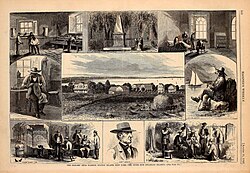
The residents were described by 19th-century sources as "inmates",2245 though this term was no longer used by the 20th century.2161 Residents were locally also known as "snugs"5061 or "snuggies".62 While staff addressed all residents as "captain" regardless of their real-world rank,76163 in practice, there was an implicit hierarchy based on residents' real-world ranks and service.10 There were relatively few rules, other than that residents be well-behaved, keep their rooms tidy, and abide by a curfew.135864 Outside of curfew hours, residents were welcome to come or go as they pleased,6165 and they could stay with families or friends for extended periods.6667 Initially, the only exception was Sunday, when they were required to attend church on-site,68 though even this was no longer compulsory by the 1890s.67
The complex had a kitchen and infirmary, alongside various amenities such as workshops, recreation rooms, theater, library, chapel, and music hall.586269 It had a dedicated fire department, power plant, and stores.70 Three meals were served daily in the complex's mess halls.5966 There was also a farm,7172 along with other structures such as a greenhouse, piggery, and creamery.72 Though residents had few responsibilities, some had voluntary side jobs,7370 although they could not work off-complex.74 Residents grew food and crops such as tobacco57 and wormwood,72 and they engaged in other activities such as model shipbuilding1375 and games such as cribbage, billiards, and pinochle.73 They also received regular allotments of liquor and tobacco,6712 and two suits a year.67
Snug Harbor was managed by a succession of governors, many of whom were former captains,65 and it employed matrons, who did housework.73 Deceased residents were buried in Snug Harbor's cemetery.7670 More buildings were added over the years as the population increased.7 Until the mid-20th century, Snug Harbor hosted few outside events;76 the grounds were sometimes opened for golf tournaments.77
1830s to 1870s
Starting with John Whetten, and with few exceptions, most of Snug Harbor's governors from 1831 to the 1960s were Marine Society members.78 Randall's corpse was disinterred from St. Mark's Church in-the-Bowery in 1834 and reinterred at Snug Harbor,876 where a granite obelisk was built.54 Some residents, unaccustomed to civilian societal norms, initially got into fights,5010 and numerous serially-inebriated residents reportedly took to theft.79 The complex had 85 residents by 1839,80 nearly half of building C's 200-person capacity.81 This prompted the construction of wings on either side between 1840 and 1842.8081 The institution recorded its first black resident in 1842.82 The same year, to address Whetten's concerns about misdeeds committed by Snug Harbor's more alcoholic residents,79 a fence around the property was built starting that year.8384 Whetten retired in 1844.85
Augustus F. De Peyster took over as Snug Harbor's second governor in 18457951 and was by some accounts more well-liked by Whetten.78 The complex had grown to include 300 residents by 1850, about one-third of whom were non-Americans.86 A purpose-built chapel was constructed on the grounds in 1856; previously, residents had prayed in building C.68
Retired sea captain Thomas Melville, the brother of Moby-Dick author Herman Melville,87 became the third governor of Snug Harbor in 1867.5185 Under Melville's tenure, the trustees began paying residents to help with chores.88 Melville was also accused of embezzlement during his tenure, but was later exonerated.1088 He also oversaw the construction of the final two buildings in Temple Row,89 which were finished in 1879–1880.90 During Melville's governorship, black residents were required to sleep and eat in segregated areas, but were allowed to mix with other residents elsewhere.91 Melville was a strict disciplinarian, frequently punishing residents who broke the rules by putting them on the "taboo list". Residents on the list were denied their tobacco ration and could not leave the premises.91
1880s to 1900s
Gustavus Trask became the fourth governor of Snug Harbor after Melville's death in 1884.8992 He commissioned Augustus Saint-Gaudens to design a statue of Randall,89 which was cast the same year;9394 building C's interior was also renovated that year.445 During Trask's tenure, several residents were investigated on suspicion of having sold their votes in the 1888 US presidential election.9596 Trask also commissioned a church and a music hall, both designed by Robert W. Gibson.4597 Snug Harbor's Music Hall was finished in July 1892,45 followed by the Randall Memorial Church the next year.9868 The original chapel was also moved about 200 feet (61 m) in 1893.99100 During that decade, the trustees unsuccessfully attempted to obtain tax exemptions.101
Trask resigned in 1898 following accusations of misconduct,102103 being replaced by Daniel Delehanty.103104 Subsequently, Delehanty instituted several major reforms, including eliminating several rules, hiring additional staff, and expanding the hospital.105 Snug Harbor had about 1,000 residents at the beginning of the 20th century,63106 many of whom had decades of service as sailors;107 they occupied rooms with one to five people each.108 The complex had grown to include numerous buildings,d along with forests and the complex's farm.24 The institution itself had become was one of the city's wealthiest,63110 earning about $400,000 annually.109111 It earned an annual surplus of $100,000 from renting out the Manhattan sites45 and had become one of Manhattan's largest landowners.112 By then, many of the residents were nearing or above age 90, and an average of fifty residents died every year.70 Although residents frequently attended events at the Music Hall, less than 10% attended church because Sunday service was no longer compulsory.7097
Snug Harbor's residents were disenfranchised in the early 1900s because of voting restrictions imposed on charitable institutions.113114 The interior of the Randall Memorial Church was destroyed in a 1904 fire.115 Delehanty banned non-smoking residents from receiving tobacco in 1907, following reports that some residents were illicitly reselling tobacco,116 and a dispute regarding rental rates for the Manhattan property arose the same year.117 Delehanty resigned that December and was succeeded by A. J. Newbury.118 One magazine wrote in 1908 that the institution was no longer using rental income to help the sailors, instead using the funds for real estate investment.59
1910s to 1930s
The trustees were considering selling the Manhattan sites by 1911; the sites' annual return on investment was 2.5%, but the trustees wanted to invest in more profitable ventures.25119 Since Randall's will had prohibited the land from being sold, the trustees sought to change the will.26120 The New York Supreme Court ruled in 1912 that the trustees could sell the Manhattan land;4014 disputes over the ruling continued until 1914, when the state's high court, the New York Court of Appeals, upheld the sale.121 New stained glass windows were installed at Randall Memorial Church in 1915.55122 The trustees hired Louis Jallade that year to design a new recreation building,123 which opened in 1917 as the Great Hall.124 Newbury remained governor until his death in 1919,125 when George Ernest Beckwith was appointed in his place.12655 The trustees loosened the bylaws during Beckwith's tenure.55
Sailors' Snug Harbor had a $2 million surplus by 1922, though the trustees refused to release more details about their finances than necessary.127 Snug Harbor continued to host events for its residents, many of whom were elderly.128 The complex had 30 buildings across 150 acres (61 ha).11128 A section of the site to the south was sold in 1927 to developers, who built the neighborhood of Randall Manor.129 By the early 1930s, Snug Harbor had around 900 residents and 200–300 staff members.22130 The institution's holdings were valued at $20 million56 or $30 million,58131 enough to sustain it despite the Great Depression.131 By then, the age requirement for residency had been raised to 65 years, due to high demand for space in Snug Harbor, although disabled sailors were still exempted.56 At the complex's centennial, it had accommodated 9,200 total residents.130
Residents' voting rights were restored in 1932,114113 and a plaque celebrating the complex's centennial was dedicated in April 1934.130 After Beckwith died in mid-1934,126 Howard A. Flynn took over as Snug Harbor's governor.56132 The number of residents began to decline in the mid-20th century due to several factors.631071 The establishment of Social Security in the 1930s provided retirement benefits to every American, reducing the need for facilities like Snug Harbor;19133 additionally, revenues from the Manhattan properties decreased, and resources were diverted after the outbreak of World War II.63 There were also fewer sailors in general, with the growing popularity of trains and, later, automotive travel.20
1940s and 1950s
Snug Harbor's trustees offered to donate 9 acres (3.6 ha) of the Staten Island campus to the city government in 1940, but Mayor Fiorello La Guardia accused the trustees of using the gift to evade taxes.134 The New York City Board of Estimate ultimately accepted the land donation in 1943.135 The city government also considered taking over Snug Harbor, particularly the Randall Memorial Church,136 but the city's corporation counsel determined that Randall's will prohibited such a gift.137 The American entry into World War II prompted many residents to enter or re-enter the armed forces.138139 Flynn served as the institution's governor until 1947,140141 and he was succeeded by Henry R. Patterson.142141e By then, Snug Harbor was increasingly relying on outside consultants' advice, as some trustees, including the mayor, never showed up to meetings.144 Mayor William O'Dwyer announced his intention to leave the board of trustees in 1949,145 receiving judicial approval.27 Also in 1949, the state attorney general sued the trustees after finding that residents were being charged fees;146147 the suit was dropped when the fees were ended.148
Snug Harbor was in financial difficulty by 1950, with about 375 remaining residents.136 That year, 23 buildings were demolished as part of a master plan created by Otis N. Auer and Harvey Wiley Corbett,53 the first major change to the campus since World War I.149 The work included adding or upgrading mechanical systems and consolidating activities in the remaining buildings.149 The trustees announced plans in 1951 to demolish the Randall Memorial Church.150151 Despite proposals to save the chapel,152153154 it was demolished in 1952.155154 The trustees also razed the complex's old hospital,151 which was replaced by a new infirmary.156 The complex's farm, the only one surviving on Staten Island's North Shore in the 1940s,157 was leased to developers who built apartments there.53158
Patterson retired in 1952, and his successor, Charles Baldwin,142143 promised not to make further changes or sell property.159 After Baldwin died in early 1955,142160 Frank Hickok served as interim governor until William C. Twigg was appointed permanently in 1956.142161 By that decade, Snug Harbor was struggling financially;162163 rental income from the Manhattan sites was insufficient to finance even a renovation of the Staten Island buildings.163 The institution's staff hierarchy was reorganized in the 1950s,153 and there was talk of converting Snug Harbor to a community college campus.164 Though the trustees initially disagreed on whether to transfer many management duties to a new director's position,165 they eventually employed a succession of directors.153 The trustees also began allowing public events in the mid-20th century,76 including graduation ceremonies166 and art shows.167 The institution still operated with few rules, though they did start charging fees for items to raise money.61 The number of residents had declined to just over 300.6169
Site proposals and sale
1960s proposals

Twigg died in 1961,168 and the next year he was replaced by Sidney Trew.142169 By then, younger sailors were increasingly living with their families, and retirement benefits had reduced demand by so much that each remaining resident had their own room.69 During that time, the trustees proposed redeveloping part of the site,170171 including constructing an apartment building on some vacant land.172171 The trustees tried to have the surrounding land rezoned for retail but were rejected twice;173 the proposal did not proceed due to financial difficulties.171 They ignored local residents' pleas that the area around the complex be rezoned to prohibit high-rises.171 City officials alternatively suggested turning the grounds into a park, allowing the trustees to pay reduced property taxes.171 By the mid-1960s, the complex had an annual maintenance outlay of $1.1 million,174 which the leases in Manhattan could not cover.162 The trustees unsuccessfully tried to sell the Staten Island property to the city.175
The complex admitted its first female resident in 1965,176 The trustees also contemplated allowing married couples to live at the complex, which previously had been restricted to men without spouses.176177146 The plans included a new clinic, apartments, and cottages.177178 The new structures would replace dormitory buildings A, B, D, and E,179 which had been cited for building-code violations.178 In October 1965, the New York City Landmarks Preservation Commission (LPC) designated buildings A–E and the chapel as six of the city's first 20 official landmarks.180 Snug Harbor's trustees generally opposed the four dormitories' designations,144181 which the Board of Estimate ratified that December.182 In 1966, Snug Harbor's trustees asked the court for permission to charge fees and admit sailors' wives for the first time.176183 New York Attorney General Louis J. Lefkowitz endorsed admitting women but initially opposed the planned rental fees;184 he later approved the fees.185
The institution began charging rent in May 1967, and residents unsuccessfully sued to stop it.28 Concurrently, the New York Supreme Court ruled that the trustees could not be compelled to pay the maintenance costs that were mandated as a result of the landmark designations.186187 The ruling effectively voided the designation, allowing redevelopment to resume,28188 but the LPC sued to have the designation restored.28189 The Cultural Arts Council made a competing proposal in December 1967, which called for the buildings to be converted into a cultural center.189 The Supreme Court's Appellate Division upheld the landmark designations in 1968.170190 Separately, Lefkowitz sued the trustees on allegations of "mismanagement and waste"; the suit was dropped for a lack of evidence.186 The idea of donating the landmarked buildings to the city was first proposed in late 1968.188 The proposal was not given serious consideration at the time,191 but Snug Harbor trustees dropped their plans to demolish some buildings.192 Trew resigned the same year, and Leo Kraszeski took over,193 quickly being promoted to Snug Harbor's directorship.194
1970s proposals and sales

By the 1970s, the New York State Department of Health found that Snug Harbor's infirmary building did not meet modern building codes.191195 The trustees were losing money operating the Staten Island campus196197 and could barely afford a new infirmary.191 Snug Harbor's trustees drew up plans for a new infirmary in 1970, which were rejected by both the LPC and the Health Department.191 By then, the Staten Island Museum—one of the founding members of the Staten Island Institute of Arts & Sciences, which wanted the city to buy the entire site198—wished to move into one of the buildings.192 The city government announced plans in February 1971 to acquire 13 acres (5.3 ha) of the site, including the six landmarked buildings.191199 The trustees asked the Manhattan surrogate's court for permission to sell the existing site and relocate to Sea Level, North Carolina,197 which the trustees chose after considering several other sites in the American South.200 Lefkowitz opposed the move, accusing the trustees of neglecting the site,201202 and many of the 170 remaining residents also lodged objections.201
The builder Sigmund Sommer offered to buy 65 acres (26 ha) of the remaining land in February 1972,203204 with plans to develop 21 buildings there.204205 The city-owned site was designated as parkland the next month.206 The city finalized the purchase of its portion of the site that September,207 and the Manhattan surrogate's court approved the Snug Harbor trustees' relocation in November.205208 Following objections to Sommer's plans, the city announced plans to acquire his land as well,204209 and the Board of Estimate designated Sommer's site as parkland in August 1973.206 The city government proposed $7.2 million for Snug Harbor in its 1973–1974 capital budget,210 which paid for Sommer's land.195 In total, the two land acquisitions totaled either $8.7 million,195 $9.2 million,211 or $9.7 million.204212
The sailors' home remained open temporarily, despite multiple inspections that discovered violations of health codes,213 as the construction of the Sea Level facility had been delayed.195214 Officials from the city government and the retirement home also argued over who should repair the buildings, some of which were unusable.215 The 1975 New York City fiscal crisis left the city government unable to finance even minor maintenance; it eventually managed to procure $82,000 for emergency repairs in mid-1976.216212 The state legislature also approved $4.5 million for repairs in 1975.217218 By that decade, the complex regularly hosted parties and other events.85
Relocation of institution
In June 1976, the institution moved to Sea Level,214219220 having dwindled to about 100221 or 200 people.222 The institution's expenses had increased to $9,000 annually per resident.196 Two sailors initially held out, even after losing essential services and receiving eviction notices;223 they, too, left in September 1976.224 Kraszeski remained with the relocated institution until 1986.225 The original institution considered returning to building C in the late 1990s, shuttering its remaining retirement-home operations.23226 This did not occur,226 and the trustees stopped operating the retirement home in 2000s, shifting their focus to distributing funds to sailors.227228
The retirement home continued to operate until 2019, when it closed permanently due to damage from Hurricane Florence and Hurricane Dorian.229 The original board of trustees, known formally as Trustees of the Sailors' Snug Harbor in the City of New York, still exists as of 2023230231 and is headquartered in Manhattan.227 It continues to provide financial support to sailors using funds from the endowment.228232 The Sailors' Snug Harbor Archives are preserved at the Stephen B. Luce Library at the State University of New York's Maritime College.211233
Use as cultural center
After the city acquired the land, the Staten Island Museum announced plans to move there,234 while Children's Aid agreed to maintain Snug Harbor's burial ground.219 Ten trustees were appointed to the Snug Harbor Center Development Committee in January 1975.235 The group was incorporated that December as a nonprofit organization, the Snug Harbor Cultural Center, to maintain the facility and host events.236 The cultural center requested that the sailors' home lend them two paintings, a tray, a uniform, and a portrait of Thomas Melville.219 The center took over the complex's operations in July 1976178 and began offering private tours of the complex that August.237 In conjunction with the United States Bicentennial,238 the complex hosted its first public event on September 12, 1976, with 15,000 attendees.239
Early years

From the outset, Snug Harbor faced funding shortages,212 with a full renovation estimated at $13.2 million.216 Emergency repairs were budgeted at $40,000, while facade stabilization was estimated at $750,000.240 Although the grounds were in good condition, the buildings needed upgrades to varying degrees.216 The Staten Island Botanical Garden became the center's first major tenant in 1977,240 although it did not have physical facilities initially.241 The cultural center's first director, Michael T. Sheehan, was appointed the next year.242 Although the entire complex had been designated as a National Historic Landmark district in 1976, making it eligible for federal preservation funds, cultural center officials were not notified for more than two years.243
In 1979, the US government provided a $100,000 grant for the renovation of Snug Harbor's chapel,217 though it rejected another grant of $588,000 to restore building C.244 Another $650,000 was donated by the Staten Island War Memorial Association,245 later increased to $800,000, which was used to renovate the complex's chapel.99 The state government released $1.14 million of the state legislature's 1975 grant to pay for emergency repairs.246 The city and state government provided funding to pay annual expenses, while the cultural center raised additional funds raised independently from donations, memberships, and other sources.218 Although a 1980 bill allowed the federal government to take over Snug Harbor as part of the Gateway National Recreation Area,247 this was not being planned yet.218
The cultural center initially struggled with funds, being unable to pay employees' payroll tax or even buy heating oil during particularly rough periods.240 By the early 1980s, several art galleries had opened at Snug Harbor, and the Music Hall was about to be restored.50 The Newhouse Gallery in Building C's main hall frequently hosted exhibitions,65248 and the grounds staged live performances and shows during the summers.65240 In addition to annual concerts hosted by the New York Philharmonic and Metropolitan Opera, the complex hosted events presented by the Snug Harbor Cultural Center or other institutions.218248 Dozens of dormitory rooms were rented to artists,218 and there were long-term plans to relocate multiple museums, cultural institutions, and art galleries there.249
Mid-1980s to 1990s

The cultural center raised millions of dollars to renovate multiple buildings in the 1980s.250 A renovation for the Staten Island Museum was announced in 1984,251 covering buildings A and B.248 Another renovation was planned for the separate Staten Island Children's Museum,250 located within Snug Harbor's former maintenance building.252 The chapel was restored as well;100250 it was rededicated as the Veterans Memorial Hall in May 1985100 and reopened as a concert hall that October.253 Other projects planned at the complex included new parking lots, the repainting of buildings A–E, upgrades for the Botanical Garden, and restoration of building C's main hall. The cultural center hired the preservation consultant Phillip Neuberg in 1985 to oversee the multi-year renovation program.252 The Children's Museum opened there in 1986,248254 and the recreation hall reopened that year as an event venue called the Great Hall.255 The cultural center's annual operating expenses had increased to over $1.7 million by then.256 Renovations of buildings A and B for the Staten Island Museum were delayed by cost overruns,257258 and the structures remained empty for decades.259
Rafael Viñoly won a design competition in 1987 to redesign the Music Hall as part of a $12 million project.260261262 The Music Hall renovation was downsized and delayed after costs reached nearly $20 million.45263264 The cultural center presented a multi-phased renovation plan in 1989, which included landscaping the grounds, renovating the existing buildings, and constructing new buildings for up to $100 million.265 Quennell Rothschild Associates presented a master plan for the site that year,266 and the Dormitory Authority of the State of New York received authorization to issue bonds to fund the renovation of several cottages.267 Four cottages were subsequently converted to artist dormitories,268 and some recital halls were also built.258 Thirteen of the buildings had been renovated by 1990.106 A Chinese garden was under development,269 the gatehouse was being restored,84 and fundraising for the Music Hall was underway.270 Workers also began restoring building C's main hall after part of the ceiling fell down.271272
The complex scaled back its event offerings after experiencing major funding reductions in the early 1990s, and many renovation projects stalled;273 there were 250,000 annual visitors by then.274 Building D, which was leased to the Noble Maritime Collection in 1991,275 was in such poor condition that volunteers spent several years restoring it.276 The same year, the city government hired Jan Hird Pokorny to renovate ten of the buildings.277 Building C's main hall was rededicated in 1993,271272 followed the next year by the complex's Botanical Garden pond.278 In addition, work on the Music Hall began in 1996,263 after the project was downsized to $3 million.45263 The Music Hall partially reopened the next year.262264279 The New York Chinese Scholar's Garden was completed at Snug Harbor in June 1999.72280 Other renovation projects in the late 1990s included a new dock and restorations of the cottages.281
2000s to present

Connie Gretz's Secret Garden was dedicated at Snug Harbor in 2000,282283 and the Noble Maritime Collection opened that October.284285 During the early 2000s, the barn occupied by the Staten Island Children's Museum was expanded, and a basement gallery and an enclosed breezeway were built between the museum's two buildings.286254 A renovation of building P and the addition of the Tuscan Garden were announced in 2003,287 and a second phase of the Music Hall project was completed the next year.262 The cultural center also began seeking tenants for building E,288 which was decrepit and unfit for habitation.289 Three other landscape projects at Snug Harbor, announced in 1998, were delayed due to a lawsuit that was voided in 2004.290291 Snug Harbor also received city funding to renovate the landscape and buildings A and P,292 though its leadership sought further funding to renovate four more buildings.293 The city provided more funds for the long-stalled renovation of buildings A and B in 2007,294295 and a conservation center between buildings B and H was built that year.294
A memorial garden to victims of the September 11 attacks opened in 2008,296297 and the Tuscan Garden opened in October 2010.298 Work on the Staten Island Museum buildings resumed in 2011.259299 The Veterans Memorial Hall was damaged by a burst pipe in 2014;300 it remained closed for years because the cultural center did not prioritize repairing it.301 After cultural center officials reported a severe funding shortage in 2015, saying that the city's $950,000 annual appropriation was insufficient,302 the city increased the annual appropriation and provided $10.5 million in capital funds.303 Although the cultural center had struggled to attract visitors in previous years, city officials believed the redevelopment of nearby St. George would entice more visitors.304 The Staten Island Museum moved into Building A in September 2015,305306 following a full reconstruction.259
Work on a restoration of the Music Hall commenced in 2019; that project was expected to be complete in two years307 but was delayed.308 Also postponed was the Staten Island Museum's plan to expand into building B by 2022.309 Snug Harbor remained open during the COVID-19 pandemic in New York City but postponed many programs310 and temporarily closed its buildings and Chinese garden.311 The city government provided funding in 2021 for the renovation of buildings B, G, and K, and the Children's Museum,312 and it subsequently allocated funds for mechanical upgrades.309 The Snug Harbor institution's trustees donated the burial ground to the city in 2024,313 and a boardwalk, observation platform, and new entrance opened the next year.314
Site and layout
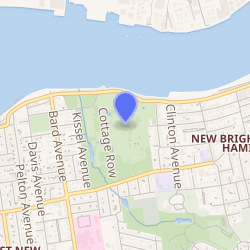
Snug Harbor is located in Randall Manor on the North Shore of Staten Island in New York City.315 It faces the Kill van Kull, a strait separating New York and New Jersey,221 and is accessed by Richmond Terrace, a west–east avenue.316 The grounds originally covered 130 acres (53 ha)62129 but have been reduced over the years to 83 acres (34 ha).129317286f Various chestnut, oak, and pine trees are planted across the grounds, and there are landscape features such as hills and ponds.10 One of Snug Harbor's trees, a paulownia, is designated as a "great tree" by the New York City Department of Parks and Recreation.318 The complex also includes a gazebo and numerous lawns,10319 including the 7.5-acre (3.0 ha) South Meadow.320 Snug Harbor also has botanical gardens (see § Staten Island Botanical Garden), which span 55 acres (22 ha),289 along with parking lots.320
Iron fence and gatehouses

An iron fence, built in the Greek Revival style, surrounds the property.83321 The fence, dating from 1842, is variously attributed to William Alexander83 or Frederick Diaper.84 Several gates flanked by granite posts are embedded in the fence.321 The grounds are accessed by numerous gatehouses that date to 1851–1875 and are designed in the Italianate, Second Empire, and Romanesque styles.322 There are five gates: two for vehicles and three for pedestrians only. The vehicular gates are the west gate on Snug Harbor Road and the east gate on Tysen Street. The others are the north gate on Richmond Terrace, the south gate on Henderson Avenue, and the Kissel gate on Kissel Avenue at the far western end of the property.323
The main vehicular entrance is the western gatehouse, which dates from 1880.324 The north gatehouse on Richmond Terrace, build in 1874, is a designated city landmark.144 Located in front of building C and set back from the fence, it is trapezoidal with a high central archway, flanked by guard rooms with rectangular windows. The quoins surrounding the archway and window openings are made of leftover marble and sandstone from the original structures. The top of the northern gatehouse has brick corbels supporting a cornice, along with a square cupola.322324 A path leads through the northern gatehouse to a marble monument to Robert Randall.131
Artwork
The grounds included a 1893 zinc fountain featuring the god Neptune,325326 located between Temple Row and the governor's house.51 The New York Times described the statue as sitting "in the middle, astride a shell held aloft by sea monsters, his trident raised. Jets of water spurt from the fountain's center and from bouquets of metal calla lilies to its sides."326 A replica of the statue, cast in 1994 due to the original's extreme deterioration,325 sits on the East Lawn.320 The grounds also featured a bronze statue of Randall designed by Augustus Saint-Gaudens in 1884.9394 After the original was relocated to Sea Level in the 1980s,94 a replica was installed in 1983.327
Burial ground
Deceased residents were buried in a graveyard called Monkey Hill,57328 covering about 6 acres (2.4 ha).81 Containing up to 8,000 corpses,81328 it is located in nearby Allison Pond Park, which used to be part of the complex. The pond supplied water to Snug Harbor until 1939.329330 Much of the land was sold to the city in 1975 and turned into a public park with hiking trails,329 while the Snug Harbor trustees retained the actual burial plot until 2024.313 The headstones were removed and placed into storage in the early 20th century due to vandalism;331 the majority of the bodies lie in unmarked graves.332 A brick wall surrounds the plot.313329
Architecture

The Snug Harbor Cultural Center has more than two dozen remaining structures from the retirement home.g Minard Lafever's original structure, building C, was designed in the Greek Revival style. Later structures were designed in a variety of styles, such as the Beaux-Arts, Gothic Revival, Italianate, Second Empire, and Victorian styles; many of the buildings have since been demolished.336 At its peak, the site may have had either 50,221325336 55,5781 more than 60,63 or 70 buildings.53 During the complex's time as a retirement home, it had nautical decorations such as paintings, ship models, compasses, and sextants.13
Temple Row
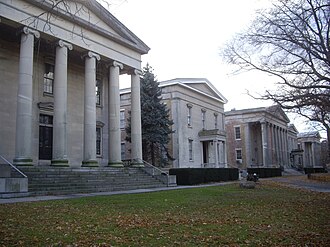
The five interlocking Greek Revival buildings at Snug Harbor, known as Temple Row,7337 are located on the northern end of the grounds (near Richmond Terrace) and are known as buildings A through E from west to east.33832690 The five buildings were designed by Lafever and Richard Smyth and were constructed from 1831 to 1880.32690 The buildings are parallel to each other, but due to the differing facade designs, buildings B and D appear set back from buildings A, C, and E.338339 Building C was an administration building, and the other Temple Row buildings were dormitories.32690 Brick passageways, known as "hyphens", link the five structures.81 Although the buildings use Greek Revival motifs, they are not strictly historically accurate; for example, the rear facades have incomplete motifs.340
These buildings were originally incorrectly attributed to Martin E. Thompson, an architect whom Lafever had followed.9341342 According to the researcher Barnett Shepherd, Lafever was mentioned in documents from building C's construction, while Thompson, who was not, was inaccurately given credit in a book by the historian Talbot Hamlin.341342343
Building C


Building C, also known as the Administration Building, was completed in 1833 and is Lafever's oldest surviving work.190 As of 2020, building C houses part of the Newhouse Center for Contemporary Art.344 The building consists of two stories, a raised basement, and an attic; it is rectangular in plan with a gable roof. The main entrance contains a set of steps underneath a stone portico, consisting of eight columns supporting a classic pediment.62339345 Early renderings show that the columns had no fluting and that the frieze and door frames were unornamented.49 The sides of building C are eight bays wide.346 The rear elevation is made of brick346340 and has simpler Greek decorations.340
Building C was originally an administrative building with 34 rooms,46 including bedrooms, kitchens, dining rooms, washrooms, and recreational rooms.346 The entrance leads to a 2+1⁄2 -story main hall with ash floors and a vaulted ceiling,346 which occupies one-third of the first floor.80 Doorways lead to other rooms on the first floor and to the other buildings,346 and a hallway connects with the infirmary.50 A staircase on the left (east) side of the main hall, with iron railings and wooden wainscoted walls, connects the first and second floors.347 The second floor consists of a balustraded balcony surrounding the main hall,348346 with fourteen doorways.347 The ceiling, shaped like an inverted keel,28 rises from brackets at each of the main hall's corners.80340347 It contains a central, domed skylight80346 and a 20-by-100-foot (6.1 by 30.5 m) mural.272 Various maritime-themed decorative elements and carvings are located on the ceiling and walls,271340347 while clerestory windows on the north and south walls resemble the sun and moon.347 Some interior decorations have been replaced over the years.349
Buildings A, B, D, and E

Buildings B and D were both designed by Minard Lafever and completed around 1840–1842.8090h Building B is not open to the public,323 and building D houses the Noble Maritime Collection.285350 Both are two stories high with an attic and a high basement, and they are rectangular in plan with gable roofs. The front facades are made of smooth stone and contain a small porch with a gable351352 and a simple stoop.628180 The structures were initially intended as dormitory buildings.353 Inside both buildings, a hallway runs from north to south, and an east–west transverse hallway connects with the hyphens.80
Buildings A and E were both designed by Richard Smyth and completed in 1879–1880.90 Building A is used by the Staten Island Museum,305 while building E, long used as a storage facility,354 is not open to the public.323 Both buildings consist of two stories and raised basement and an attic, and they are rectangular in plan with gable roofs. The main entrances of both buildings contain a set of steps underneath a stone portico, consisting of six columns supporting a classic pediment,326353355 decorated in the Ionic order.81 The structures were originally dormitory buildings.351
Veterans Memorial Hall
The Veterans Memorial Hall (completed 1856), formerly the chapel, was designed by local builder James Solomon.90356 It is located south of the Snug Harbor Music Hall, near the campus's east end.323 Stylistically, it is a "transitional" building, with stylistic elements mainly rooted in Italianate architecture as well as some elements of Greek Revival architecture.357 The design of the chapel is based on that of a typical New England church.358 The chapel contains a gable roof. The front entrance consists of a tower with a belfry projecting from the front end of the chapel.357322 The entrance leads to a plaster-walled vestibule with three round arches and three plaques. The brick facade has six round-arched windows on each side, separated by pilasters. At the rear is a one-story extension with an office and sacristy.357322 The chapel has stained glass windows.358322


Inside is a rectangular space that could fit 600 people;357 in the 1980s, the capacity was reduced to 205.359 The space also contains wooden pews and wainscoted walls. The coved ceiling has a recessed panel with two lamps. A gallery on the north end is supported by two cast-iron columns and has recessed wood paneling. An apse at the south end surrounds a raised former altar area.357 At the center of an apse is a doorway to the office, which has plastered walls with bookcases built into them, as well as a stone fireplace.360 There are also plaques honoring Vietnam veterans.359 As part of the hall's 1980s renovation, a lobby, box office, and other front of house facilities were added beneath the existing chapel.359
When built, the main entrance was through a central round arch at the front, topped by a pediment with Doric pilasters. A round-arched window and lintel flanked the main entrance, while a full-height pilaster was located at each corner.357 One observer in 1873 called the chapel a "plain but handsome brick building, without any cupola or belfry."361 The chapel's bell tower and stained glass date to 1883,99357 and the entire chapel was moved in 1893.99100357 The Veterans Memorial Hall was renovated into a concert hall in 1985,253 though it is not open to the public as of 2018.323
Other buildings
Another set of buildings, labeled F through H, are respectively located south of buildings D through B, and are connected to each other and to the buildings immediately north of them.323 These buildings are linked by tunnels, which are closed to the public.362 When the cultural center opened, building H was used as a visitor center and concession shop, while building G was used by the Newhouse Center.363

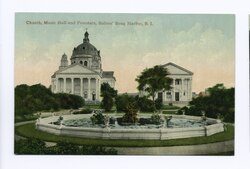
The Great Hall and Music Hall are located east of buildings H through F.323 The Great Hall was designed in the Beaux-Arts style by Louis Jallade and completed in 1917, with Doric columns and a large window on one facade, and brick walls on the other facades.124 Inside are a chandelier, wood panels, and vaulted ceiling;50124 the Great Hall's main hall can accommodate 450 people, while the Lower Great Hall below can hold 250 people.124 The adjacent Music Hall, a 686-seat Greek Revival auditorium,261 was designed by Robert W. Gibson and opened in 1892.45 It is the second-oldest music hall in New York City, after Carnegie Hall;289291 the orchestra level originally had 600 seats, while the balcony had 300 seats for trustees and their guests.45364365
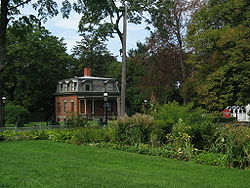
A matron's house and a maintenance building are south of buildings H through F and east of the chapel. The Staten Island Children's Museum and World Trade Center Educational Tribute are in the center of the grounds, south of the maintenance building and matron's house, while the Snug Harbor Administration building is south of the museum.323 On the west end of the site323 are five cottages;221325 one is used as a gift shop, while the others accommodate uses such as film shoots and intern housing.325 The Governors' House, a Victorian structure, dates from the 19th century.221319
Former buildings
On the campus was formerly the Randall Memorial Church, designed in the Renaissance style15045 by Robert W. Gibson.45366 The building, completed in 1893,367 was patterned after St. Paul's Cathedral, London.17562 It had a floor plan shaped like a Greek cross, with four arms intersecting at an octagonal vault.366 The facade was made of brick and marble, with a 135-foot-tall (41 m) copper dome and a pair of turrets, while the interiors were clad in marble.366
Over the years, there have also been other structures, including a hospital, dining hall, and gazebo.81 The hospital, with four wings at its peak, was designed in a Greek Revival style.368 There was also a theater with a curtain depicting the Vanderbilt family's Staten Island farmhouse.42
Management
The Snug Harbor Cultural Center and the Staten Island Botanical Garden merged in 2008 to become the Snug Harbor Cultural Center and Botanical Garden,369370 four years after the merger was first proposed.371 The combined entity is a Smithsonian Institution–affiliated110372 nonprofit organization that operates the Snug Harbor complex.373374 In fiscal year 2023, it recorded revenue of $5.56 million, expenses of $5.48 million, assets of $5.12 million, and liabilities of $435,000.374
The Snug Harbor Cultural Center manages the grounds and some of its own programs, including the Staten Island Botanical Garden and the Newhouse Center.302 Other occupants, including the Noble Collection, Staten Island Children's Museum, and Staten Island Museum,71370 lease space at the site.302 Friends of Snug Harbor, a volunteer group, raises funds and hosts events and other activities.248 There are numerous venues for performing arts, recreation, and other cultural events throughout the complex.334 The Snug Harbor Cultural Center and the Staten Island and Children's museums are members of the city's Cultural Institutions Group (CIG), a partnership of cultural and educational institutions;302 the Noble Maritime Collection also became part of the CIG in 2025.375 Although the grounds are accessible free of charge, some institutions and attractions charge a fee.110376
Staten Island Botanical Garden

The Staten Island Botanical Garden, part of the cultural center since 1977,240377 is managed directly by the Snug Harbor Cultural Center.302 Arranged based on Quennell Rothschild Associates' 1989 landscape plan,266 it includes landscape features such as a pond, lawns, and rows of trees and flowers.377 There is a conservatory known as the Carl Grillo Glass House,378 which hosts exhibits corresponding to three biomes.325 The grounds also contain a restaurant within a cottage,333 along with a 20-acre (8.1 ha) wetland.296266 The Heritage Farm, covering about 2 acres (0.81 ha) at the Botanical Garden,379 hosts urban-agriculture training programs.380
There are over 20 special gardens at the Botanical Garden.266378 Among these are the White Garden, inspired by Vita Sackville-West's garden at Sissinghurst,266381 and the Lions Sensory garden, which includes plants selected for their texture, smell, and sound.320382 Connie Gretz's Secret Garden, named for the late wife of a local resident, contains a moat, castle, maze, and walled secret garden.282 The New York Chinese Scholar's Garden, an authentic, walled Chinese garden, was built in the style of the famous gardens of Suzhou,320369 with features such as pavilions and a pond.280 The Tuscan Garden contains terraces, pools, potted plants, and other features inspired by a similar garden at Florence's Villa Gamberaia.298 The Healing Garden includes a path, a wall memorializing Staten Island's 9/11 victims, a sculpture, and saplings from a tree that survived the 9/11 attacks.297 Other special gardens include butterfly, herb, perennial, portage, rose, and shade gardens and a Victorian pond.378
Newhouse Center for Contemporary Art
The Newhouse Center for Contemporary Art, established 1977, exhibits work by Staten Island residents or about Staten Island106 and is also a subsidiary of the Cultural Center.302 The Newhouse Center provides artist-in-residence exhibitions and 15,000 square feet (1,400 m2) of gallery space.383 Although the Newhouse was founded with a focus on artists who live or have their studios on Staten Island384 and art that reflects the history of Staten Island or Snug Harbor,106 the Newhouse moved on to a broader focus on contemporary art. It can mount large shows and large works, along with outdoor sculpture shows.385386
Noble Maritime Collection

The Noble Maritime Collection is a museum in building D, with a particular emphasis on the work of artist, lithographer, and sailor John A. Noble (1913–1983).275370 It opened in 2000285284 and features Noble's paintings, drawings, and other artworks.63387 The museum also includes exhibits such as an interactive old printing press,175 a replica of a houseboat Noble used as a studio,175333 ship models,304 and a salvaged ferryboat light.388 The Washington Post called the houseboat "a home on the water and an artist's lair all in one",333 while The New York Sun called the Noble Collection "an unsung gem among New York museums".389
Staten Island Children's Museum
The Staten Island Children's Museum, which has a collection of hands-on exhibits,390 has been located at Snug Harbor since 1986.254289 Its three-story main building dates from 1913, spanning 20,000 square feet (1,900 m2). An enclosed walkway connects to a 6,000-square-foot (560 m2), two-story barn, dating from 1891, has exhibits of biomes.254
Staten Island Museum
The Staten Island Museum opened a location at Snug Harbor in September 2015,305 later moving all its operations from its previous St. George location to building A.391 The museum includes artwork, documents, scientific exhibits, and objects relating to the history of Staten Island.370
Other organizations and events
Snug Harbor is home to the Staten Island Conservatory of Music.370 The Children's Montessori School, located at Snug Harbor since c. 1978, is a Montessori school with mixed-age classrooms where students work independently.289 In addition, it contains Art Lab, a school of fine and applied art,71392 which has been operating at Snug Harbor since 2000.289 The Council on the Arts & Humanities for Staten Island is also headquartered at Snug Harbor.393394 Over the years, Snug Harbor has also hosted a variety of smaller organizations.317 Previously, these included a contract bridge club, a vocational studies program, and Alcoholics Anonymous chapters.395
The Snug Harbor Cultural Center provides space for artists and arts organizations as well.317 Each year, Snug Harbor hosts the Snug Harbor Artist Residency Program, a two-month fellowship for artists;396397 eight artists are selected each year, creating artworks that are exhibited at the end of the residency.397 The complex also hosts activities such as dance, yoga, and martial arts,393 and it is sometimes used for weddings.319394 Walking tours of the complex are hosted as well.394
Transportation

When Snug Harbor opened, it was served by a dock, where a boathouse was built in 1879. The Staten Island Railway and local streetcars began traveling to the Staten Island Ferry at St. George Terminal in 1886, providing additional means of access.281 The Sailors' Snug Harbor station was served by the Staten Island Railway's now-defunct North Shore Branch until 1953;398 a retaining wall and stairways from the station still exist.399 The S40 bus, which travels to and from St. George Terminal,400 stops at Snug Harbor's front gate.106 The cultural center initially operated a shuttle to St. George Terminal,106401 which stopped running in the early 1990s.317
Impact
Reception and media
Because of the architectural styles used, Snug Harbor is sometimes described as having a Victorian feel.58336 In 1895, one observer described the complex as having a "peculiar and lasting charm",402 describing Temple Row as having a "substantial and artistic" appearance.51 Another observer in 1946 said the residents' advanced ages contributed to the buildings' Victorian character.13 The Staten Island Advance wrote in 1960 that the complex "may appear to the passerby as about as aloof and apart as a ship at sea".76 The site has been described as Staten Island's "crown jewel"403 and "an incomparable remnant of New York's 19th-century seafaring past".326 The complex's 1976 National Historic Landmark designation report said the buildings had "no equal in scale, extent or quality in America".243 The architecture garnered notice from observers such as the writer Herman Melville and the sailor Joshua Slocum, who frequently discussed Snug Harbor.336 Numerous sources regarded buildings A–E as among the US's best Greek Revival buildings.401404405
After the cultural center opened to the public, the architect David Gibson compared it to "an architectural catalog of stylistic development in the United States for 90 years".10 The Atlanta Constitution wrote in 1982 that the garden "lends softness to the soaring marble pillars of the buildings".405 In 1987, Paul Goldberger of the New York Times likened Snug Harbor to a campus, saying that buildings A–E "seem at once to embrace the 19th-century tradition of picturesque design and, by virtue of their rigid linear order, to reject it."261 The AIA Guide to New York City described Temple Row as "five Greek temples serenely surveying an immaculately groomed lawn",406 while another book called the row "the most ambitious moment of the classic revival in the United States".404
Of the cultural center, a Times writer said in 2001 that the complex "offers an escape for every taste and age",335 a sentiment repeated in New York magazine.394 The Staten Island Advance called the complex's artistic and cultural offerings "unparalleled on Staten Island", enhanced by the architecture.393 The buildings were also the subject of Barnett Shepherd's 1979 book Sailors' Snug Harbor (1801–1976),407408 and numerous residents have published books as well.55
Landmark designations
Parts of the complex had been identified as candidates for historical preservation as early as the 1950s.409410 The complex includes eight city landmarks designated by the New York City Landmarks Preservation Commission (LPC),3361 specifically buildings A–E, the Veterans Memorial Hall, the Richmond Terrace gatehouse, and the fence.1326 Buildings A–E and the Veterans Memorial Hall were individually listed as city landmarks in October 1965.144180 The gate house and fence were listed as city landmarks in 1973;144206 the fence's designation applies to 1⁄3 mile (0.54 km) on the northern edge of the property.321 The interiors of building C and the Veterans Memorial Hall were similarly designated in 1982.1
The complex was added to the National Register of Historic Places in 1972,2663 and the grounds were declared a National Historic Landmark district in 1976.243411 Except for the eight existing city landmarks, most of the complex lacks a corresponding city landmark designation,326412 which would have covered another 22 buildings.413 The more restrictive city historic district status would have mandated LPC approval for all modifications to the district, potentially increasing renovation costs.414 The LPC proposed designating the complex as Staten Island's first city historic district in the 1980s,414 but the Snug Harbor Cultural Center opposed it.326415 Amid the cultural center's continued opposition, the LPC deferred a decision on the historic-district designation until 2016,416 when the agency declined to designate the district.412
See also
See also
References
References
Notes
- The estate was located near Washington Square Park.910 It does not line up exactly with the modern Manhattan street grid, but sources generally agree that the land is bounded roughly by Fifth Avenue to the west, 10th Street to the north, and Fourth Avenue to the east. The southern boundary is variously given as 6th Street,111213 8th Street,14 or both Waverly Street and Astor Place.15
- The positions of state chancellor and state recorder, who were named as trustees in the original will, had been abolished by the 20th century,2526 while the mayor was removed from the board in 1950.27
- One source cites Randall's will as having required six years of service.22
- Sources cite figures of more than 30,108 42,42 or 50 structures.109 These included 8 administration buildings.107108
- Sometimes referred to as "Robert Patterson"143
- Figures in other sources add up to 80 acres (32 ha).206
- It is variously cited as having 2628650221333 or 28 structures.110334335
- The AIA Guide to New York City cites building B as having been completed in 1840 and building D as having been completed in 1842.90 Barnett Shepherd cites the buildings as having been completed in 1840 and 1842, respectively, though he does not label the buildings by letter.80
Citations
- Dolkart, Andrew; Postal, Matthew A.; New York City Landmarks Preservation Commission. Guide to New York City landmarks (3rd ed.). John Wiley & Sons. p. 333. OCLC 1035146114. Retrieved October 31, 2025.
- "National Register Information System". National Register of Historic Places. National Park Service. April 15, 2008.
- "Sailors' Snug Harbor". National Historic Landmark summary listing. National Park Service. September 11, 2007. Archived from the original on June 6, 2011.
- Landmarks Preservation Commission 1982a, p. 1.
- Barry 2000, p. 17.
- Barry 2000, pp. 18–19.
- Greene 2017, p. 32.
- "Sailor's Snug Harbor, on Staten Island, Has Had a Peaceful Existence One Hundred Years, and Will Celebrate the Anniversary This Week: Retired Seamen's Home the Sailor's Snug Harbor, on Staten Island—fruits of Beneficence of Captain Randall Governor and Trustees of the Sailor's Snug Harbor". New-York Tribune. May 25, 1902. pp. B8, B9, B13. ISSN 1941-0646. ProQuest 571133299. Retrieved November 3, 2025 – via Newspapers.com.
- Shepherd 1976, p. 108.
- Boies 1981, p. 21.
- ""Snug Harbor" Keeps Sea Tang for Sailors of an Older Day: Ships of World Commerce Pass Before Door of Home on Staten Island—Bequest Made in 1801 Led to Establishment of Famous Institution Founded by Robert Randall Legal Entanglements Overcome". The Christian Science Monitor. November 23, 1927. p. 1. ISSN 0882-7729. ProQuest 512275156.
- Patterson, H. L. (June 27, 1935). "Chit Chat". The Cawker City News. p. 2. Retrieved November 10, 2025 – via Newspapers.com.
- Hollander, Herbert (September 22, 1946). "Sailors' Snug Harbor Funds Keep Piling Up". Syracuse Herald-Journal. pp. 1, 2. Retrieved November 10, 2025 – via Newspapers.com.
- "Snug Harbor May Now Sell Lands". The Brooklyn Daily Times. August 14, 1912. p. 10. Retrieved November 9, 2025 – via Newspapers.com.
- "A Charity So Rich It Can't Spend Its Money; So the Trustees of Sailors' Snug Harbor Are Asking the Courts to Help Them Solve the Problem of What to Do About Their Property and the Enormous Revenue It Brings". The New York Times. April 14, 1912. ISSN 0362-4331. Retrieved November 3, 2025.
- New York (State) Department of Social Welfare (1901). Report. p. 110.
- "Definition of SNUG HARBOR". Merriam-Webster. August 5, 2024. Retrieved March 15, 2026.
- Barry 2000, pp. 13–14.
- Greene 2017, p. 31.
- Correal, Annie; Newman, Andy; Rueb, Emily S. (September 26, 2014). "New York Today: A Sailor's Life on Staten Island". City Room. Retrieved November 10, 2025.
- Barry 2000, p. 93.
- ""Sea Dogs'" Home is 101 Years Old: Snug Harbor for Sailors in New York Has Historic Setting". Daily Boston Globe. August 22, 1932. p. 19. ISSN 0743-1791. ProQuest 758426057.
- Fressola, Michael J. (April 5, 1998). "Island treasures could sail home". Staten Island Advance. pp. A1, A10. Retrieved November 2, 2025 – via Newspapers.com.
- "Retired Seafarers in Safe Haven: Sailors' Snug Harbor Prospect". The Christian Science Monitor. September 6, 1913. p. 11. ISSN 0882-7729. ProQuest 508867165.
- "Queer Little New York Farm That Has Grown to Be Worth Twenty Millions of Dollars". New-York Tribune. November 12, 1911. pp. 2, 5. Retrieved November 9, 2025 – via Newspapers.com.
- "A New Regime for Snug Harbor Estate; Supreme Court Asked to Permit Sale of Property of Century-Old Charity". The New York Times. May 5, 1912. ISSN 0362-4331. Retrieved November 9, 2025.
- "O'Dwyer Freed Of Sailors' Snug Harbor Post: Court Rules His 'Onerous' Duties Permit Him to Resign Inherited Office". New York Herald Tribune. June 28, 1950. p. 24. ISSN 1941-0646. ProQuest 1327255429; "Court Lets Mayor Quit Snug Harbor; Job Imposed by Will of Man Who Died in 1801 Ended by O'Dwyer's 'Onerous Duties'". The New York Times. June 28, 1950. ISSN 0362-4331. Retrieved November 10, 2025.
- Ennis, Thomas W. (June 11, 1967). "Snug Harbor Due for Big Changes; Staten Island Retreat to Be Rebuilt Into a Modern Retirement Colony". The New York Times. ISSN 0362-4331. Retrieved October 30, 2025.
- Barry 2000, pp. 23–24.
- Barry 2000, p. 26.
- Barry 2000, pp. 27–28.
- Barry 2000, p. 29.
- Barry 2000, pp. 29–30.
- Barry 2000, pp. 30–31.
- West Publishing Company (1914). The Northeastern Reporter. National reporter system: State series. West Publishing Company. p. 545. Retrieved November 3, 2025.
- Barry 2000, p. 32.
- "Snug Harbor Cultural Center". New York City Department of Parks and Recreation. February 19, 2014. Archived from the original on July 25, 2014. Retrieved February 19, 2014.
- Barry 2000, p. 35.
- Barry 2000, p. 36.
- "Court Frees Dr. J. Simms". New-York Tribune. August 14, 1912. p. 5. ISSN 1941-0646. ProQuest 574968143.
- Clines, Francis X. (July 4, 1965). "Apartments Rise on Sailors' Tract". The New York Times. p. R1. ISSN 0362-4331. ProQuest 116905342.
- "Sailors' Snug Harbor". Shenandoah Herald. May 23, 1913. p. 3. Retrieved November 9, 2025 – via Newspapers.com.
- Attwood, William (April 2, 1949). "Washington Sq. Block Is Leased To N. Y. U.; Dwellings to Remain: Area Including Mews Rented for 203 Years From Sailors' Snug Harbor for Faculty Homes". New York Herald Tribune. p. 1. ISSN 1941-0646. ProQuest 1327482659; "Lease Widens Hold of N.Y.U. In 'Square'; College to Rent Most of Block From Sailors Snug Harbor for Two Centuries". The New York Times. April 2, 1949. ISSN 0362-4331. Retrieved November 10, 2025.
- Reif, Rita (May 26, 1970). "Washington Mews: Beguiling Houses on a Cobblestone Street". The New York Times. ISSN 0362-4331. Retrieved October 31, 2025.
- Gray, Christopher (April 7, 1996). "Streetscapes/The Music Hall at Snug Harbor Cultural Center;A Low-Budget Revival for a Grand 1890 Theater". The New York Times. ISSN 0362-4331. Archived from the original on January 23, 2023. Retrieved October 30, 2025.
- Barry 2000, p. 40.
- Shepherd 1976, pp. 108–109.
- Shepherd 1976, p. 113.
- Shepherd 1976, p. 109.
- Dunning, Jennifer (June 27, 1980). "Guide to the New Snug Harbor; A Visitor's Guide to Staten Island's New Snug Harbor Show About Village Art of 50's Much Remains to Be Done". The New York Times. ISSN 0362-4331. Retrieved October 31, 2025.
- Woodward 1895, p. 694.
- Barry 2000, p. 24.
- Barry 2000, p. 142.
- Barry 2000, p. 42.
- Barry 2000, p. 105.
- "Snug Harbor, Wealthy Home For Sailors, Has New Governor". New York Herald Tribune. January 27, 1935. p. A1. ISSN 1941-0646. ProQuest 1247053578.
- "Sailors' Snug Harbor". The Noble Maritime Collection. Retrieved November 4, 2025.
- "Vast Wealth of Sailors' Snug Harbor Is Piling Up". Sunday Times Signal. August 20, 1950. p. 31. Retrieved October 30, 2025 – via Newspapers.com.
- Richardson 1908, p. 1218.
- Reycraft, Jack (November 14, 1982). "Derbys were a rule at Sailors Snug Harbor". Staten Island Advance. p. 32. Retrieved October 31, 2025 – via Newspapers.com.
- Burns, Robert S. (November 3, 1957). "Every Man A 'Captain' At 'Harbor': Sailors' Home Offers Dignity". New York Herald Tribune. p. A11. ISSN 1941-0646. ProQuest 1327630698.
- Greene 2017, p. 33.
- McLaren, Robert (August 2008). "Where All the Residents Were Called Captain". Naval History. Vol. 22, no. 4. p. 72. ProQuest 203467662. Retrieved November 3, 2025.
- Richardson 1908, pp. 1218–1219.
- "Arts Replace Sailors at Snug Harbor". The New York Times. August 12, 1983. ISSN 0362-4331. Retrieved October 31, 2025.
- Barry 2000, p. 83.
- "Sailors' Snug Harbor: The Institution Founded by a Quiet Philanthropist an Enormously Wealthy Trust That Has Grown Out of the Old Minto Farm on Broadway Nearly 900 Old Salts in a Spot of Almost Ideal Beauty". The Hartford Courant. January 17, 1891. p. 10. ISSN 1047-4153. ProQuest 193664401.
- Barry 2000, p. 84.
- Sibley, John (January 24, 1960). "Sailors Snug Harbor Is Home to 314 Retired 'Captains'; 130-Acre Refuge Is Gift of Privateer in the Revolution". The New York Times. ISSN 0362-4331. Retrieved October 30, 2025.
- Richardson 1908, p. 1219.
- Greene 2017, p. 34.
- Raver, Anne (June 10, 1999). "HUMAN NATURE; An Urban Oasis for Confucius to Ponder". The New York Times. ISSN 0362-4331. Retrieved November 2, 2025.
- Barry 2000, p. 81.
- "Union Asks Inquiry at Seamen's Home". The New York Times. January 7, 1947. ISSN 0362-4331. Retrieved November 10, 2025.
- "Retired Captains Become Experts In Making Clipper Ship Models: Inmates of Sailors' Snug Harbor, Who Passed Careers Aboard Vessels of a Vanishing Age, Create Copies of Craft From Photographs". New York Herald Tribune. July 29, 1934. p. A3. ISSN 1941-0646. ProQuest 1114845553.
- Endress, Erwin (February 21, 1961). "Land-locked Refuge in Classic Lines". Staten Island Advance. p. 2. Retrieved October 30, 2025 – via Newspapers.com.
- "Set-back to Sunday Golf: Sailors' Snug Harbor Objects to Playing on Its Property". The New York Times. January 28, 2023. ISSN 0362-4331. Retrieved November 11, 2025.
- Barry 2000, p. 95.
- Barry 2000, p. 91.
- Shepherd 1976, p. 110.
- Barry 2000, p. 43.
- Barry 2000, p. 79.
- Shepherd, Barnett (Autumn 1977). "The Iron Fence at Sailors' Snug Harbor". Nineteenth Century. Vol. 3, no. 2. pp. 81–83. ProQuest 1320744801.
- Young, Deborah (October 17, 2008). "No defense for the fence at Snug Harbor". Staten Island Advance. p. 3. Retrieved November 3, 2025 – via Newspapers.com.
- Barry 2000, p. 94.
- Barry 2000, p. 78.
- Parker, Hershel (1996). Herman Melville: A Biography (Volume 1, 1819–1851). Baltimore and London: Johns Hopkins University Press. p. 651. ISBN 0-8018-5428-8.
- Barry 2000, p. 97.
- Barry 2000, p. 98.
- White, Norval; Willensky, Elliot; Leadon, Fran (2010). AIA Guide to New York City (5th ed.). New York: Oxford University Press. p. 904. ISBN 978-0-19538-386-7.
- Balcerski, Thomas J. (2021). ""The Little Spark of Manhood I Have Left": Governor Thomas Melville and the Aged Seamen of Sailors' Snug Harbor". New York History. 102 (1): 82–105. ISSN 0146-437X. Retrieved February 8, 2026.
- "City and Suburban News". The New York Times. March 18, 1884. p. 8. ISSN 0362-4331. Retrieved November 4, 2025 – via Newspapers.com.
- Boies, Elaine (September 24, 1980). "Snug Harbor may lose its founder's statue". Staten Island Advance. pp. 1, 18. Retrieved October 31, 2025 – via Newspapers.com.
- Engels, Mary (December 21, 1982). "Drive is launched for sailor statue". New York Daily News. p. 223. ISSN 2692-1251. Retrieved October 31, 2025 – via Newspapers.com.
- Barry 2000, p. 99.
- "Snug Harbor's Troubles.; No Investigation is Yet Ordered. Some Recorded Figures About Various Elections at the Harbor—an Old Sailor's Story". The New York Times. January 28, 2023. ISSN 0362-4331. Retrieved November 10, 2025.
- Barry 2000, p. 85.
- "A New Minister in a New Church: The Rev. Arthur Sloan to Be Chaplain at the Sailors' Snug Harbor". New-York Tribune. April 2, 1893. p. 13. ISSN 1941-0646. ProQuest 573806263; "Cost a Quarter of a Million.; Dedication of the New Church at Sailors' Snug Harbor". The New York Times. January 28, 2023. ISSN 0362-4331. Retrieved November 11, 2025.
- Hurley, John E. (September 26, 1983). "Ground breaking slated at Harbor for music hall". Staten Island Advance. pp. A1, A12. Retrieved November 2, 2025 – via Newspapers.com.
- Engels, Mary (May 26, 1985). "New memorial hall worth wait, work". New York Daily News. p. 603. ISSN 2692-1251. Retrieved November 2, 2025 – via Newspapers.com.
- "Eighteen Bills Made Law: Work Accomplished by Gov. Flower Yesterday". The New York Times. May 17, 1892. p. 5. ISSN 0362-4331. ProQuest 1016049303.
- "Resignation of Gov. Trask: The Trustees of Sailor's Snug Harbor to Meet to-morrow to Consider Names for the Vacancy". New-York Tribune. January 6, 1898. p. 3. ISSN 1941-0646. ProQuest 574403091; "Capt. Trask Has Resigned; Trustees of Sailors' Snug Harbor Will Meet to Act on the Resignation To-morrow". The New York Times. January 28, 2023. ISSN 0362-4331. Retrieved November 4, 2025.
- "Sailors' Snug Harbor: Lieutenant Commander to Succeed Trask as Governor". The Hartford Courant. January 15, 1898. p. 1. ISSN 1047-4153. ProQuest 554771199.
- "Snug Harbor's New Governor; Lieut. Commander Delehanty Selected by the Board of Trustees to Succeed Capt. Trask". The New York Times. January 28, 2023. ISSN 0362-4331. Retrieved November 4, 2025.
- Barry 2000, pp. 103–104.
- "Sunday Outing; On Staten I., New Use For Gracious Landmark". The New York Times. November 18, 1990. ISSN 0362-4331. Retrieved November 2, 2025.
- "Sailors' Snug Harbor Is One Hundred Years Old". Brooklyn Eagle. April 27, 1902. p. 10. Retrieved November 9, 2025 – via Newspapers.com.
- "Friend of the Sailors: F. P. Greenwood Keeps Track of Them. Rooms at 287 Hanover St Are Made Attractive to Seafarers. Snug Harbor of New York is a Palatial Home". Boston Daily Globe. July 1, 1906. p. 39. ISSN 0743-1791. ProQuest 500607946. Retrieved November 8, 2025 – via Newspapers.com.
- "Good That Men Do". The Republican Pilot. June 12, 1902. p. 2. Retrieved November 9, 2025 – via Newspapers.com.
- "Snug Harbor Cultural Center and Botanical Garden: Hours, admission and more about the tourist spot". Staten Island Advance. February 28, 2015. Retrieved November 5, 2025.
- Woodward 1895, p. 695.
- "Thirteen Families Own One Fifteenth of Gotham's Land: The Real Estate is Assessed at More Than Two Hundred Million' Dollars and Taxes Amount Annually to More Than Four Million Dollars". Nashville Tennessean and the Nashville American. September 5, 1915. p. 1b. ProQuest 905614169.
- "800 Old Sailors At Snug Harbor Get Ballot Right: Franchise Is Restored to Retired Seafaring Men After Lapse of 30 Years Home Wins Long Fight Seamen, Ardent Wets, Are Evenly Divided Politically". New York Herald Tribune. September 22, 1932. p. 4. ISSN 1941-0646. ProQuest 1125437774; "800 Ex-Sailors at Snug Harbor Win Vote After 30-Year Ban". The New York Times. September 22, 1932. ISSN 0362-4331. Retrieved November 10, 2025.
- Barry 2000, p. 129.
- "Fire Ruins Chapel in Sailors' Snug Harbor; Fine Roosevelt Organ and Prize Stained Windows All Wrecked". The New York Times. December 27, 1904. ISSN 0362-4331. Retrieved November 9, 2025; "$75,000 Chapel Burned". The Baltimore Sun. December 27, 1904. p. 10. Retrieved November 9, 2025 – via Newspapers.com; "Randall Chapel Fire: Watchman at First Barred Firemen From Sailor's Snug Harbor". New-York Tribune. December 27, 1904. p. 3. Retrieved November 9, 2025 – via Newspapers.com.
- "Hardships at Snug Harbor; Old Salts, Under a Ban, Greatly Miss Their Pannikins". The New York Times. January 12, 1907. ISSN 0362-4331. Retrieved November 9, 2025; "No Tobacco for These Salts". New York Herald. January 1, 1907. p. 10. Retrieved November 9, 2025 – via Newspapers.com.
- "Snug Harbor Tenants Rebel; Say That Trustees' New Demands Amount Almost to Confiscation". The New York Times. March 10, 1907. ISSN 0362-4331. Retrieved November 9, 2025.
- "New Snug Harbor Governor". New-York Tribune. December 4, 1907. p. 4. ISSN 1941-0646. ProQuest 572048464; "$1,225 for Milton Bible; His Autograph In It – Total of Buckler Rare Book Sale, $27,000". The New York Times. December 4, 1907. ISSN 0362-4331. Retrieved November 4, 2025.
- "Could Not Foresee Future.: Sailors' Home Founder's New York City Orchard Now Worth $21,000,000". The Washington Post. October 27, 1911. p. 6. ISSN 0190-8286. ProQuest 145086890; "Want to Sell Off Snug Harbor Land; Trustees Will Try to Break the Will of Capt. Randall, Founder of the Sailors' Home". The New York Times. October 26, 1911. ISSN 0362-4331. Retrieved November 9, 2025.
- "Dead Hand Weighs Heavily on Trustees of $20,000,000 Sailor's Snug Harbor: Officials Would Change Policy Set Down by Captain Randall for Custodians of Estate in City's Heart Given a Century Ago for Benefit of Old Salts and Now Worth About 1,400 Times Its Value Then". New-York Tribune. May 12, 1912. p. A12. ISSN 1941-0646. ProQuest 574923791; "Need of Changes in Snug Harbor Finances". New York Herald. May 5, 1912. p. 16. Retrieved November 9, 2025 – via Newspapers.com.
- "Snug Harbor Trustees Win". New York Herald. May 7, 1914. p. 14. Retrieved November 9, 2025 – via Newspapers.com; "Frees Snug Harbor Trust; Court of Appeals Sanctions Improvement of Great Property". The New York Times. May 6, 1914. ISSN 0362-4331. Retrieved November 9, 2025.
- "Five Windows for Chapel at Sailors' Snug Harbor". The Duluth News Tribune. June 27, 1915. p. 18. Retrieved November 9, 2025 – via Newspapers.com.
- "Big City Home Gives Way to Apartment; Lease of 25-Room Floor by Mr. Straus Shows Tendency to Abandon Town Houses". The New York Times. January 17, 1915. ISSN 0362-4331. Retrieved November 9, 2025; "A Recreation Building". New-York Tribune. January 17, 1915. p. 33. Retrieved November 9, 2025 – via Newspapers.com.
- Fressola, Michael (May 31, 1998). "A rich past, an elegant future". Staten Island Advance. p. 29. Retrieved November 2, 2025 – via Newspapers.com.
- "Governor of Sailors' Snug Harbor Dead". The Hartford Courant. March 25, 1919. p. 2. ISSN 1047-4153. ProQuest 556669925.
- "Capt. Beckwith Dies; Governor Of Snug Harbor: Administrator of Home for Ancient Mariners for 15 Years Passes at 69 Sailed on Windjammers Native of Nova Scotia, He Served U. S. in Two Wars". New York Herald Tribune. August 23, 1934. p. 13. ISSN 1941-0646. ProQuest 1243779023; "G. E. Beckwith Dead; Seamen's Home Head; Governor of Sailors' Snug Harbor Succumbs at 69 – Served in the World War". The New York Times. August 23, 1934. ISSN 0362-4331. Retrieved November 5, 2025.
- "Snug Harbor Riches Grow; Sailors' Home Now Has a Surplus of $2,000,000". The New York Times. December 3, 1922. ISSN 0362-4331. Retrieved November 9, 2025.
- "Snug Harbor, Haven Of Old Sailors, Kept Ship-Shape: About 800 Ancient Mariners, Once Proud Sea-Farers, Are All Captains Now As They Keep Alive Traditions of By-Gone Era". The Hartford Courant. Associated Press. October 6, 1926. p. 26. ISSN 1047-4153. ProQuest 557270387.
- Fioravante, Janice (July 9, 1995). "If You're Thinking of Living In/Randall Manor; A Snug Harbor for Staten Island Families". The New York Times. ISSN 0362-4331. Retrieved November 2, 2025.
- "Sailors' Snug Harbor Dedicates Memorial". New York Herald Tribune. April 28, 1934. p. 5. ISSN 1941-0646. ProQuest 1242969124.
- "Sailors' Snug Harbor Weathers Financial Storm With Flying Colors". Portland Press Herald. July 9, 1933. p. 27. Retrieved November 10, 2025 – via Newspapers.com.
- Richmond, Bernice (July 7, 1935). "Former Maine Sea Captain Is at the Helm of the Sailors' Snug Harbor". Portland Press Herald. p. 25. Retrieved November 5, 2025 – via Newspapers.com.
- Barry 2000, p. 92.
- "Mayor Accuses Snug Harbor of Dodging Taxes: Conduct 'Most Unbecoming' in Offer of Park Site, He Warns City Board". New York Herald Tribune. May 1, 1941. p. 38. ISSN 1941-0646. ProQuest 1324143753; "Park 'Gift' to City Called Tax Dodge; Mayor Asks Board to Rescind Acceptance of Site From Sailors Snug Harbor". The New York Times. May 1, 1941. ISSN 0362-4331. Retrieved October 30, 2025.
- "City Welcomes 2d Land Offer Of Snug Harbor: Even Mayor Is Amenable Alter Charges of Tax Dodge in First Gift Plan". New York Herald Tribune. May 7, 1943. p. 19. ISSN 1941-0646. ProQuest 1267796980; "Snug Harbor Land Accepted at Last; Gift of Nine Acres in Staten Island, Taken and Rejected in 1941, Is Approved". The New York Times. May 7, 1943. ISSN 0362-4331. Retrieved October 30, 2025.
- "Hall Suggests Snug Harbor as City College". Staten Island Advance. November 10, 1950. pp. 1, 2. Retrieved October 30, 2025 – via Newspapers.com.
- "Will Bans Gift to City of Harbor, Is Ruling". Staten Island Advance. January 19, 1951. pp. 1, 2. Retrieved October 30, 2025 – via Newspapers.com.
- Barry 2000, pp. 130–131.
- "Retired Old 'Salts' Return to the Sea; Near 70, Two Score Give Up Soft, Snug Harbor Berths to Help 'Lick Hitler'". The New York Times. July 23, 1942. ISSN 0362-4331. Retrieved November 10, 2025.
- "Capt. H. A. Flynn, Ran Snug Harbor: Retired as Governor in '47; Became Skipper at 21". New York Herald Tribune. June 16, 1948. p. 20. ISSN 1941-0646. ProQuest 1326816792; "Capt. Howard Flynn, Headed Snug Harbor". The New York Times. June 15, 1948. ISSN 0362-4331. Retrieved November 5, 2025.
- "Sailors Snug Harbor's Governor a Seafarer". Staten Island Advance. October 8, 1947. p. 22. Retrieved November 5, 2025 – via Newspapers.com.
- Barry 2000, p. 106.
- "Governor Retires". Staten Island Advance. September 19, 1952. p. 1. Retrieved November 5, 2025 – via Newspapers.com.
- Barry 2000, p. 140.
- Ingalls, Leonard (May 4, 1949). "O'Dwyer Seeks To Give Up Post At Snug Harbor: Is Ex-Officio Trustee, but Says Law Bars Mayor From Any Business Tie". New York Herald Tribune. p. 40. ISSN 1941-0646. ProQuest 1327149876; "Mayor Would Quit Snug Harbor Board; Organization Is 'Big Business' and He Is Seeking Legal Way Out, He Says". The New York Times. May 4, 1949. ISSN 0362-4331. Retrieved November 3, 2025.
- Barry 2000, p. 141.
- "State Acts to Bar Levy on Sailors At Snug Harbor: Goldstein Files Complaint Against Trustees to Halt Charges Up to $4 a Day". New York Herald Tribune. May 3, 1949. p. 1. ISSN 1941-0646. ProQuest 1327148944; Gelb, Arthur (May 3, 1949). "Snug Harbor Sued for Charging Fees; State Wants Home Restrained From Exacting Payments From Aged Sailors Living There Sailors Snug Harbor Is Sued by State". The New York Times. ISSN 0362-4331. Retrieved November 3, 2025.
- Lewis, Milton (June 1, 1949). "Sailors' Snug Harbor Forgoes Making Some of Its Wards Pay: Won't Ask Old Seamen to Sign Over Their Property; Goldstein Drops Suit for Injunction". New York Herald Tribune. p. 1. ISSN 1941-0646. ProQuest 1336678009; Gelb, Arthur (June 1, 1949). "Snug Harbor Ends Charge to Seamen; Maintenance Bills Rescinded Under an Agreement Reached With Attorney General". The New York Times. ISSN 0362-4331. Retrieved November 3, 2025.
- "Remodel Sailors' Home; Owners Plan Change in Snug Harbor on Staten Island". The New York Times. October 8, 1950. ISSN 0362-4331. Retrieved October 30, 2025.
- "Randall Chapel To Be Demolished: Sailors' Snug Harbor Gets No Offer to Maintain It". New York Herald Tribune. June 17, 1951. p. 30. ISSN 1941-0646. ProQuest 1322039124.
- "Snug Harbor Hospital Next to Go, Says Hall". Staten Island Advance. June 14, 1951. pp. 1, 4. Retrieved October 30, 2025 – via Newspapers.com.
- "Action Started To Save Church At Snug Harbor: Richmond Borough Head Plans Condemnation to Halt Demolition Plans". New York Herald Tribune. July 24, 1951. p. 17. ISSN 1941-0646. ProQuest 1318264502; "Church Razing Set for Snug Harbor; Memorial in Staten Island, Lacking $56,000 for Repair, Faces Demolition in Fall". The New York Times. July 19, 1951. ISSN 0362-4331. Retrieved October 30, 2025.
- Barry 2000, p. 143.
- Boies 1981, pp. 21–22.
- "60-Year-Old Church Being Demolished". The New York Times. August 13, 1952. ISSN 0362-4331. Retrieved November 10, 2025.
- "Snug Harbor Gets in Shipshape Trim; New Ultra-Modern Infirmary Is Among Improvements at Home for Aged Mariners Infirmary Opens Next Month Financed by Real Estate". The New York Times. March 12, 1951. ISSN 0362-4331. Retrieved October 30, 2025.
- Endress, Erwin (August 4, 1949). "Sailors Snug Harbor Farm Dates Back Hundred Years". Staten Island Advance. p. 13. Retrieved November 10, 2025 – via Newspapers.com.
- "Apartment House to Rise Near Bay; 30 Acres on Staten Island Leased for 99 Years by Sailors' Snug Harbor". The New York Times. November 2, 1958. p. R1. ISSN 0362-4331. ProQuest 114522413.
- "Snug Harbor Not to Change, Says Governor". Staten Island Advance. December 2, 1952. p. 2. Retrieved November 5, 2025 – via Newspapers.com.
- "C. C. Baldwin Dies; Headed Snug Harbor". New York Herald Tribune. January 22, 1955. p. 10. ISSN 1941-0646. ProQuest 1328069008; "Capt. C. o. Baldwin, Retired Skipper, Dies; Governor of Sailors Snug Harbor Was 67". The New York Times. January 22, 1955. ISSN 0362-4331. Retrieved November 5, 2025.
- "Ship's Master Takes Snug Harbor Helm". Staten Island Advance. November 16, 1955. p. 13. Retrieved November 5, 2025 – via Newspapers.com.
- Barry 2000, p. 149.
- Eisen, David (February 16, 1954). "Institution Owner of Valuable Real Estate But Land Doesn't Produce Enough Rent". Staten Island Advance. p. 13. Retrieved November 10, 2025 – via Newspapers.com.
- McSheehy, S. S. (March 2, 1955). "City Eyes Snug Harbor as Island College Site". Staten Island Advance. pp. 1, 2. Retrieved November 5, 2025 – via Newspapers.com.
- "Snug Harbor Control Plan Hits a Snag". New York Herald Tribune. May 18, 1958. p. A9. ISSN 1941-0646. ProQuest 1323974491; "Seagoing Flavor Gets a Reprieve; Plans for Modernization of Sailors Snug Harbor Put Off by Tie in Board Vote". The New York Times. May 4, 1958. ISSN 0362-4331. Retrieved November 3, 2025.
- "99 Graduated on S.I.; Class Is the Largest Ever at Community College There". The New York Times. June 13, 1961. ISSN 0362-4331. Retrieved October 30, 2025.
- See, for instance: "700 Paintings Will Hang in Outdoor Show". Staten Island Advance. September 12, 1952. p. 13. Retrieved November 5, 2025 – via Newspapers.com; "S.I. Sailors' Home Host to Art Show; Novices and Professionals Mix at 12th Annual Event". The New York Times. September 10, 1962. ISSN 0362-4331. Retrieved October 30, 2025.
- "Capt. W. C. Twigg, Governor of Snug Harbor". New York Herald Tribune. October 7, 1961. p. 6. ISSN 1941-0646. ProQuest 1327369220.
- "New Boss at Sailors Harbor". New York Herald Tribune. March 11, 1962. p. B7. ISSN 1941-0646. ProQuest 1325675006; "Sailors' Snug Harbor Names Head". The New York Times. March 10, 1962. ISSN 0362-4331. Retrieved November 5, 2025.
- "Snug Harbor Saved by Court Decision". The New York Times. March 23, 1968. ISSN 0362-4331. Archived from the original on July 26, 2022. Retrieved August 13, 2020.
- Barry 2000, p. 145.
- "Shopping Center Zoning Again Opposed". Staten Island Advance. March 17, 1960. p. 15. Retrieved October 30, 2025 – via Newspapers.com.
- "Nix Snug Harbor Scores Again". Staten Island Advance. April 7, 1960. p. 1. Retrieved October 30, 2025 – via Newspapers.com.
- "Snug Harbor History Traced by Governor". Staten Island Advance. May 5, 1964. p. 4. Retrieved October 30, 2025 – via Newspapers.com.
- Kissel, Howard (January 20, 2001). "Once Upon a Maritime on Staten Island, Snug Harbor Preserves Seafaring History & More". New York Daily News. p. 23. ISSN 2692-1251. ProQuest 305571548.
- Tomasson, Robert E. (May 26, 1966). "Home for Seamen May Admit Wives; Snug Harbor Notes Increase in Married Sailors". The New York Times. ISSN 0362-4331. Retrieved October 30, 2025.
- Nusser, Richard (February 11, 1965). "New Concept in Old Folks' Homes". Staten Island Advance. p. 17. Retrieved October 30, 2025 – via Newspapers.com.
- Boies 1981, p. 22.
- "Drive to Preserve Landmarks to Start Tuesday". Staten Island Advance. September 19, 1965. p. 23. Retrieved October 30, 2025 – via Newspapers.com.
- Hanson, Kitty (October 18, 1965). "Help! Landmarks Group Issues Civic SOC". New York Daily News. p. 474. ISSN 2692-1251. Archived from the original on April 5, 2023. Retrieved April 3, 2023 – via Newspapers.com; Fowle, Farnsworth (October 18, 1965). "First Official Landmarks of City Designated; 20 Sites Listed—Each to Get Year's Grace". The New York Times. ISSN 0362-4331. Archived from the original on April 6, 2023. Retrieved April 3, 2023.
- Ennis, Thomas W. (November 7, 1965). "Disputed Landmarks: Commission's New Authority Faces Court Attacks by Powerful Forces". The New York Times. p. R1. ISSN 0362-4331. ProQuest 116705413; Berlowitz, Cy (October 17, 1965). "Snug Harbor Nixes Landmark Proposals". Staten Island Advance. p. 22. Retrieved October 30, 2025 – via Newspapers.com.
- "6 Buildings OKd As Landmarks". Staten Island Advance. December 3, 1965. p. 7. Retrieved October 30, 2025 – via Newspapers.com.
- "He Bids for Snugger Sailor's Snug Harbor". New York Daily News. May 26, 1966. p. 240. ISSN 2692-1251. Retrieved October 30, 2025 – via Newspapers.com.
- "Lefky Agrees; Snug Harbor Can be Coed". Staten Island Advance. July 1, 1966. p. 1. Retrieved October 30, 2025 – via Newspapers.com.
- O'Connor, John J. (March 15, 1967). "Snug Harbor Fee Carried Experts' OK". Staten Island Advance. p. 3. Retrieved October 30, 2025 – via Newspapers.com.
- Barry 2000, p. 146.
- Tomasson, Robert E. (May 13, 1967). "City's Right to Save Historic Buildings Imperiled by Court". The New York Times. ISSN 0362-4331. Retrieved October 30, 2025; "Snug Harbor Upsets City's Landmark Tag". Staten Island Advance. May 13, 1967. p. 1. Retrieved October 30, 2025 – via Newspapers.com.
- Barry 2000, p. 153.
- Eskow, Dennis (December 24, 1967). "Civic Group Seeks to Save Old Snug Harbor Buildings". New York Daily News. p. 811. ISSN 2692-1251. Retrieved October 30, 2025 – via Newspapers.com.
- Fetherston, Drew (March 23, 1968). "Court forbids razing". Staten Island Advance. pp. 1, 3. Retrieved October 30, 2025 – via Newspapers.com.
- Barry 2000, p. 154.
- Cook, Christopher M. (July 6, 1970). "Snug Harbor being eyed as new site for museum". Staten Island Advance. pp. 1, 4. Retrieved October 31, 2025 – via Newspapers.com.
- Barry 2000, p. 147.
- Barry 2000, p. 150.
- "Snugs' new harbor in N.C. behind schedule". Staten Island Advance. May 19, 1974. pp. 1, 2. Retrieved October 31, 2025 – via Newspapers.com.
- Asbury, Edith Evans (July 28, 1976). "Snug Harbor Vexed by Costs DespiteWealth". The New York Times. ISSN 0362-4331. Archived from the original on January 23, 2023. Retrieved August 13, 2020.
- McSheehy, S.S. (February 24, 1971). "Snug Harbor plans to leave; Asks OK to sell site and buildings". Staten Island Advance. pp. 1, 2. Retrieved October 29, 2025 – via Newspapers.com.
- Barry 2000, pp. 180–181.
- "City Is Purchasing Five S.I. Landmarks From Snug Harbor". The New York Times. February 3, 1971. ISSN 0362-4331. Retrieved October 29, 2025.
- Barry 2000, p. 155.
- Phalon, Richard (August 12, 1971). "State Fights Snug Harbor Bid to Move". The New York Times. ISSN 0362-4331. Retrieved October 29, 2025.
- Miller, R. F. (July 30, 1971). "Snug Harbor fund waste alleged". Staten Island Advance. p. 1. Retrieved October 31, 2025 – via Newspapers.com.
- Fowler, Glenn (January 31, 1972). "Snug Harbor Site Is Sold To Builder for $6‐Million". The New York Times. ISSN 0362-4331. Retrieved October 29, 2025; Huus, William (January 20, 1972). "Snug Harbor in land sale pact". Staten Island Advance. pp. 1, 2. Retrieved October 31, 2025 – via Newspapers.com.
- Barry 2000, p. 157.
- Harrigan, Peter (November 14, 1972). "Sailors Snug Harbor relocation OKd". Staten Island Advance. pp. 1, 4. Retrieved October 29, 2025 – via Newspapers.com.
- Azzara, Michael (August 17, 1973). "maps say Snug Harbor is all park". Staten Island Advance. p. 1. Retrieved October 31, 2025 – via Newspapers.com.
- DeMaria, Lawrence (September 23, 1972). "Snug Harbor buildings belong to city now". Staten Island Advance. pp. 1, 11. Retrieved October 31, 2025 – via Newspapers.com; "Snug Harbor Tract Bought By City as Center for Arts". The New York Times. September 23, 1972. ISSN 0362-4331. Retrieved October 29, 2025.
- Waggoner, Walter H. (November 14, 1972). "Surrogate Approves Relocation of Sailors Snug Harbor to South". The New York Times. p. 92. ISSN 0362-4331. ProQuest 119482437.
- Huus, William (June 15, 1973). "City to buy all of Snug Harbor". Staten Island Advance. pp. 1, 14. Retrieved October 31, 2025 – via Newspapers.com.
- Gupte, Pranay (August 5, 1973). "Planning Commission Picks 60 Projects for Capital Budget". The New York Times. ISSN 0362-4331. Retrieved October 31, 2025.
- Engels, Mary (May 23, 1976). "Snug Harbor's Old Salts to Be Tarheels". New York Daily News. p. 914. ISSN 2692-1251. Retrieved October 31, 2025 – via Newspapers.com.
- Schuman, Wendy (June 6, 1976). "Snug Harbor Faces Cash Shortage as Culture Center". The New York Times. ISSN 0362-4331. Archived from the original on January 23, 2023. Retrieved August 13, 2020.
- "Snug Harbor safe until Nov.?". Staten Island Advance. January 18, 1975. p. 1. Retrieved October 31, 2025 – via Newspapers.com.
- Barry 2000, p. 161.
- Crudele, John T. (August 16, 1974). "Snug Harbor, city argue over repairs". Staten Island Advance. pp. 1, 5. Retrieved October 31, 2025 – via Newspapers.com.
- Barry 2000, p. 175.
- Kivlan, Terence J. (April 10, 1979). "U.S. gives Snug Harbor $100,000 for work on chapel". Staten Island Advance. pp. 1, 11. Retrieved October 31, 2025 – via Newspapers.com.
- Boies 1981, p. 23.
- Boies, Elaine (June 13, 1976). "Snug Harbor institution even taking big statue". Staten Island Advance. pp. 1, 4. Retrieved October 31, 2025 – via Newspapers.com.
- King, Wayne (August 24, 1976). "Old Salts Anchor At a New Harbor". The New York Times. ISSN 0362-4331. Archived from the original on January 23, 2023. Retrieved August 13, 2020.
- Boies 1981, p. 19.
- Engels, Mary (August 4, 1983). "Snug Harbor on sea of celebration". New York Daily News. p. 299. ISSN 2692-1251. Retrieved November 2, 2025 – via Newspapers.com.
- Asbury, Edith Evans (June 30, 1976). "Last 2 Seamen at Snug Harbor Vow to Stay". The New York Times. ISSN 0362-4331. Retrieved October 29, 2025; Wagenvoord, James; Boies, Elaine (July 9, 1976). "Sailors Snug Harbor moves to evict 2 stubborn snugs". Staten Island Advance. pp. 1, 2. Retrieved October 31, 2025 – via Newspapers.com.
- "Two Holdout Ex-Mariners Are Leaving Snug Harbor". The New York Times. September 30, 1976. ISSN 0362-4331. Archived from the original on January 23, 2023. Retrieved August 13, 2020.
- Barry 2000, p. 166.
- O'Grady, Jim (October 25, 1998). "Neighborhood Report: Livingston; Collection's Home Is at Sea". The New York Times. ISSN 0362-4331. Retrieved November 2, 2025.
- Fressola, Michael J. (August 19, 2012). "Sailor's Snug Harbor, formerly based on Staten Island, offers aid to retired seamen". Staten Island Advance. Retrieved November 3, 2025.
- McCormack, Frank (March 21, 2023). "Sailors' Snug Harbor Sustains Retired Mariners, Regardless Of Where They Served". The Waterways Journal. Retrieved November 3, 2025.
- Clouser, Elise (December 19, 2019). "Sea Level's Snug Harbor closes". Carolina Coast Online. Retrieved October 30, 2025; "Carteret County retirement facility to close before the end of the year". WCTI. October 23, 2019. Retrieved October 30, 2025.
- Suozzo, Andrea; Glassford, Alec; Ngu, Ash; Roberts, Brandon (May 9, 2013). "Trustees Of The Sailors Snug Harbor In The City Of New York". ProPublica. Retrieved November 2, 2025.
- "Trustees of the Sailors' Snug Harbor in the City of New York". guidestar.org. Archived from the original on July 26, 2022. Retrieved August 13, 2020.
- "Sailors' Snug Harbor introduction". AJOT.COM. December 17, 2024. Retrieved November 4, 2025.
- "Sailors' Snug Harbor Board of Trustees –". NYPAP. Archived from the original on July 24, 2020. Retrieved August 13, 2020.
- "Push City to Act on Cultural Center". New York Daily News. August 11, 1974. p. 292. ISSN 2692-1251. Retrieved October 31, 2025 – via Newspapers.com; "Museum to move next year". Staten Island Advance. July 7, 1974. p. 16. Retrieved October 31, 2025 – via Newspapers.com.
- Boies, Elaine (January 12, 1975). "BP picks trustees for Harbor center". Staten Island Advance. pp. 1, 2. Retrieved October 31, 2025 – via Newspapers.com.
- Boies, Elaine (December 31, 1975). "Snug Harbor Center incorporated". Staten Island Advance. pp. 1, 6. Retrieved October 31, 2025 – via Newspapers.com.
- "Snug Center lists private tours". Staten Island Advance. August 19, 1976. p. 20. Retrieved October 31, 2025 – via Newspapers.com.
- Engels, Mary (September 5, 1976). "A Splash in Art and Bicen Bash Coming Up". New York Daily News. p. 836. ISSN 2692-1251. Archived from the original on January 23, 2023. Retrieved August 13, 2020 – via Newspapers.com.
- Williams, Robert A. (September 13, 1976). "Snug Harbor swells as 15,000 romp through". Staten Island Advance. pp. 1, 5. Retrieved October 31, 2025 – via Newspapers.com.
- Barry 2000, p. 177.
- Dunlap, David W. (May 19, 1987). "Koch Nominates 6 for Landmarks Panel". The New York Times. ISSN 0362-4331. Retrieved November 2, 2025.
- "Snug Harbor Arts Center Names Executive Director". The New York Times. July 28, 1978. ISSN 0362-4331. Retrieved October 31, 2025.
- Kivlan, Terence J. (April 22, 1979). "Landmark status for Harbor boosts chances for federal $". Staten Island Advance. pp. 1, 4. Retrieved October 31, 2025 – via Newspapers.com.
- Milza, Jane (April 24, 1979). "Grant vetoed". Staten Island Advance. p. 4. Retrieved October 31, 2025 – via Newspapers.com.
- "New York City Donates $650,000 for S.I. Field". The New York Times. November 15, 1979. ISSN 0362-4331. Retrieved October 31, 2025; "Goldin conveys money for war memorial". Staten Island Advance. November 15, 1979. p. 6. Retrieved October 31, 2025 – via Newspapers.com.
- "Agency chaos last obstacle for Snug Harbor $". Staten Island Advance. July 24, 1980. pp. 1, 2. Retrieved October 31, 2025 – via Newspapers.com.
- Haberman, Clyde (July 28, 1980). "Snug Harbor Bill Signed; Advantage and Disadvantage Seen". The New York Times. ISSN 0362-4331. Retrieved October 31, 2025.
- "Snug Harbor: 80 acres for Islanders to enjoy". Staten Island Advance. April 26, 1987. p. E45. Retrieved November 2, 2025 – via Newspapers.com.
- Silverstein, Irving; Johns, Frank (May 14, 1985). "This is...Livingston". Staten Island Advance. p. 17. Retrieved November 2, 2025 – via Newspapers.com.
- "Lamberti to chair Snug Harbor event". Staten Island Advance. January 27, 1984. p. 12. Retrieved November 2, 2025 – via Newspapers.com.
- Carmody, Deirdre (February 5, 1984). "Staten Island Museum Moving". The New York Times. ISSN 0362-4331. Retrieved November 2, 2025; Russo, Philip (January 25, 1984). "It's official: Museum plans late spring move to Harbor". Staten Island Advance. p. 4. Retrieved November 2, 2025 – via Newspapers.com.
- Russo, Philip (January 27, 1985). "Renovations speed up at Snug Harbor". Staten Island Advance. p. 98. Retrieved November 2, 2025 – via Newspapers.com.
- "Arts Facility Opens On Staten Island". Back Stage. Vol. 26, no. 40. October 4, 1985. pp. 34A. ProQuest 962804687; Siegel, Eileen (October 4, 1985). "Music mania at the Harbor". Staten Island Advance. p. 29. Retrieved November 2, 2025 – via Newspapers.com.
- Radomsky, Rosalie R. (July 14, 2002). "POSTINGS: At Staten Island Site for Children; Connecting The Buildings Of a Museum". The New York Times. ISSN 0362-4331. Retrieved October 31, 2025.
- Fressola, Michael J. (September 27, 1986). "Great Hall at Harbor elegantly restored". Staten Island Advance. pp. A1, A3. Retrieved November 2, 2025 – via Newspapers.com.
- Fressola, Michael J. (June 1, 1986). "Mrs. Proske recalls the tough times at Harbor". Staten Island Advance. pp. A1, A6. Retrieved November 2, 2025 – via Newspapers.com.
- Smith, Maria T. (September 19, 1986). "Snug Harbor project halted". Staten Island Advance. pp. A1, A13. Retrieved November 2, 2025 – via Newspapers.com.
- Newman, Andy (November 25, 2006). "Found: Dinosaur Fossils and a 4-Headed Chicken". The New York Times. ISSN 0362-4331. Retrieved November 3, 2025.
- Lucadamo, Kathleen (March 28, 2013). "Old Space to New Home". The Wall Street Journal. ISSN 0099-9660. Retrieved November 10, 2025.
- Russo, Philip (June 11, 1987). "Architect chosen for Music Hall renovation". Staten Island Advance. pp. A1, A5. Retrieved November 2, 2025 – via Newspapers.com.
- Goldberger, Paul (July 5, 1987). "The Slow Stylish Redesign of Snug Harbor". The New York Times. ISSN 0362-4331. Archived from the original on February 27, 2019. Retrieved February 27, 2019.
- Stern, Fishman & Tilove 2006, p. 1263.
- Fressola, Michael J. (December 5, 1996). "Work on Music Hall finally begins". Staten Island Advance. p. 8. Retrieved November 2, 2025 – via Newspapers.com.
- Barry 2000, p. 178.
- Paulsen, Ken (August 6, 1989). "Harbor plans elicit concern". Staten Island Advance. pp. A1, A8. Retrieved November 2, 2025 – via Newspapers.com.
- "Snug Harbor Cultural Center and Botanical Garden". TCLF. October 6, 2012. Retrieved November 3, 2025.
- Campanile, Carl (July 2, 1989). "State legislature OKs measure for Snug Harbor colony". Staten Island Advance. p. 10. Retrieved November 2, 2025 – via Newspapers.com.
- Reyes, Damaso (November 20, 1997). "Burgeoning art scene a stone's throw from Manhattan". New York Amsterdam News. p. 36. ProQuest 2642554949.
- "Plans progressing for nation's first Chinese Garden". Staten Island Advance. June 12, 1990. p. 39. Retrieved November 2, 2025 – via Newspapers.com.
- Fressola, Michael J. (June 15, 1990). "Snug Harbor names an interim president". Staten Island Advance. p. 20. Retrieved November 2, 2025 – via Newspapers.com.
- "POSTINGS: Snug Harbor Cultural Center; An Ornate Rotunda Has Been Restored". The New York Times. December 19, 1993. ISSN 0362-4331. Archived from the original on January 18, 2018. Retrieved August 13, 2020.
- Fressola, Michael J. (October 29, 1993). "Looking up at Harbor's Main Hall". Staten Island Advance. pp. D1, D3. Retrieved November 2, 2025 – via Newspapers.com.
- Fressola, Michael J. (December 6, 1992). "2 decades as a work-in-progress". Staten Island Advance. pp. E1, E3. Retrieved November 2, 2025 – via Newspapers.com.
- Fressola, Michael J. (January 19, 1990). "Cultural groups uneasy over state budget". Staten Island Advance. p. 2. Retrieved November 2, 2025 – via Newspapers.com.
- Fressola, Michael J. (February 26, 1991). "John Noble art to be moved to Snug Harbor". Staten Island Advance. p. 13. Retrieved November 2, 2025 – via Newspapers.com.
- Barry 2000, pp. 178–179.
- "Snug Harbor Restoration: $1.7 Million Project". The New York Times. February 9, 1992. p. R1. ISSN 0362-4331. ProQuest 109030197.
- Schlesinger, Vivian (September 14, 1994). "Renovated Botanical Garden pond at Snug Harbor is rededicated". Staten Island Advance. p. 68. Retrieved November 2, 2025 – via Newspapers.com.
- "Snug Harbor to honor Music Hall contributors". Staten Island Advance. January 14, 2000. p. 39. Retrieved November 2, 2025 – via Newspapers.com.
- Azzara, Mike (June 13, 1999). "A Delight to Behold". Staten Island Advance. pp. A21, A23. Retrieved November 2, 2025 – via Newspapers.com.
- "Snug Harbor a unique mix of artistic pursuits". Staten Island Advance. April 25, 1999. p. 150. Retrieved November 2, 2025 – via Newspapers.com.
- Engels, Mary (August 21, 2000). "Secret garden for kids". New York Daily News. p. 321. ISSN 2692-1251. Retrieved November 3, 2025 – via Newspapers.com.
- Stewart, Barbara (July 4, 2000). "Unsecret Garden Is Tribute to Love". The New York Times. ISSN 0362-4331. Archived from the original on October 4, 2019. Retrieved August 13, 2020.
- Delbanco, Andrea (October 29, 2000). "Neighborhood Report: Snug Harbor; New Home for Maritime Art". The New York Times. ISSN 0362-4331. Archived from the original on July 27, 2022. Retrieved August 13, 2020.
- Engels, Mary (October 29, 2000). "Museum was Noble effort". New York Daily News. p. 97. ISSN 2692-1251. Retrieved November 3, 2025 – via Newspapers.com.
- Stern, Fishman & Tilove 2006, p. 1260.
- Rich, Kiawana (February 11, 2003). "Tuscan Garden to grow at Snug Harbor Cultural Center". Staten Island Advance. p. 4. Retrieved November 3, 2025 – via Newspapers.com.
- Dunlap, David W. (December 16, 2004). "New York: Staten Island: Opportunity At Snug Harbor". The New York Times. ISSN 0362-4331. Retrieved November 3, 2025.
- "Inside the gates of Snug Harbor". Staten Island Advance. April 18, 2004. p. 11. Retrieved November 3, 2025 – via Newspapers.com.
- "Gardens Get Green Light". Parks & Recreation. Vol. 39, no. 8. August 2004. p. 23. ProQuest 198196096.
- Horwitz, Simi (January 29, 2004). "Staten Island To Become Major Cultural Center?". Back Stage. Vol. 45, no. 4. pp. 5, 36. ProQuest 221094199.
- Scholl, Michael (June 23, 2004). "More Snug Harbor funds under discussion". Staten Island Advance. p. 77. Retrieved November 3, 2025 – via Newspapers.com.
- Annese, John (March 3, 2005). "Snug Harbor seeking $1.4M for renovations". Staten Island Advance. p. 66. Retrieved November 3, 2025 – via Newspapers.com.
- Donnelly, Frank (July 27, 2007). "Cramped S.I. Museum is getting a new home". Staten Island Advance. pp. A1, A10. Retrieved November 3, 2025 – via Newspapers.com.
- Pogrebin, Robin (July 28, 2007). "Money for Staten Island". The New York Times. ISSN 0362-4331. Retrieved November 3, 2025.
- Kelley, Tina (September 26, 2008). "On a Rainy Day, a Garden Opens for Healing". City Room. Retrieved November 3, 2025.
- Rich, Kiawana (September 27, 2008). "A place for healing". Staten Island Advance. p. 6. Retrieved November 3, 2025 – via Newspapers.com.
- Reifer, Jodi Lee (October 20, 2010). "Tuscan garden at Snug Harbor debuts at family-friendly festival". Staten Island Advance. Retrieved November 3, 2025.
- Pogrebin, Robin (March 23, 2011). "Staten Island Museum Breaks Ground on New Home". ArtsBeat. Retrieved November 5, 2025; "Staten Island Museum Breaks Ground on New Home". Artforum. March 23, 2011. Retrieved November 5, 2025.
- Fressola, Michael J. (January 26, 2014). "Polar Freeze Busts Pipes, Drenches Veterans Hall at Snug Harbor; Damage Being Assessed". Staten Island Advance. Archived from the original on July 27, 2022. Retrieved August 15, 2020.
- Steussy, Lauren (September 3, 2015). "Fixing Veteran's Memorial Hall not a priority, Snug Harbor officials say". Staten Island Advance. Retrieved November 3, 2025.
- Lore, Diane C. (June 7, 2015). "A fiscal crisis at Snug Harbor: Cultural center could close". Staten Island Advance. Retrieved November 2, 2025.
- Sanders, Anna (July 3, 2015). "Snug Harbor gets budget boost, but wants more support". Staten Island Advance. Retrieved November 3, 2025.
- Cole, Marine (April 21, 2014). "Snug Harbor spins its wheel of fortune". Crain's New York Business. Vol. 30, no. 16. p. 4. ProQuest 1520188895. Retrieved November 3, 2025.
- Pogrebin, Robin (September 18, 2015). "Staten Island Museum Is Reopening in Snug Harbor Complex". The New York Times. ISSN 0362-4331. Archived from the original on August 29, 2019. Retrieved August 13, 2020.
- Steussy, Lauren (September 12, 2015). "Staten Island Museum is finally opening: 8 things you need to know". Staten Island Advance. Retrieved October 29, 2025; Sayer, Jason (September 18, 2015). "Gluckman Tang's $24 million renovation of the Staten Island Museum opens after a decade". The Architect's Newspaper. Retrieved November 1, 2025.
- Weaver, Shaye (July 30, 2019). "Snug Harbor Cultural Center Music Hall will expand programming after $19.5M renovation". amNewYork. Retrieved October 30, 2025; DeRosa, Christine (May 31, 2019). "Snug Harbor Music Hall to be upgraded, expanded with $19.5 million project". Staten Island Advance. Retrieved October 30, 2025.
- Bascome, Erik (April 26, 2024). "Snug Harbor receives $2.1M state grant to complete renovation of historic music hall". Staten Island Advance. Retrieved October 30, 2025.
- Liotta, Paul (September 8, 2023). "Snug Harbor institutions net $11M in NYC funding for sitewide improvements". Staten Island Advance. Retrieved April 8, 2024.
- "New York Arts Institutions Closed Because of Coronavirus". The New York Times. March 13, 2020. ISSN 0362-4331. Retrieved November 10, 2025; Priola, Victoria (March 13, 2020). "Coronavirus closures for March 13, 2020: Staten Island's latest cancellations, postponements". Staten Island Advance. Retrieved November 10, 2025.
- Soloski, Alexis (May 14, 2020). "Keeping a Distance, From Everything but Nature". The New York Times. ISSN 0362-4331. Retrieved November 10, 2025.
- Dalton, Kristin F. (August 26, 2021). "Snug Harbor cultural institutions receive $11.1M for upgrades, expansions". Staten Island Advance. Retrieved November 4, 2025.
- Wrobleski, Tom (June 7, 2024). "Historic cemetery, scene of boozy St. Patrick's Parade teen bacchanal, donated to NYC Parks". Staten Island Advance. Retrieved November 10, 2025.
- Bascome, Erik (October 20, 2025). "Snug Harbor Cultural Center: New entrance and wetlands boardwalk now open". Staten Island Advance. Retrieved October 30, 2025.
- Robledo, S. Jhoanna; Davidson, Justin; Cushing, Belle; Crowley, Chris; Reid, Hilary; Elizalde, Molly; Kleeman, Alexandra; Tabor, Nick; Menza, Kaitlin (September 8, 2016). "The Case for Living in Staten Island". Intelligencer. Retrieved November 10, 2025.
- "Fine Road System on Staten Island; Plan to Widen All Main Arterial Highways to 100-Foot Boulevards". The New York Times. September 2, 1928. ISSN 0362-4331. Retrieved November 9, 2025.
- Hurley, John E. (January 31, 1992). "Snug Harbor". Staten Island Advance. p. 57. Retrieved November 2, 2025 – via Newspapers.com.
- Delaney, Jillian (October 30, 2024). "Staten Island has 17 'Great Trees'; Here's what you need to know". Staten Island Advance. Retrieved November 10, 2025.
- Levine, Jean (July 13, 1987). "Snug Harbor wants to land your business". Staten Island Advance. p. 8. Retrieved November 2, 2025 – via Newspapers.com.
- "Snug Harbor". Staten Island Advance. September 18, 2016. p. 82. Retrieved November 10, 2025 – via Newspapers.com.
- "Sailors' Snug Harbor, Iron Fence" (PDF). New York City Landmarks Preservation Commission. May 15, 1973. Archived (PDF) from the original on October 4, 2019. Retrieved August 13, 2020.
- National Park Service 1972, p. 4.
- "Site Map" (PDF). Snug Harbor Cultural Center and Botanical Garden. 2018. Archived (PDF) from the original on September 11, 2021. Retrieved August 13, 2020.
- "Sailors' Snug Harbor, North Gatehouse" (PDF). New York City Landmarks Preservation Commission. May 15, 1973. Archived (PDF) from the original on July 10, 2021. Retrieved August 13, 2020.
- Salamone, Gina (November 7, 2010). "Your Guide to Snug Harbor Cultural Center". New York Daily News. p. 14. ISSN 2692-1251. ProQuest 762726885.
- Dunlap, David W. (March 23, 1987). "Dispute Grows on Ex-Sailors' Home". The New York Times. ISSN 0362-4331. Archived from the original on November 9, 2017. Retrieved August 13, 2020.
- Lacy-Pendleton, Stevie (September 25, 1983). "Captain Randall returns home". Staten Island Advance. p. 14. Retrieved October 31, 2025 – via Newspapers.com.
- Fressola, Michael (January 14, 2001). "Resting in peace". Staten Island Advance. p. 57. Retrieved November 3, 2025 – via Newspapers.com.
- "Allison Pond Park Highlights". NYC Parks. Archived from the original on May 13, 2016. Retrieved December 29, 2017.
- "Staten Island Gems – Allison Pond Park, Randall Manor". Staten Island Advance. July 15, 2012. Retrieved November 3, 2025.
- "Gravestones hidden from vandals of yore". Staten Island Advance. May 26, 1969. p. 2. Retrieved November 5, 2025 – via Newspapers.com.
- Anarumo, Theresa; Seaberg, Maureen (2017). Hidden History of Staten Island. Arcadia Publishing. p. 28. ISBN 9781467138680. Archived from the original on January 23, 2023. Retrieved February 27, 2019.
- Lichtenstein, Grace (August 26, 2007). "Boroughing Into Staten Island". The Washington Post. ISSN 0190-8286. Archived from the original on February 12, 2019. Retrieved November 3, 2025.
- Horwitz, Simi (March 25, 2004). "Snug Harbor Cultural Center: In Search of a New Model". Back Stage. Vol. 45, no. 12. pp. 4, 48. ProQuest 221145543.
- Wilson, Claire (August 17, 2001). "On an Island That's Worth Remembering". The New York Times. ISSN 0362-4331. Retrieved November 3, 2025.
- Greenfield, Wendy (August 5, 1983). "Snug Harbor celebrates 150th anniversary". Staten Island Advance. pp. C1, C3. Retrieved October 29, 2025 – via Newspapers.com.
- Scherer, Jenna (May 3, 2017). "Staten Island's coolest architectural gems, mapped". Curbed NY. Archived from the original on May 3, 2017. Retrieved November 2, 2025.
- Greene 2017, pp. 32–33.
- "Sailors' Snug Harbor: Building "C" (Administration Building)" (PDF). New York City Landmarks Preservation Commission. October 14, 1965. Archived (PDF) from the original on July 10, 2021. Retrieved August 13, 2020.
- Shepherd 1976, p. 120.
- Boies, Elaine (June 27, 1976). "A dispute: Who was Snug Harbor's primary architect?". Staten Island Advance. p. 32. Retrieved October 31, 2025 – via Newspapers.com.
- Barry 2000, p. 39.
- Shepherd 1976, p. 111.
- "About the Newhouse Center for Contemporary Art". Snug Harbor Cultural Center & Botanical Garden. March 30, 2020. Archived from the original on August 20, 2020. Retrieved August 13, 2020.
- National Park Service 1972, p. 8.
- Landmarks Preservation Commission 1982a, p. 2.
- Landmarks Preservation Commission 1982a, p. 3.
- Barry 2000, p. 41.
- Shepherd 1976, p. 121.
- "Sailors' Snug Harbor". The Noble Maritime Collection. Archived from the original on November 12, 2020. Retrieved August 13, 2020.
- National Park Service 1972, pp. 2, 4.
- Sailors' Snug Harbor: Building "B" (PDF) (Report). New York City Landmarks Preservation Commission. October 14, 1965. Archived (PDF) from the original on July 10, 2021. Retrieved August 13, 2020; Sailors' Snug Harbor: Building "D" (PDF) (Report). New York City Landmarks Preservation Commission. October 14, 1965. Archived (PDF) from the original on July 10, 2021. Retrieved August 13, 2020.
- National Park Service 1972, p. 2.
- Akam, Simon (September 11, 2017). "Removal of Objects at Snug Harbor Stirs Uproar". City Room. Retrieved October 30, 2025.
- "Sailors' Snug Harbor: Building "A"" (PDF). New York City Landmarks Preservation Commission. October 14, 1965. Archived (PDF) from the original on July 10, 2021. Retrieved August 13, 2020; "Sailors' Snug Harbor: Building "E"" (PDF). New York City Landmarks Preservation Commission. October 14, 1965. Archived (PDF) from the original on July 10, 2021. Retrieved August 13, 2020.
- Landmarks Preservation Commission 1982b, p. 1.
- Landmarks Preservation Commission 1982b, p. 2.
- "Sailors' Snug Harbor: Chapel" (PDF). New York City Landmarks Preservation Commission. October 14, 1965. Archived (PDF) from the original on July 10, 2021. Retrieved August 13, 2020.
- Fressola, Michael J. (September 26, 1985). "Renovation of Memorial Hall at Snug Harbor is good news". Staten Island Advance. pp. A1, A6. Retrieved November 2, 2025 – via Newspapers.com.
- Landmarks Preservation Commission 1982b, p. 3.
- Bagger, Louis (January 1873). "The Sailors' Snug Harbor". Harper's New Monthly Magazine. 46: 197. Archived from the original on April 7, 2022. Retrieved August 15, 2020.
- "Tunnels". Staten Island Advance. July 25, 1999. p. A11. Retrieved November 2, 2025 – via Newspapers.com.
- Barry 2000, p. 181.
- "Snug Harbor Cultural Center & Botanical Garden". Archived from the original on December 8, 2019. Retrieved April 13, 2016.
- Molinaro, James P. "Staten Island Attractions: Official Guide to Staten Island Museums, Parks, Historic Sites, Theatre and Concerts, and Fun Places to Visit" Archived March 12, 2012, at the Wayback Machine.
- "The Randall Memorial Church: A Fine Building Soon to Be Dedicated on Staten Island". New-York Tribune. January 2, 1893. p. 2. ISSN 1941-0646. ProQuest 573812029.
- "The Fine New Snug Harbor Church: It Will Be Opened in Easier Weer by Dr. Dix". New-York Tribune. March 25, 1893. p. 4. ISSN 1941-0646. ProQuest 573766074.
- Barry 2000, pp. 83–84.
- Vora, Shivani (August 29, 2018). "A Chinese Garden Oasis in Staten Island". The New York Times. ISSN 0362-4331. Archived from the original on August 16, 2020. Retrieved August 13, 2020.
- Cuccinello, Karen McLaughlin (June 15, 2021). Historic New York: A Tour of More Than 120 of the State's Top National Landmarks. Simon and Schuster. pp. 178–179. ISBN 978-1-4930-5638-5.
- Fressola, Michael J. (December 22, 2004). "Snug Harbor and Botanical Garden considering merger". Staten Island Advance. p. 73. Retrieved November 3, 2025 – via Newspapers.com.
- "Smithsonian Affiliations". Archived from the original on March 17, 2016. Retrieved April 13, 2016.
- "Snug Harbor Cultural Center and Botanical Garden". GuideStar Profile. Retrieved November 2, 2025.
- Suozzo, Andrea; Glassford, Alec; Ngu, Ash; Roberts, Brandon (May 9, 2013). "Snug Harbor Cultural Center And Botanical Garden". ProPublica. Retrieved November 2, 2025.
- Pontone, Maya (September 30, 2025). "BRIC and Bronx Children's Museum Join Cultural Institutions Group". Hyperallergic. Retrieved October 1, 2025; Towfighi, Michaela (September 30, 2025). "Organizations in 5 Boroughs Get a Boost With City Funds". The New York Times. ISSN 0362-4331. Retrieved October 1, 2025.
- "Admission". Snug Harbor Cultural Center & Botanical Garden. July 7, 2025. Retrieved November 5, 2025.
- "Botanical Garden is public treasure". Staten Island Advance. June 12, 1990. p. 39. Retrieved November 2, 2025 – via Newspapers.com.
- "Botanical Garden always in bloom". Staten Island Advance. April 25, 2004. p. 71. Retrieved November 3, 2025 – via Newspapers.com.
- Sherry, Virginia N. (October 21, 2012). "Heritage Farm celebrates Snug Harbor's agricultural tradition". Staten Island Advance. Retrieved November 4, 2025.
- Koeppel, David (April 22, 2013). "Farm School NYC: a different kid of urban growth". Crain's New York Business. Vol. 29, no. 16. p. 13. ProQuest 1346625360.
- "White Garden". Snug Harbor Cultural Center & Botanical Garden. Archived from the original on August 7, 2020. Retrieved August 13, 2020.
- "Events: Historical Tours And Sensory Journeys". The New York Times. August 17, 1995. ISSN 0362-4331. Retrieved November 10, 2025.
- "NYC Tourism". Archived from the original on December 30, 2017. Retrieved December 29, 2017.
- Raynor, Vivien (May 7, 1989). "ART – Sculpture Dominates a Show on S.I." The New York Times. ISSN 0362-4331. Archived from the original on January 23, 2023. Retrieved April 13, 2016.
- Cotter, Holland (April 11, 1997). "An Era Still Driven to Abstraction". The New York Times. ISSN 0362-4331. Archived from the original on January 23, 2023. Retrieved April 13, 2016.
- Cotter, Holland (August 9, 2002). "ART REVIEW – Rain or Shine, Residing Outdoors". The New York Times. ISSN 0362-4331. Archived from the original on March 11, 2007. Retrieved April 13, 2016.
- Beem, Edgar Allen (April 2002). "Fresh kills land(fill) scapes". PDN – Photo District News. Vol. 22, no. 4. pp. 100–103. ProQuest 202881630.
- O'Grady, Jim (November 25, 2001). "Neighborhood Report: Staten Island Up Close; The Baffling Voyage of the Staten Island-Australia Ferry". The New York Times. ISSN 0362-4331. Retrieved November 2, 2025.
- Morrone, Francis (September 5, 2008). "A Home for Ancient Mariners". New York Sun. Archived from the original on June 12, 2008. Retrieved October 29, 2025.
- Sutphen, Melissa (October 8, 1981). "Children's Exhibits Stress Participation". The New York Times. ISSN 0362-4331. Retrieved October 31, 2025.
- Bailey, Rob (April 28, 2017). "Staten Island Museum Closing in St. George, Consolidating at Snug Harbor". Staten Island Advance. Archived from the original on July 26, 2022. Retrieved August 13, 2020.
- Time Out New York. Time Out. July 21, 2014. ISBN 978-1-84670-271-6. Retrieved October 29, 2025.
- "Cultural pursuits are unparalleled at Snug Harbor". Staten Island Advance. April 27, 2008. p. 86. Retrieved November 3, 2025 – via Newspapers.com.
- Fichera, Chris. "Snug Harbor Cultural Center". New York. Retrieved November 3, 2025.
- Reifer, Jodi Lee (May 9, 2000). "Snug Harbor Bridge Club told to leave after 24 years". Staten Island Advance. pp. A1, A4. Retrieved November 2, 2025 – via Newspapers.com; "Neighborhood Report: Snug Harbor; For a Longtime Bridge Club, An Unexpected Ouster". The New York Times. June 11, 2000. ISSN 0362-4331. Retrieved November 2, 2025.
- Steussy, Lauren (June 4, 2015). "Snug Harbor presents latest SHARP showcase artists". Staten Island Advance. Retrieved November 2, 2025.
- Rizzi, Nicholas (August 1, 2012). "Artists from Snug Harbor's Fellowship Program to Exhibit Work". DNAinfo New York. Retrieved November 2, 2025.
- Wrobleski, Tom (July 15, 2024). "Haunting photos show shattered remnants of these stations on the old North Shore rail line". Staten Island Advance. Retrieved November 11, 2025.
- "North Shore Alternatives Analysis: Rail Alignment Drawings Arlington-St. George" (PDF). mta.info. Metropolitan Transportation Authority. September 2010. Archived (PDF) from the original on July 22, 2015. Retrieved July 20, 2015; "North Shore Alternatives Analysis: Public Meeting THURSDAY, APRIL 22, 2010 7:00 P.m." (PDF). zetlin.com. Metropolitan Transportation Authority. April 22, 2010. Archived from the original (PDF) on March 4, 2016. Retrieved July 31, 2015.
- "Staten Island Bus Map" (PDF). Metropolitan Transportation Authority. January 2020. Retrieved December 1, 2020.
- Butler, Kathleen (April 6, 1986). "New York City: Staten Island: 10 Reasons to Visit". The Baltimore Sun. p. 1J. ISSN 1930-8965. ProQuest 909631822.
- Woodward 1895, p. 693.
- Kugel, Seth (November 11, 2007). "Staten Island: Getting Beyond the Ferry". The New York Times. ISSN 0362-4331. Archived from the original on April 2, 2015. Retrieved July 16, 2008.
- Smith, G. E. Kidder; Goldberger, Paul; Smith, G. E. Kidder (2000). Source Book of American Architecture: 500 Notable Buildings from the 10th Century to the Present. New York: Princeton Architectural Press. p. 179. ISBN 978-1-56898-253-3. OCLC 47351906.
- Carlton, Michael (October 3, 1982). "A serene oasis in Manhattan's shadow: Staten Island's Richmond town recalls bygone era". The Atlanta Constitution. p. 8G. ISSN 2473-1609. ProQuest 1623143371.
- Fioravante, Janice (August 10, 1997). "Snug Harbor, Parks and a Fine Zoo, Too". The New York Times. ISSN 0362-4331. Retrieved November 2, 2025.
- "Reception, party mark publication of book chronicling history of Sailors' Snug Harbor". Staten Island Advance. August 9, 1979. p. 14. Retrieved October 31, 2025 – via Newspapers.com.
- Roberts, Sam (September 7, 2025). "Barnett Shepherd, Champion of Staten Island's Heritage, Dies at 87". The New York Times. ISSN 0362-4331. Retrieved November 2, 2025.
- "City's Landmarks Subject of Study; Art Societies Find About 200 Pre-world War I Buildings Are Worthy of Preservation". The New York Times. January 24, 1954. ISSN 0362-4331. Retrieved December 16, 2020.
- "Save Landmarks for Future, City Art Society Urges". Staten Island Advance. January 4, 1952. p. 2. Retrieved November 10, 2025 – via Newspapers.com.
- Carolyn Pitts (August 3, 1976). "National Register of Historic Places Inventory-Nomination: The Sailors' Snug Harbor". National Park Service. Archived from the original on January 23, 2023. Retrieved July 15, 2008. and Accompanying 9 photos and prints, from 1965 and undated. (3.53 MB)
- Warerkar, Tanay (February 23, 2016). "PepsiCola Sign, Greenwood Cemetery Among Items To Be Prioritized for Landmark Status". Curbed NY. Archived from the original on February 24, 2016. Retrieved November 10, 2025.
- "Landmarks hearing set for Snug Harbor". Staten Island Advance. September 27, 1984. p. 20. Retrieved November 2, 2025 – via Newspapers.com.
- Fanciullo, Anne (November 8, 1984). "Harbor board divided on landmark proposal". Staten Island Advance. pp. A1, A10. Retrieved November 2, 2025 – via Newspapers.com.
- Barbini, Ed (August 23, 1987). "Commissioner prepares to fight for job". Staten Island Advance. p. 6. Retrieved November 2, 2025 – via Newspapers.com.
- Trager, Cara (February 17, 2016). "Landmarks Preservation Commission tries to tighten its grip on Staten Island—and clear 50-year backlog". Crain's New York Business. Vol. 32, no. 7. p. 17. ProQuest 1766117708. Retrieved November 10, 2025.
Sources
- Barry, Gerald J. (2000). The Sailors' Snug Harbor: A History, 1801–2001. Fordham University Press. ISBN 978-0-8232-2072-4.
- Boies, Elaine (March 1981). "The Struggle to Save Snug Harbor". Historic Preservation. Vol. 33, no. 2. pp. 18–23. ProQuest 2283834811.
- Greene, Elizabeth B. (2017). Buildings and Landmarks of 19th-Century America: American Society Revealed. Bloomsbury Publishing. ISBN 978-1-4408-3573-5.
- Richardson, Gardner (November 26, 1908). "The Sailors' Snug Harbor at Staten Island". The Independent ... Devoted to the Consideration of Politics, Social and Economic Tendencies, History, Literature, and the Arts. Vol. 65, no. 3130. ProQuest 90560307.
- The Sailors' Snug Harbor (Report). National Register of Historic Places, National Park Service. March 16, 1972. Archived from the original on April 11, 2021.
- Sailors' Snug Harbor: Building "C" (Administration Building) Interior (PDF) (Report). New York City Landmarks Preservation Commission. October 12, 1982. Archived (PDF) from the original on July 10, 2021.
- Sailors' Snug Harbor: Chapel Interior (PDF) (Report). New York City Landmarks Preservation Commission. October 12, 1982. Archived (PDF) from the original on July 10, 2021.
- Shepherd, Barnett (1976). "Sailors' Snug Harbor Reattributed to Minard Lafever". Journal of the Society of Architectural Historians. 35 (2). [Society of Architectural Historians, University of California Press]: 108–123. ISSN 0037-9808. JSTOR 989127.
- Stern, Robert A. M.; Fishman, David; Tilove, Jacob (2006). New York 2000: Architecture and Urbanism Between the Bicentennial and the Millennium (2000 ed.). New York: Monacelli Press. ISBN 978-1-58093-177-9.
- Woodward, Mrs. R. F. (June 1895). "The Sailors' Snug Harbor". Frank Leslie's Popular Monthly. Vol. XXXIX, no. 6. ProQuest 136559575.
Further reading
Further reading
- Gibson, David (1979). Sailors' Snug Harbor: An Historic Structures Report (Report). Vol. 1, 2. Snug Harbor Cultural Center.
- Shepherd, Barnett (1995). Sailors' Snug Harbor, 1801–1976. Snug Harbor Cultural Center.
External links
External links
- Snug Harbor Cultural Center & Botanical Garden
- The Trustees of the Sailors' Snug Harbor in the City of New York
- Sailors' Snug Harbor Archives at SUNY Maritime College
HABS
- Historic American Buildings Survey (HABS) No. NY-5473, "Sailors' Snug Harbor, Richmond Terrace, Staten Island, New Brighton, Richmond County, NY", 16 photos, 2 measured drawings, 11 data pages, 2 photo caption pages
- HABS No. NY-5474, "Sailors' Snug Harbor, Dormitory A", 5 data pages, supplemental material
- HABS No. NY-5475, "Sailors' Snug Harbor, Dormitory B", 5 data pages, supplemental material
- HABS No. NY-5476, "Sailors' Snug Harbor, Dormitory C & Administration Building", 7 photos, 7 measured drawings, 8 data pages
- HABS No. NY-5477, "Sailors' Snug Harbor, Dormitory D", 2 photos, 7 measured drawings, 5 data pages
- HABS No. NY-5478, "Sailors' Snug Harbor, Dormitory E", 6 measured drawings, 5 data pages
- HABS No. NY-5479, "Sailors' Snug Harbor, Dining Hall", 1 photo, 5 data pages, supplemental material
- HABS No. NY-5480, "Sailors' Snug Harbor, Chapel", 2 photos, 6 measured drawings, 5 data pages
- HABS No. NY-5481, "Sailors' Snug Harbor, Residences", 2 photos, 4 data pages, supplemental material
- HABS No. NY-5482, "Sailors' Snug Harbor, North Gatehouse", 1 photo, 1 measured drawing, 4 data pages
- HABS No. NY-5483, "Sailors' Snug Harbor, West Gatehouse", 1 photo, 1 measured drawing, 4 data pages
- HABS No. NY-5484, "Sailors' Snug Harbor, East Gatehouse", 1 photo, 3 data pages, supplemental material
- HABS No. NY-6115, "Sailors' Snug Harbor, Governor's House", 6 measured drawings
- HABS No. NY-6116, "Sailors' Snug Harbor, Music Hall", 2 photos, 5 measured drawings
- HABS No. NY-6244, "Sailors' Snug Harbor, Captain's Cottage No. 2", 6 measured drawings
- HABS No. NY-6245, "Sailors' Snug Harbor, Recreation Building", 2 photos, 5 measured drawings
- HABS No. NY-6316, "Sailors' Snug Harbor, Bandstand", 1 photo