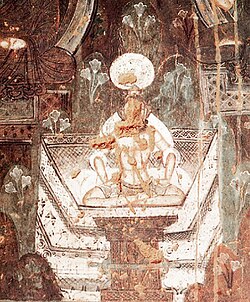
The Simsim Caves, also called the Caves of Senmusaimu (Chinese: 森木塞姆石窟; pinyin: Sēnmùsāimǔ shíkū), are decorated Buddhist caves in the area of Kucha, Tarim Basin, China. Other famous sites nearby are the Ah-ai Grotto, Kizil Caves, the Kizilgaha Caves, the Kumtura Caves, and Subashi Temple.23
References
References
- Howard, Angela; Vignato, Giuseppe (10 November 2014). Archaeological and Visual Sources of Meditation in the Ancient Monasteries of Kuča. BRILL. p. 130. ISBN 978-90-04-27939-1.
- (Other than Kizil)... "The nearby site of Kumtura contains over a hundred caves, forty of which contain painted murals or inscriptions. Other cave sites near Kucha include Subashi, Kizilgaha, and Simsim." in Buswell, Robert E.; Lopez, Donald S. (24 November 2013). The Princeton Dictionary of Buddhism. Princeton University Press. p. 438. ISBN 978-1-4008-4805-8.
- Vignato, Giuseppe (2006). "Archaeological Survey of Kizil: Its Groups of Caves, Districts, Chronology and Buddhist Schools". East and West. 56 (4): 359–416. ISSN 0012-8376. JSTOR 29757697.
Sources
Sources
- Zhongguo Xinjiang Bihua Quanji 5: Keziergaha Senmusaimu 中国新疆壁画全集 5: 克孜尔尕哈 森木赛姆 [Complete Collection of Xinjiang Murals 5: Keziergaha Senmusaimu Grottoes] 中国壁画全集编辑委员会 Zhongguo Bihua Quanji Bianji Weiyuanhui. Tianjin, 1995; ISBN 7531412969 (Tianjin Renmin Meishu 天津人民美术)
- Peter Hopkirk: Foreign Devils on the Silk Road: The Search for the Lost Cities and Treasures of Chinese Central Asia. The University of Massachusetts Press, Amherst 1980, ISBN 0-87023-435-8.
- Zhongguo da baike quanshu: Kaoguxue. Beijing: Zhongguo da baike quanshu chubanshe, 1986
External links
- Turfanforschung
- Grabungen in Sim-Sim (Auf Hellas Spuren in Ostturkistan)
- Auf Hellas Spuren in Ostturkistan: vol.1, S. 109
41°46′06″N 83°23′56″E / 41.7683°N 83.3989°E / 41.7683; 83.3989