 | |
| Names | |
|---|---|
| IUPAC name
Silver chlorite
| |
Other names
| |
| Identifiers | |
3D model (JSmol)
|
|
| ChemSpider | |
PubChem CID
|
|
| |
| |
| Properties | |
| AgClO2 | |
| Molar mass | 175.32 g/mol |
| Appearance | Slightly yellow solid |
| Melting point | 156 °C (313 °F; 429 K)2 (decomposes) |
| 0.45 g/100ml1 | |
Refractive index (nD)
|
2.12 |
| Structure3 | |
| Orthorhombic | |
| Pcca | |
a = 6.075 Å, b = 6.689 Å, c = 6.123 Å
| |
| Thermochemistry | |
Heat capacity (C)
|
20.81 cal/deg4 |
Std molar
entropy (S⦵298) |
32.16 cal/deg4 |
Std enthalpy of
formation (ΔfH⦵298) |
0.0 kcal/mol1 |
| Hazards | |
| GHS labelling: | |

| |
| Related compounds | |
Other anions
|
Silver chlorate Silver perchlorate Silver hypochlorite |
Other cations
|
Sodium chlorite |
Except where otherwise noted, data are given for materials in their standard state (at 25 °C [77 °F], 100 kPa).
| |

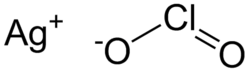
Silver chlorite is a chemical compound with the formula AgClO2. This slightly yellow solid is shock sensitive and has an orthorhombic crystal structure.
Preparation
Silver chlorite is prepared by the reaction of silver nitrate and sodium chlorite:5
- AgNO3 + NaClO2 → AgClO2 + NaNO3
Reactions and properties
If normally heated, it explodes violently at 105 °C:2
- AgClO2 → AgCl + O2
If heated very carefully, it decomposes at 156 °C to form silver chloride. It can also decompose to silver chlorate if chlorous acid is present.2
Silver chlorite reacts explosively with various substances such as sulfur and hydrochloric acid, forming silver chloride. It also gets reduced by sulfur dioxide, and reacts with sulfuric acid to form chlorine dioxide.6 This compound explodes in contact with iodomethane and iodoethane.7
Silver chlorite complexes
Silver chlorite can react with anhydrous ammonia to form triammonia-silver chlorite:6
- AgClO2 + 3NH3 → 3NH3·AgClO2
References
References
- A. G. Massey; N. R. Thompson; B. F. G. Johnson (2016). The Chemistry of Copper, Silver and Gold (Ebook). Pergamon International Library of Science, Technology, Engineering and Social Studies: Elsevier Science. p. 108. ISBN 9781483181691.
- F. Solymosi (1968). "The Thermal Stability and Some Physical Properties of Silver Chlorite, Chlorate and Perchlorate*". Zeitschrift für Physikalische Chemie. 57 (1). Oldenbourg Wissenschaftsverlag: 1–18. doi:10.1524/zpch.1968.57.1_2.001. S2CID 102195060.
- M. Okuda; M. Ishihara; M. Yamanaka; S. Ohba; Y. Saito (1990). "Structures of lead chlorite, magnesium chlorite hexahydrate and silver chlorite". Acta Crystallogr. 46 (10): 1755–1759. Bibcode:1990AcCrC..46.1755O. doi:10.1107/S010827019000066X.
- Wendell V. Smith; Kenneth S. Pitzer; Wendell M. Latimer (1937). "Silver Chlorite: Its Heat Capacity from 15 to 300K., Free Energy and Heat of Solution and Entropy. The Entropy of Chlorite Ion". J. Am. Chem. Soc. 59 (12): 2640–2642. Bibcode:1937JAChS..59.2640S. doi:10.1021/ja01291a046.
- J. Cooper; R. E. Marsh (1961). "On the structure of AgClO2". Acta Crystallogr. 14 (2): 202–203. Bibcode:1961AcCry..14..202C. doi:10.1107/S0365110X61000693.
- Joseph William Mellor (1922). Supplement to Mellor's Comprehensive Treatise on Inorganic and Theoretical Chemistry: suppl. 3. K, Rb, Cs, Fr. University of Illinois at Urbana-Champaign: Longmans, Green and Company. p. 284.
- Urben, Peter, ed. (2013). Bretherick's Handbook of Reactive Chemical Hazards. Elsevier Science. p. 4. ISBN 9780080523408.