| Silurus lithophilus | |
|---|---|
| |
| Rock catfish | |
Scientific classification 
| |
| Kingdom: | Animalia |
| Phylum: | Chordata |
| Class: | Actinopterygii |
| Order: | Siluriformes |
| Family: | Siluridae |
| Genus: | Silurus |
| Species: | S. lithophilus
|
| Binomial name | |
| Silurus lithophilus Tomoda, 1961
| |
| Synonyms | |
| |
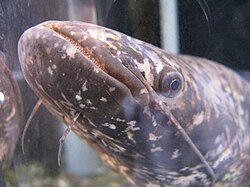
Silurus lithophilus, the rock catfish (in Japanese, イワトコナマズ [iwatoko-namazu]), is a species of catfish that is endemic to the Lake Biwa basin in Japan.2 It primarily inhabits rocky habitats.3
Silurus lithophilus is a predator that feeds on small fishes, crustaceans and insects. It is caught for food around Lake Biwa, but is usually eaten locally in Gifu Prefecture rather than exported.4 This species reaches a maximum length of 58.0 cm (22.8 in) and maximum weight of 1.5kg (3.3 lbs), although 21.2cm (8.3 in) is more typical.5
It is most closely related to the Japanese populations of the Amur catfish, Silurus asotus.6 A leucistic variation of this species occurs in the wild, and appears to occur with higher frequency than in other catfishes.
Silurus lithophilus spawns in shallow, rocky areas around midnight. It synchronises it's spawning nights with a larger relative, the giant Lake Biwa catfish Silurus biwaensis, but avoids competition for spawning sites with it by spawning away from S. biwaensis, or spawning after S. biwaensis has left the spawning sites. It is thought spawning on the same nights as S. biwaensis reduces predation on S. lithophilus eggs.7 Unlike most catfishes, the eggs of Silurus lithophilus are non-adhesive.8
References
References
- Hasegawa, K., Kanao, S. & Mukai, T. (2019). "Silurus lithophilus". IUCN Red List of Threatened Species. 2019 e.T110464579A110464605. doi:10.2305/IUCN.UK.2019-2.RLTS.T110464579A110464605.en. Retrieved 21 December 2023.
{{cite journal}}: CS1 maint: multiple names: authors list (link) - Masuda, H., K. Amaoka, C. Araga, T. Uyeno and T. Yoshino, 1984. The fishes of the Japanese Archipelago. Vol. 1. Tokai University Press, Tokyo, Japan. 437 p. (text)
- "イワトコナマズ | 魚類 | 市場魚貝類図鑑". ぼうずコンニャクの市場魚貝類図鑑 (in Japanese). Retrieved 2026-06-30.
- "イワトコナマズ | 魚類 | 市場魚貝類図鑑". ぼうずコンニャクの市場魚貝類図鑑 (in Japanese). Retrieved 2026-06-30.
- Froese, Rainer; Pauly, Daniel (eds.). "Silurus lithophilus". FishBase. June 2013 version.
- Kishimoto, Yuu; Okuyama, Hisashi; Takahashi, Jun-ichi (2021-09-02). "Complete mitochondrial DNA sequence of the Japanese endemic catfish Silurus lithophilus (Siluriformes: Siluridae)". Mitochondrial DNA Part B. 6 (9): 2559–2561. doi:10.1080/23802359.2021.1920486. ISSN 2380-2359. PMC 8344260. PMID 34377829.
- Maehata, Masayoshi (2002-05-01). "Features of the reproductive ecology of the rock catfish Silurus lithophilus". Ichthyological Research. 49 (2): 109–113. Bibcode:2002IchtR..49..109M. doi:10.1007/s102280200014. ISSN 1341-8998.
- Legendre, Marc; Linhart, Otomar; Billard, Roland (November 1996). "Spawning and management of gametes, fertilized eggs and embryos in Siluroidei". Aquatic Living Resources. 9: 59–80. Bibcode:1996AqLR....9...59L. doi:10.1051/alr:1996042. ISSN 0990-7440.