| Silphidium | |
|---|---|
| |
Scientific classification 
| |
| Kingdom: | Plantae |
| Clade: | Embryophytes |
| Clade: | Tracheophytes |
| Clade: | Angiosperms |
| Clade: | Eudicots |
| Clade: | Asterids |
| Order: | Asterales |
| Family: | Asteraceae |
| Subfamily: | Asteroideae |
| Tribe: | Coreopsideae |
| Subtribe: | Coreopsidinae |
| Genus: | Silphidium (Torr. & A.Gray) Mesfin & D.J.Crawford |
| Species: | S. latifolium
|
| Binomial name | |
| Silphidium latifolium (Michx.) Mesfin & D.J.Crawford
| |
| Synonyms2 | |
| |
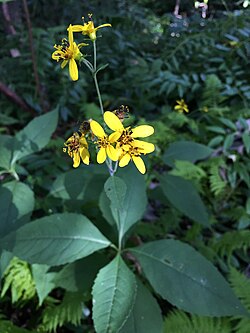
Silphidium latifolium is a North American species of flowering plant in the aster family known by the common name broad-leaved tickseed. It is the sole species in genus Silphidium. It is native to the southeastern United States, primarily in the southern Appalachians of the states of Georgia, North Carolina, South Carolina, and Tennessee.134
The species was first described as Coreopsis latifolia by André Michaux in 1803. In 2023 Mesfin Tadesse and Daniel J. Crawford placed the species in the new genus Silphidium as Silphidium latifolium.2
Description
Silphidium latifolium, a rhizomatous perennial herb, grows up to 1.5 metres (4.9 ft) tall. The leaves are oval and may exceed 20 centimetres (7.9 in) long by 10 centimetres (3.9 in) wide.5
The inflorescence is a corymb3 of flower heads, each with five phyllaries which may be over a centimeter long. The head contains yellow ray florets between 1 and 2 centimeters long and yellow disc florets. Flowering occurs in August and September.5
Distribution
Silphidium latifolium is native to the Blue Ridge Mountains, its distribution extending from the Great Craggy Mountains to the South Carolina line. Populations in Tennessee are disjunct.3 The plant grows in moist hardwood forest habitat on mafic rock such as amphibolite or hornblende gneiss. It can sometimes be seen on roadsides. In its range it is most abundant in North Carolina, but it is rare in general.1
It is likely a relict species which had a wider distribution in the past.6
Conservation
Silphidium latifolium is threatened with the loss of its habitat, which is being consumed for development. It is a listed Vulnerable plant species. In some of its range it is considered to be stable and not declining quickly.1
References
References
- [1] The Nature Conservancy.
- "Silphidium latifolium (Michx.) Mesfin & D.J.Crawford". Plants of the World Online. Royal Botanic Gardens, Kew. Retrieved 31 July 2025.
- Coreopsis latifolia. Archived 2011-10-26 at the Wayback Machine Center for Plant Conservation.
- Biota of North America Program 2014 county distribution map
- Coreopsis latifolia. Flora of North America.
- Crawford, D. J., et al. (1988). Allozyme variation within and between populations of Coreopsis latifolia (Asteraceae). Plant Species Biology 3(1) 1-5.