| Sigma Hydrids | |
|---|---|
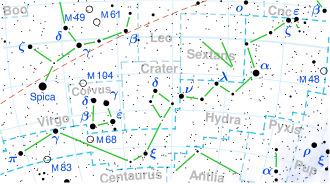 Celestial map of Hydra | |
| Parent body | Unknown C/2023 P1 (Nishimura)? |
| Radiant | |
| Constellation | Hydra |
| Right ascension | 8h 19m 60s |
| Declination | +02° 00′ 00″ |
| Properties | |
| Occurs during | November 22 to January 41 |
| Date of peak | December 7 |
| Velocity | 58.81 km/s |
| Zenithal hourly rate | 3-7 |
Sigma Hydrids are a faint, minor (Class II) meteor shower that peak around 7 December. The ZHR is 3-7 and population index is 3. They are active from November 22 to January 4.1
Sigma hydrids were discovered by Richard E. McCrosky and Annette Posen.2
2023
Long-period comet C/2023 P1 (Nishimura) has been suggested to be the parent body of the meteor shower and came to perihelion (closest approach to the Sun) in September 2023. There is a chance of increased activity during the 2023 meteor shower if Earth passes through older meteoroid streams (such as 1591)3 that have had time to spread out over the comets orbit.4
References
References
- "2023 Meteor Shower List". American Meteor Society (AMS). Retrieved 2023-09-10.
- [1] archive:[2]
- Tp = 2302476.6 converts to 1591.
- Green, Daniel. "Electronic Telegram No. 5290: COMET C/2023 P1 (NISHIMURA)". Central Bureau for Astronomical Telegrams. Harvard University. Retrieved 29 August 2023.
- P. Clay Sherrod; Thomas L. Koed (2012). A Complete Manual of Amateur Astronomy: Tools and Techniques for Astronomical Observations. Courier Corporation. p. 59. ISBN 978-0-486-15216-5.