| Shoshonea | |
|---|---|
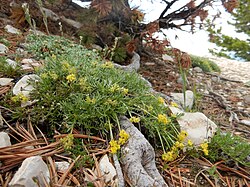
| |
| On Heart Mountain, Wyoming | |
Scientific classification 
| |
| Kingdom: | Plantae |
| Clade: | Embryophytes |
| Clade: | Tracheophytes |
| Clade: | Spermatophytes |
| Clade: | Angiosperms |
| Clade: | Eudicots |
| Clade: | Asterids |
| Order: | Apiales |
| Family: | Apiaceae |
| Subfamily: | Apioideae |
| Tribe: | Selineae |
| Genus: | Shoshonea Evert & Constance |
| Species: | S. pulvinata
|
| Binomial name | |
| Shoshonea pulvinata Evert & Constance
| |
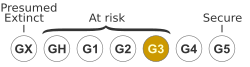
Shoshonea is a monotypic genus of flowering plants belonging to the parsley family. Its native range is Western Central USA.2
Description
Shoshonea plants are low growing plants without a main stem. They grow as a tuft of leaves that are pulvinate, having a swollen base to the leaf stalk allowing it to move without growing. The plants are quite small, only reaching 2 to 8 centimeters (3⁄4–3+1⁄4 in) in height. It is a perennial that sprouts from a woody taproot and a caudex which is usually branched underground.3
Taxonomy
The genus Shoshonea and its one species Shoshonea pulvinata were scientifically described and named in 1982 by Erwin F. Evert and Lincoln Constance. It is further classified in the family Apiaceae. It has no synonyms or subspecies.4
Names
The genus was named Shoshonea for the Shoshone River that flows nearby in northwestern Wyoming.3 The genus name is also used as a common name for the species.1 Although the species does not much resemble the garden carrot in either its above ground or below ground parts,5 it is given the common name Shoshone carrot in the Natural Resources Conservation Service database.6
References
References
Citations
- NatureServe 2026.
- POWO 2026b.
- Evert & Constance 1982, p. 471.
- POWO 2026a; POWO 2026b.
- Heidel 2017, p. 5.
- NRCS 2026.
Sources
Journal articles
- Evert, Erwin F.; Constance, Lincoln (October 1982). "Shoshonea pulvinata, a New Genus and Species of Umbelliferae from Wyoming". Systematic Botany. 7 (4): 471. doi:10.2307/2418678. JSTOR 2418678.
Magazines and newsletters
- Heidel, Bonnie (December 2017). "Common names for uncommon plants". Castilleja: the newsletter of the Wyoming Native Plant Society. Vol. 36, no. 4. Retrieved 14 February 2026.
Web sources
- NRCS (2026). "Shoshonea pulvinata". PLANTS Database. United States Department of Agriculture (USDA). Retrieved 14 February 2026.
- NatureServe (30 January 2026). "Shoshonea pulvinata". NatureServe Explorer. Arlington, Virginia. Retrieved 14 February 2026.
- POWO (2026a). "Shoshonea Evert & Constance". Plants of the World Online. Royal Botanic Gardens, Kew. Retrieved 14 February 2026.
- POWO (2026b). "Shoshonea pulvinata Evert & Constance". Plants of the World Online. Royal Botanic Gardens, Kew. Retrieved 14 February 2026.